What is thermostat price? A Homeowner's Guide to Costs and Savings
Explore what determines thermostat price, from device type and installation to rebates and energy savings. A practical guide for homeowners troubleshooting thermostats.


Thermostat price is the upfront cost of the thermostat hardware plus any installation charges. It varies by device type (basic, programmable, smart Wi-Fi), features (scheduling, learning algorithms, remote access), and whether you install it yourself or hire a professional. According to Thermostat Care, understanding these factors helps homeowners estimate total costs and choose a solution that fits both budget and goals.
Understanding what thermostat price represents
Thermostat price is more than a single label on a box. It encompasses two broad components: the hardware you select and any installation that may be necessary. The Thermostat Care team emphasizes that price also reflects how the thermostat will be used in your home, its compatibility with your HVAC system, and whether you demand connectivity to a home network. In practical terms, a basic, non-programmable model tends to cost less than a feature-rich smart thermostat with remote monitoring and occupancy sensing. Nevertheless, even among basic devices there can be small variations in build quality, display clarity, and warranty terms. When planning a purchase, homeowners should consider how frequently they’ll use the thermostat, whether they will ever utilize advanced functions, and how software updates may influence long-term value. This framing helps avoid overpaying for capabilities you won’t use while reserving space for features that deliver real value. According to Thermostat Care analysis, price often points to the balance between simplicity and capability, not merely the sticker price.
What drives the price: device type and features
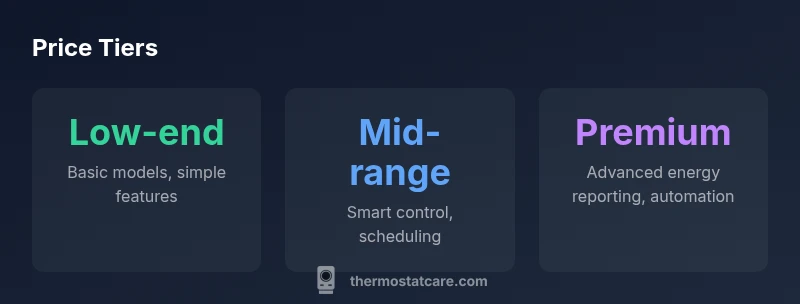
Prices are primarily shaped by device type and the features you choose. At the low end, you’ll find basic thermostats that offer simple on/off control or simple scheduling. In the mid-range, programmable options introduce daily or weekly scheduling and standard energy-saving modes. At the premium end, smart thermostats add remote access, learning algorithms, multi-user support, advanced energy reports, and integration with other smart home devices. The price delta between these tiers reflects not only the hardware but also the software ecosystem, ongoing updates, and compatibility with your HVAC setup. When selecting, weigh what you truly need against the added convenience of features like geofencing or adaptive learning. Thermostat Care’s guidance emphasizes mapping your daily routines to features rather than chasing every new capability, which helps prevent paying for bells and whistles you won’t use.
Installation costs and options
Installation choices can significantly influence total cost. If you’re comfortable with DIY work and your model is designed for straightforward wiring, you may minimize labor charges by installing it yourself. However, professional installation may be necessary if you lack a compatible power supply, proper wiring (such as a C-wire), or if your HVAC system requires specialized setup. Fees for professional installation vary by region and complexity, and some installers may bundle wiring checks, thermostat mounting, and basic app configuration into a single service. When budgeting, include the possibility of a home safety check and any furnace compatibility verification that a pro provides. This step also helps ensure you won’t encounter reliability issues later that could negate upfront savings. Thermostat Care notes that installation considerations often determine whether a thermostat’s price is a short-term cost or a long-term value.
Hidden and long-term value: energy savings and rebates
Beyond the sticker price, many homeowners benefit from energy savings over time. The actual savings depend on your climate, energy usage patterns, and how regularly you use the thermostat’s optimization features. In some regions, utility rebates or government incentives exist for upgrading to programmable or smart thermostats, which can reduce the effective price. It’s important to research local programs before purchasing and to document the device’s compatibility with your HVAC system to qualify for incentives. While savings aren’t guaranteed, smart thermostats frequently help households reduce wasted energy through scheduling, occupancy awareness, and remote control. The Thermostat Care analysis highlights that rebates, when available, can meaningfully narrow the gap between upfront price and long-term value, especially for households with irregular schedules or high energy costs.
How to estimate your costs without guessing
To estimate costs without guessing, start by defining your needs and the HVAC compatibility of your system. Create three tentative device options (basic, mid-range, premium) and compare their lists of features—prioritize those aligned with your goals, such as energy monitoring or remote accessibility. Check whether your home requires any wiring updates, such as a C-wire, and request a rough labor estimate from local installers if you plan professional help. Add the price of any necessary accessories (backplates, wire adaptors) and estimate potential rebates based on local programs. Finally, weigh long-term value by considering potential energy savings and warranty coverage. This approach helps you make a rational decision about the upfront price while acknowledging the broader financial picture. Thermostat Care’s framework emphasizes clarity on costs and benefits, reducing the risk of overpaying for features you won’t use.
Price considerations by brand and ecosystem
Brand ecosystems shape price through perceived value, support, and compatibility. Some brands emphasize integration with other smart devices, which can raise upfront costs but simplify automation and maintenance. Others prioritize modular hardware with flexible compatibility across HVAC setups, offering more affordable entry points. When evaluating brands, consider not only device price but also software updates, app reliability, customer support, and compatibility with existing voice assistants or home hubs. A strong ecosystem can deliver smoother performance and fewer compatibility headaches, potentially saving money in the long run by reducing troubleshooting time and replacement costs. The right choice balances initial price with ongoing value, support, and future-proofing.
Common scenarios and sample pathways
Scenario A focuses on a budget retrofit: you want a simple thermostat, minimal setup, and reliable operation. Scenario B targets smart features for better control and energy awareness, leveraging mobile apps and scheduling. Scenario C aims for premium outcomes: comprehensive energy reporting, detailed automation, and integration with multiple smart devices. Each path has a distinct price feel and value proposition, so it’s important to map your priorities before choosing. By framing scenarios around actual use cases—such as daily scheduling, occupancy-based control, or remote monitoring—you can select a device that aligns with your routine and budget. Thermostat Care recommends starting with a clear list of must-have features and a realistic plan for installation to identify the most cost-effective option.
Quick tips to save on thermostat price
- Start with a clear need list: prioritize core functions over extras to avoid paying for unused features.
- Check compatibility early: ensure the thermostat supports your HVAC system to prevent costly rewiring.
- Explore energy rebates and utility incentives in your area and factor them into the total cost.
- Consider DIY installation if your model is straightforward and you’re comfortable with basic wiring.
- Compare total cost of ownership, including potential maintenance and software updates, rather than focusing only on the upfront price.
Qualitative price bands by thermostat type
| Category | Key Considerations | Qualitative Price Band |
|---|---|---|
| Basic non-programmable thermostat | Simple interface, reliable basic control | low-end |
| Programmable thermostat | Energy scheduling, compatibility with HVAC | mid-range |
| Smart thermostat (basic features) | Wi-Fi, remote control, app support | mid-range |
| Smart thermostat (advanced) | AI learning, geofencing, energy reports | premium |
Questions & Answers
What factors influence thermostat price?
Device type, features, installation method, and compatibility determine price. Some models offer more value through energy data and smart home integration.
Prices vary by device type, features, and installation needs; choose what fits your home.
Do smart thermostats save money over time?
Smart thermostats can reduce energy use through scheduling and efficiency reports, but savings depend on climate and usage. Costs may be offset over time with proper use.
Smart thermostats often save energy, but your savings depend on how you use them.
Should I hire a pro or DIY install?
DIY installation is possible for many models, but incorrect wiring can damage your HVAC or create safety risks. A professional may be safer for complex systems.
DIY works for simple setups; otherwise, hire a pro to avoid problems.
Are rebates or incentives available for thermostats?
Rebates and incentives exist in some regions, but availability varies by utility and location. Check local programs before purchasing.
Rebates can help, but check your local programs first.
Does the brand affect price more than features?
Branding can influence price due to ecosystem and support, but the feature set and compatibility typically drive value more.
Brand can matter, but features and compatibility usually matter more.
“Price is a signal, not a verdict. The right thermostat pays for itself through comfort, control, and energy savings when it matches your HVAC system.”
What to Remember
- Define your needs before shopping.
- Differentiate device price from installation costs.
- Consider long-term energy savings when evaluating price.
- Check compatibility and rebates to lower the effective cost.
- Compare total cost of ownership, not just sticker price.