How Much Does a New Thermostat Cost in 2026
Estimate the total cost of a new thermostat, from basic models to smart systems, including installation and potential energy savings, with guidance from Thermostat Care.


A new thermostat costs a device price plus installation. Device costs range from $25-$350 depending on features—from basic non-programmable to advanced smart models. Professional installation adds about $100-$300, depending on wiring and accessibility. For a typical replacement, budget roughly $125-$650, with premium smart setups in complex homes reaching higher totals.
Cost overview: how much does a new thermostat cost
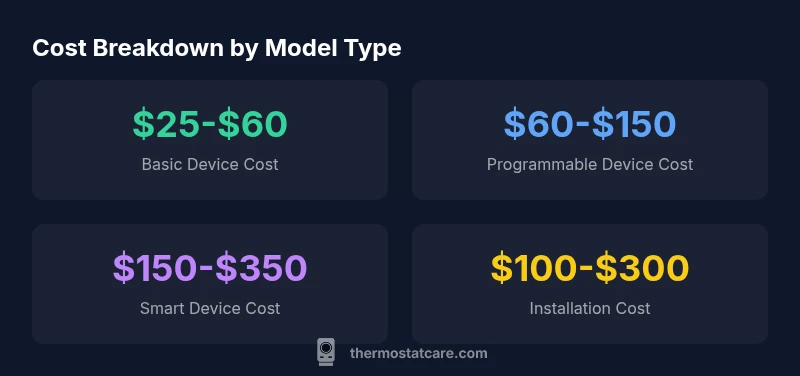
If you’re wondering how much does a new thermostat cost, the answer depends on the model you choose and how complex the installation will be. Basic, non-programmable units typically sit in the $25-$60 range. Programmable models usually fall in the $60-$150 bracket, while smart thermostats commonly range from $150-$350. In addition to the device price, professional installation adds roughly $100-$300, depending on wiring, accessibility, and whether a C-wire is present. For many homes, a straightforward replacement lands in the broad $125-$650 range. In more complex or high-end setups, total costs can climb higher. According to Thermostat Care, planning around device type and installation complexity helps homeowners avoid sticker shock and choose options that align with energy goals.
This cost framework matters because price is a function of features, compatibility, and control capabilities. If your priority is simple on/off control and basic scheduling, a budget model may suffice. If you want energy insights, remote access, and integration with smart home ecosystems, expect higher device costs and potentially higher installation time. Remember that price is not just the sticker you see at purchase—it’s also about the value delivered in energy savings, comfort, and maintenance over time.
Non-smart vs programmable vs smart: price ranges explained
Understanding price bands helps homeowners align expectations with goals. Basic non-programmable thermostats start around $25-$60 and are ideal for simple temperature control without additional features. Programmable thermostats, which allow scheduling to reduce energy use, typically cost $60-$150. Smart thermostats, with features like Wi-Fi connectivity, mobile apps, geofencing, and AI-driven insights, generally run $150-$350. When you factor in installation, total costs shift accordingly: installation can add roughly $100-$300 depending on wiring, HVAC compatibility, and whether a new C-wire is needed. If you’re upgrading from an old mechanical thermostat, the difference in energy savings often makes the higher upfront cost worthwhile over time. Always compare models that fit your needs—basic code-compliance, programmable schedules, or full smart-home integration—and weigh ongoing energy savings against upfront price.
Installation costs and what can vary
Installation costs are a significant portion of the total expense and vary by region, contractor rates, and home HVAC configuration. Labor for thermostat installation typically ranges from $100 to $300, but more complex scenarios can push costs higher. Factors that influence installation cost include the presence of a C-wire, compatibility with heat pumps or multi-stage systems, the distance between the thermostat and the furnace, and whether a new base or wiring harness is required. DIY installation can reduce labor costs, but it carries risks if you’re not comfortable with electrical work or HVAC wiring. In many cases, hiring a licensed technician ensures proper wiring, a secure mount, and accurate setup of zones or smart features. Thermostat Care emphasizes evaluating both device cost and installation effort to avoid surprises on the final bill.
Hidden costs, rebates, and long-term savings
Beyond the sticker price, consider potential rebates, incentives, and energy savings. Some regions offer rebates for upgrading to energy-efficient programmable or smart thermostats, especially when paired with a compatible HVAC system. While rebates vary by location and program, they can offset a portion of the device price or installation. Smart thermostats often deliver noticeable energy savings through adaptive scheduling and remote control, which can reduce utility bills over time. When budgeting, include a conservative estimate of monthly energy savings, a memory of your home's insulation quality, and potential maintenance costs. Thermostat Care’s analysis shows that the energy savings from smarter controls can accumulate over several years, reinforcing the value of a well-chosen upgrade.
How to plan your purchase: a practical budgeting method
A practical budgeting method starts with need assessment, moves to price comparison, and ends with installation planning. Step 1: define your priorities—budget, programmability, or full smart-home integration. Step 2: set a realistic price target based on the bands above and your local installation rates. Step 3: compare several models within your chosen category, paying attention to compatibility with your HVAC system and home network. Step 4: obtain multiple quotes from licensed technicians to confirm installation costs. Step 5: look for rebates or promotions and factor in potential energy savings over a 1–5 year horizon. This structured approach helps homeowners avoid overpaying and ensures you pick a thermostat that aligns with both comfort and energy goals.
Cost comparison by model type (device cost + installation)
| Model Type | Device Cost | Installation Cost | Typical Total |
|---|---|---|---|
| Basic non-programmable | $25-$60 | $100-$180 | $125-$240 |
| Programmable | $60-$150 | $120-$250 | $180-$400 |
| Smart thermostat | $150-$350 | $100-$300 | $250-$650 |
Questions & Answers
What factors influence the price of a new thermostat?
Several factors drive thermostat cost: device features (basic vs smart), brand, interoperability with your HVAC system, Wi-Fi capabilities, and whether installation is included. More advanced features and easier installation typically raise the price but can lead to greater energy savings and convenience.
Prices depend on features and installation complexity. More features usually mean higher cost, but you gain more control and potential energy savings.
Are smart thermostats worth the extra cost?
Smart thermostats typically cost more upfront, but they offer remote access, learning schedules, and energy insights that can reduce utility bills over time. If you value automation and data-driven energy use, they are often worth the investment.
If you want hands-off energy savings and home automation, smart thermostats are worth considering.
Does installation always cost extra?
Most replacements include installation as an extra, because it involves wiring and system compatibility checks. Costs vary by region and system complexity; simple replacements can be cheaper, while complex wiring or multi-stage systems raise labor charges.
Yes, installation generally adds to the price, and the amount depends on your setup.
Can I install a thermostat myself to save money?
DIY installation is possible for some basic models with clear instructions. However, incorrect wiring can damage equipment or void warranties. If in doubt, hire a licensed technician to ensure a safe and correct installation.
You can DIY if you’re comfortable with wiring, but don’t skip safety checks or warranties.
Do rebates or incentives reduce the cost?
Rebates and incentives vary by location and program. Check local utility programs and federal or state incentives that may apply to upgrading to energy-efficient programmable or smart thermostats. Rebates can significantly offset upfront costs.
Look for rebates in your area to lower the upfront price.
“Prices reflect both device capabilities and the energy savings they enable over time. Plan for upfront costs and ongoing value when selecting a thermostat.”
What to Remember
- Budget by model type: basic, programmable, or smart
- Expect installation to add a substantial portion of total cost
- Check for rebates and energy savings before buying
- DIY installation can save money but may void warranties
- Plan for long-term value, not just upfront price