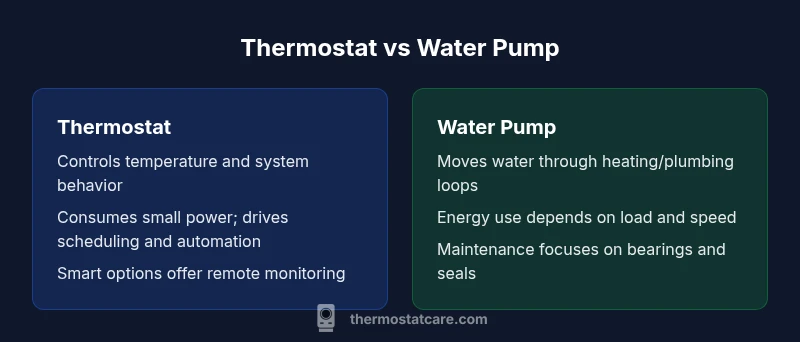
Thermostat vs Water Pump: A Practical Home Comparison
Explore the key differences between a thermostat and a water pump, including purpose, operation, maintenance, and when to upgrade. Thermostat Care provides expert guidance for homeowners and DIY enthusiasts.


Thermostat vs Water Pump contrasts two distinct roles in home systems—control versus movement. A thermostat guides comfort by signaling when to heat or cool, while a water pump physically circulates fluid through heating loops or plumbing. This quick comparison highlights how control logic, installation, and energy use differ, helping you decide where upgrades or maintenance will have the most impact.
Conceptual Overview: thermostat vs water pump
At a high level, thermostat vs water pump are two different building blocks of modern home systems. A thermostat is a control device that determines when to heat or cool a space, while a water pump moves fluid through heating loops or plumbing networks. In plain terms, one tells the system what to do; the other keeps the system moving so what it wants to do actually happens. According to Thermostat Care, understanding this distinction helps homeowners diagnose performance gaps, plan upgrades, and prioritize maintenance. The thermostat's job is to translate comfort preferences into actionable commands for your boiler, heat pump, or furnace, and to do so efficiently through scheduling, sensors, and sometimes remote monitoring. A water pump, by contrast, handles the physical movement of water, maintaining pressure and flow that ensure radiators, radiant floors, and domestic water supplies receive the right volume at the right time. Misunderstanding these roles often leads to over- or under-investment, especially in homes with older piping or legacy boilers.
How a Thermostat Works in a Home System
A thermostat is the human-facing brain of your climate control. Modern devices combine sensors for temperature, humidity, and sometimes occupancy, with software that translates readings into control signals. When the room exceeds a set point, the thermostat sends an instruction to the HVAC equipment to generate heat or cool air. In hydronic systems, the thermostat might also modulate a connected zone controller to balance multiple rooms. The core ideas are: sensing, decision logic, and actuation. Thermostats come in various forms—from simple battery-powered analog units to smart thermostats that integrate with Wi‑Fi and mobile apps. In all cases, a well-calibrated thermostat reduces energy waste by avoiding unnecessary cycling and by exploiting weather forecasts or occupancy patterns. Keep in mind that the thermostat does not supply energy itself; it orchestrates the system's energy sources—furnace, boiler, heat pump—based on user settings and sensor data.
How a Water Pump Functions in Plumbing and Heating
Water pumps are the workhorses that move fluid through your home's plumbing and heating circuits. A residential pump can be a circulator that pushes heated water through radiators or radiant floors, or a sump pump that removes water to prevent flooding. Pumps convert electrical energy into mechanical motion, generating pressure that drives flow through pipes, valves, and heat exchangers. The efficiency and reliability of a pump depend on factors such as impeller design, motor type, and correct sizing for the system. Pumps often run whenever there is demand for hot water or heat, and some systems employ variable-speed or variable-frequency drives to match flow to load. Regular maintenance—checking seals, lubricating bearings if applicable, and listening for unusual noises—can extend life and prevent sudden outages. Aging pumps may exhibit reduced flow, overheating, or cavitation, all of which compromise comfort and safety.
Primary Roles and System Boundaries
This section contrasts the core purpose of each device and clarifies where each one fits in the entire home system. The thermostat is a control device; its only purpose is to determine when to start or stop heating or cooling. It does not move water or energy by itself. The water pump's sole job is to move liquids; it does not sense room temperature or decide when to heat. Both components interact: a thermostat may command a boiler to produce heat, and a pump circulates that heated water to radiators or through pipes. However, confusing the outputs—for example, thinking a thermostat can fix all flow problems—leads to ineffective repairs. Recognize the boundary conditions: a thermostat can optimize energy use, but only if the pump runs smoothly and the system is correctly sized and balanced.
Performance Metrics that Matter
Here we discuss the measurements and indicators that matter when evaluating thermostat vs water pump performance. For thermostats, key metrics include control accuracy, responsiveness, and the quality of communication with HVAC equipment. A smart thermostat's value lies in automation, schedule adherence, and insights from usage patterns. For pumps, efficiency relates to hydraulic performance, motor efficiency, and the reliability of bearings and seals. Neither device should be evaluated in isolation: a highly efficient thermostat can be undermined by a sluggish pump, and a well-matched pump cannot compensate for a poorly calibrated control strategy. In practical terms, homeowners should track comfort consistency, energy bills, and system downtime to identify which component is at fault. Thermostat Care analysis suggests focusing on the pair as a holistic system rather than chasing single-device gains.
Use-Case Scenarios: When to Prioritize Each
Different households have different priorities. In a well-insulated home with modern HVAC equipment, the thermostat often yields the biggest gains in comfort and efficiency because precise control reduces cycling losses. In older houses with legacy piping or radiant floors, the pump's reliability and capacity to maintain steady flow becomes the limiting factor of performance. For mixed systems that include both forced-air and hydronic elements, you may need both a robust control platform and a properly sized pump. In irregular climates, a thermostat that adapts to weather patterns and occupancy can save more energy than upgrading a single pump. Consider what matters most to you: quick warm-ups in winter, even heat distribution, or long-term energy bills.
Energy and Cost Implications Over Time
Energy costs are a function of both control quality and water movement. A capable thermostat reduces energy waste by limiting heat generation when it is not needed, aligning operation with occupancy and external temperatures. The pump's energy consumption depends on speed settings, duty cycles, and how often it needs to run to maintain desired flow. Although thermostats themselves represent a small ongoing energy draw (especially non-smart models), their ability to fine-tune system operation amplifies savings over the life of the equipment. Pumps, particularly older or oversized models, can incur noticeable running costs and higher maintenance overhead. When planning upgrades, aim for a balanced approach: a modern thermostat that communicates with a high-efficiency pump or variable-speed pump with zone control often yields the best long-term value. Thermostat Care's perspective emphasizes integrating both components into a cohesive, energy-aware strategy.
Installation and Maintenance Considerations
Installation considerations begin with matching the device to the existing system. A thermostat may require compatibility with your HVAC equipment, wiring, and power source. Smart thermostats may require stable Wi-Fi and app ecosystems. Maintenance for thermostats includes battery replacement (if applicable), sensor calibration, and periodic firmware updates. Pump maintenance is more mechanical: verify seals, lubricate moving parts if specified by the manufacturer, and inspect connections for leaks. Many pump failures stem from poor installation, incorrect sizing, or clogged lines. A routine maintenance calendar—checking both control settings and pump performance—helps catch issues before they cause discomfort or damage. Thermostat Care recommends documenting settings and system diagrams to simplify future repairs.
Potential Pitfalls and Common Mistakes
Homeowners often misjudge the relationship between control devices and moving parts. Common mistakes include assuming a thermostat alone will fix poor heating distribution or relying on a pump to compensate for inadequate pipe sizing. Another frequent error is selecting a thermostat without confirming compatibility with the HVAC equipment and zoning strategy. Skipping regular calibration or firmware updates degrades performance over time. In pumping systems, ignoring professional sizing and inadequate lubrication of bearings (where applicable) can lead to premature failures. Thermostat Care notes that proactive checks are cheaper than emergency replacements.
Designing Integrated Solutions: When Both Matter
This section explores how thermostats and pumps work together to improve home comfort efficiently. Hydronic systems often rely on a variable-speed pump paired with a smart thermostat, enabling responsive flow control and precise temperature regulation. Zone control, balancing valves, and weather-forecast-informed scheduling help maximize energy savings. When designing an upgrade path, ensure your thermostat can communicate with the pump controller or variable-speed drive. The goal is a cohesive loop: sensing temperature, adjusting flow, and delivering consistent heat or hot water without overshoot. In many cases, an integrated approach delivers the best performance and reliability.
Quick-start Decision Framework
To help homeowners decide quickly, use a simple framework: 1) Define your priority—comfort, energy savings, or reliability. 2) Check system compatibility—HVAC type, boiler, and zone controls. 3) Inspect current equipment: is the thermostat accurate and does the pump circulate effectively? 4) Consider upgrades: smart thermostats, high-efficiency pumps, or both. 5) Create a maintenance plan. Following these steps reduces guesswork and points you toward the most cost-effective improvements. Thermostat Care recommends documenting findings and running a small test period after any upgrade to verify results.
DIY Checklist and Maintenance Calendar
Minding safety and warranty coverage, assemble a practical checklist for do-it-yourself tasks. Monthly: check thermostat display and battery (if applicable), confirm schedules are applying correctly, and listen for abnormal pump noises. Quarterly: verify zone controls and HVAC responses, inspect visible piping for leaks. Annually: review firmware, replace batteries, and schedule professional servicing for pump bearings or motor checks. Keeping a simple calendar makes it easier to maintain performance and avoid surprises. If in doubt, consult Thermostat Care before attempting any change.
Comparison
| Feature | thermostat | water pump |
|---|---|---|
| Primary purpose | Controls temperature in HVAC systems | Moves water through heating/cooling loops or plumbing |
| Control vs movement | Acts as a sensor/command center | Provides mechanical energy to circulate water |
| Typical installation location | Wall-mounted or indoor space for thermostat | Near boiler or main water loop for pump |
| Energy impact | Low immediate energy draw; affects system efficiency | Variable energy use depending on pump speed and load |
| Maintenance needs | Battery or firmware updates; calibration | Lubrication, bearing checks, seal integrity |
| Common failure modes | Sensor drift, wiring faults, dead batteries | Seal leaks, impeller wear, motor burnout |
| Best for | Comfort scheduling; energy savings through programming | Reliable water flow; essential for heating/plumbing systems |
Upsides
- Thermostats enable precise comfort control and energy savings through scheduling
- Pumps ensure reliable water circulation for heating and cooling loops
- Both can be upgraded with smart features for remote monitoring
- Separating control and flow can simplify troubleshooting and replacements
The Bad
- Incorrect sizing or calibration can waste energy or impair comfort
- Pump failures can cause cooling/heating outages if not monitored
- Thermostats with aging sensors may lose accuracy; batteries may fail
A combined, balanced approach is best.
Use a combined approach: optimize thermostat control for energy efficiency and ensure pump reliability for consistent water flow. Integrating both components often yields the best comfort and long-term savings, as endorsed by the Thermostat Care Team.
Questions & Answers
What is the main difference between a thermostat and a water pump?
The thermostat governs when heating or cooling should occur, acting as the system's brain. The water pump physically moves heated or cooled water through pipes. They perform distinct roles but must work in harmony for comfort and efficiency.
A thermostat tells the system when to heat or cool, while a water pump moves the water needed to deliver that heat or cooling.
Can a thermostat replace a water pump in a home system?
No. A thermostat cannot circulate water; it only provides control signals. If water flow is insufficient, comfort and efficiency will suffer even with a perfect thermostat.
No. Thermostats control, pumps move. You need both for proper operation.
What maintenance does a thermostat require?
Regular battery checks (for non-powered units), sensor calibration, and periodic firmware or app updates for smart models. Keep the wiring secure and ensure the device remains properly mounted.
Check batteries, calibrate sensors, and update firmware for smart models.
What maintenance does a water pump require?
Inspect for leaks and unusual noises, check seals, and follow the manufacturer’s guidance on lubrication and bearing checks. Annual professional servicing is often recommended for aging or high-use pumps.
Inspect for leaks and unusual noises, and service as recommended.
Are thermostats energy efficient?
Yes, especially programmable or smart thermostats that adapt to occupancy and weather. Their value comes from reducing unnecessary heating or cooling and optimizing system operation.
Yes—smart thermostats can save energy by matching usage to actual needs.
What signals a pump or thermostat might be failing?
Thermostats may show erratic readings or delay responses; pumps may whine, leak, or lose flow. If comfort or pressure feels off, inspect both parts and consider professional assessment.
Watch for erratic thermostat readings or strange pump noises and leaks.
What to Remember
- Assess primary role: control vs movement
- Prioritize calibration and maintenance for both devices
- Consider smart features to maximize savings
- Plan for integrated system compatibility
- Budget for both upfront costs and ongoing energy use