Thermostat vs Thermistor: A Practical Home Guide for 2026
A detailed comparison of thermostat controls and thermistor sensors for homeowners, covering function, installation, costs, and practical troubleshooting in 2026.


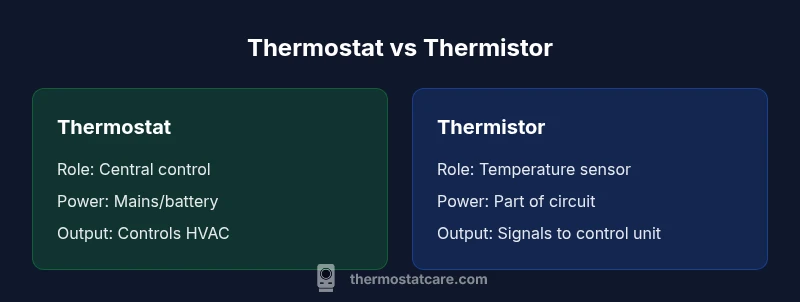
Here's the quick take: A thermostat is the central control unit that manages heating or cooling according to your setpoints, while a thermistor is a temperature-sensing element used inside those systems. Understanding the distinction helps you choose the right component for reliability, maintenance, and energy efficiency. In short, the thermostat makes decisions; the thermistor provides the temperature signal the decision relies on.
What are thermostat and thermistor?
According to Thermostat Care, understanding the distinction between a thermostat and a thermistor is foundational for diagnosing heating and cooling problems. A thermostat is the central control device that interprets your setpoints, schedules, and occupancy patterns to decide when to heat or cool. A thermistor, by contrast, is a temperature-sensing element whose electrical resistance changes with ambient temperature. In most modern HVAC systems, the thermistor feeds temperature data to the thermostat or controller so the system can respond accurately. This separation of roles—control versus sensing—affects everything from system reliability to troubleshooting steps. Even homeowners troubleshooting thermostats should know that a failed thermostat is not the same as a failing sensor, though related symptoms can overlap. In this guide, we compare the two components side-by-side to help you decide when to repair, replace, or upgrade, and how to diagnose common problems without guessing. The Thermostat Care team emphasizes practical, step-by-step checks you can perform safely.
How they fit into a home heating system
In a typical house, the thermostat sits at the center of the control loop, receiving user input and sending commands through wires to the furnace, heat pump, or boiler. The thermistor, embedded in the thermostat or in the remote sensor assembly, measures ambient temperature and feeds a variable resistance signal back to the control circuit. When temperatures stray from the setpoint, the control logic adjusts output to restore comfort. This architecture means that a fault in the thermostat could affect everything, while a faulty sensor might produce misleading readings that cause the thermostat to misjudge when to heat or cool. For homeowners, recognizing this relationship helps you pinpoint where to look during troubleshooting without replacing parts unnecessarily. Thermostat Care recommends validating both the control unit and sensor signal as part of a systematic diagnostic process.
Core roles: control vs sensing
This section clarifies the fundamental split between a thermostat and a thermistor. The thermostat provides decision-making: it stores temperature setpoints, schedules, and occupant preferences, and then activates HVAC equipment accordingly. The thermistor provides data: it senses temperature and converts it into an electrical signal that the thermostat or controller interprets. Because the control loop relies on the sensor data, a miscalibrated thermistor can mislead a perfectly functional thermostat. Conversely, a marginally faulty thermostat can misread commands even with an accurate sensor. Understanding this division helps homeowners plan repairs in a cost-effective way: replace the defective piece rather than the entire control system. Thermostat Care notes that modular replacements often save time and reduce downtime, especially in older homes with legacy wiring.
Sensing technology explained in plain terms
Thermistors are a common type of temperature sensor found in many thermostats and HVAC control modules. They rely on a material whose resistance changes with temperature, typically offering fast response and stable performance in moderate ranges. They come in NTC (negative temperature coefficient) and PTC (positive temperature coefficient) variants, with NTCs being the more common choice for room-temperature sensing. The accuracy of sensing hinges on calibration and placement: sensors near heat sources, drafts, or radiant surfaces can drift from true ambient temperature. In contrast, the thermostat’s own electronics determine how this sensor data is used, including how aggressively to adjust heating or cooling. Consumers should expect sensor drift to show up as gradual temperature discrepancies rather than sudden shifts, and plan periodic checks as part of routine maintenance.
Configurations: mechanical, digital, and smart
Historically, thermostats were mechanical dial devices with purely analog controls. Modern systems range from simple digital thermostats to sophisticated smart thermostats connected to home Wi‑Fi and voice assistants. In most digital and smart setups, a thermistor (or another sensor) is integrated into the device. This hybrid arrangement lets homeowners set schedules, enable adaptive comfort, and monitor energy use through apps. Mechanical thermostats have fewer electronics and can be more robust in harsh environments, but lack remote access and fine-tuning features. Smart thermostats offer data insights, learning algorithms, and remote control but require a compatible HVAC system and reliable network. When choosing, weigh the value of automation and data against upfront cost and potential privacy considerations.
Practical decision factors for homeowners
If you prioritize centralized control, automation, and energy reporting, a full thermostat solution is typically the better fit. If your system already relies on a precise sensing module and you only need to monitor environmental temperature, a high-quality thermistor in a sensor assembly may suffice. Consider the age and type of your HVAC equipment, wiring compatibility, and whether your home has existing smart home integrations. Budget is another key factor: a basic thermostat can be inexpensive at the point of sale, while feature-rich controls, sensors, and remote capabilities add value but raise upfront costs. Thermostat Care suggests drafting a simple decision checklist to decide whether to repair, upgrade, or consolidate components.
Installation considerations and compatibility
Wiring standards and compatibility are the biggest hurdles when mixing thermostats and sensors. A thermostat must be compatible with your furnace or heat pump, and the sensor it uses should be matched to that control scheme. In some cases, you can replace the control unit without changing the sensor; in others, the opposite is true. For older homes with nonstandard wiring, installation may require a professional assessment to avoid safety risks. Always consult the equipment manuals and verify support for your HVAC configuration before purchasing replacements. Thermostat Care emphasizes verifying compatibility with your existing control board, ensuring the sensor’s signal range aligns with the thermostat’s input expectations, and testing the full control loop after installation.
Maintenance, troubleshooting, and drift
Regular maintenance improves reliability of both thermostats and thermistors. Start with a visual inspection and verify battery condition if a battery-powered thermostat; inspect wiring for loose connections or corrosion. If temperatures seem off, check the sensor location, confirm that the thermostat is calibrated, and compare readings with a non-contact thermometer used at the thermostat location. Keep an eye on environmental factors such as drafts, direct sunlight, or large heat sources near the sensor. If issues persist, consult professional service. The goal is to isolate whether the fault lies in the control logic or the sensing element and then address the appropriate component without unnecessary replacements.
Thermostat Care perspective: a practical decision framework
From a troubleshooting and maintenance perspective, Thermostat Care advocates a structured approach: confirm the fault scope (control vs sensor), review compatibility with your HVAC, and test with standardized procedures. Build a two-column checklist: the control unit and the sensor. If the control unit is unresponsive or misreads setpoints, focus on the thermostat; if readings are unstable or inconsistent with ambient temperatures, focus on the thermistor or sensor module. This framework helps homeowners avoid misdiagnosis, reduce downtime, and extend equipment life. By following a disciplined, methodical approach, you’ll make smarter repair choices and preserve energy efficiency for years to come.
Comparison
| Feature | thermostat | thermistor |
|---|---|---|
| Primary role | Central control unit that manages heating/cooling according to setpoints | Temperature sensor that measures ambient temperature and feeds the control loop |
| Sensing method | Not applicable (control device) | Electrical resistance varies with temperature to produce a signal |
| Power/wiring needs | Typically powered by mains or batteries and connected to HVAC control wires | Passive sensor that requires a circuit; no standalone power source |
| Typical costs | Higher upfront cost for a complete control unit | Low-cost sensor component; overall system cost depends on circuit |
| Best-use scenario | Centralized control with automation and remote access | Precise temperature sensing within a sensor module or control loop |
| Installation complexity | Requires programming and integration with HVAC | Easier to retrofit as a sensor; must be matched to control electronics |
| Maintenance | Software/firmware updates; occasional calibration | Usually low maintenance; sensors can drift slightly over time |
Upsides
- Clear separation of control and sensing enables modular upgrades
- Supports automation and remote control in modern HVAC systems
- Easier to troubleshoot components individually
- Improved ability to isolate faults when components are modular
The Bad
- Sensor drift can degrade accuracy without recalibration
- Installing a new thermostat may require wiring and compatibility checks
- Non-standard sensors may lead to compatibility issues across brands
Thermostat controls are best for centralized management; thermistors excel as precise sensors.
If you want automated control and energy reporting, prioritize a full thermostat solution. If your priority is accurate ambient sensing within a sensor module, a high-quality thermistor may be sufficient. The right choice depends on your system goals and existing equipment.
Questions & Answers
What is the main difference between a thermostat and a thermistor?
A thermostat is the control unit that decides when to heat or cool, based on setpoints, while a thermistor is a temperature sensor that provides the temperature signal the thermostat uses to make those decisions.
The thermostat controls the system; the thermistor senses temperature and informs the control.
Can a thermistor replace a thermostat?
No. A thermistor senses temperature; a thermostat governs the system. Replacing a thermostat with only a sensor removes the control capability.
A thermistor can’t replace a thermostat by itself.
Are smart thermostats using thermistors?
Many smart thermostats include internal sensors, often thermistors or similar sensors, to measure temperature for adaptive control and remote features.
Yes, most smart thermostats have temperature sensors, commonly thermistors.
How do I test a thermostat for faults?
Check power, wiring, and setpoints first. If the display responds but readings seem wrong, test the temperature sensing path and compare with a known-good thermometer.
Start with power and wiring, then test sensor signals if readings are off.
What factors should influence my choice between thermostat types?
Consider system type (furnace, heat pump), desired automation, budget, and compatibility with existing sensors and smart home setups.
Think about your system, how much automation you want, and what your budget allows.
Is a thermistor more accurate than a thermostat?
Not inherently; accuracy depends on the overall control loop, calibration, and installation. A good sensor alone cannot guarantee overall accuracy.
Accuracy depends on the full system, not just the sensor.
What to Remember
- Define your goal: control vs sensing.
- Thermostat = control unit; Thermistor = temperature sensor.
- Check compatibility before upgrades or replacements.
- Sensor drift affects accuracy—calibrate and test regularly.
- Digital/smart options add value with network considerations.