Thermostat or Thermometer: A Practical Home Comparison
Discover the key differences between thermostats and thermometers, when to use each, installation basics, and how they influence home comfort and energy efficiency.


According to Thermostat Care, thermostat and thermometer serve distinct roles in home comfort. A thermostat controls heating and cooling to maintain setpoints, while a thermometer measures ambient temperature. For energy efficiency and consistent comfort, prioritize a reliable thermostat; a thermometer provides precise readings when you need verification. In most homes, you’ll use both, but if you must choose one, the thermostat wins for overall control.
Why the Distinction Matters
In everyday households, the words thermostat and thermometer are often used interchangeably, which leads to confusion about what each device actually does. The simple truth is that a thermostat and a thermometer solve different problems: one manages climate, the other reports temperature. When you understand this distinction—sometimes framed as choosing between a thermostat or thermometer—you can optimize both comfort and energy efficiency. According to Thermostat Care, recognizing the difference helps homeowners avoid over- or under-heating and ensures that the HVAC system runs only when needed. This foundational insight sets the stage for informed shopping and smarter maintenance decisions.
Core Functions: Thermostat vs Thermometer
A thermostat is a control device. It interprets readings from built-in sensors and, based on the configured setpoint, signals the heating or cooling system to turn on or off. In contrast, a thermometer is a measuring instrument that reports current temperature. It can be analog or digital and is used for a variety of purposes—from cooking to medical readings to HVAC balancing. When confronted with the phrase thermostat or thermometer, think control versus measurement. The thermostat focuses on the system, while the thermometer focuses on the environment. This functional split is why home energy management hinges on having both tools where appropriate.
How They Work in Practice
Modern thermostats combine sensing, communication, and control. They may learn occupancy patterns, adjust for weather, and integrate with smart home ecosystems. A thermometer, meanwhile, can be a simple device that displays or logs ambient temperature, sometimes with high precision but without any mechanism to alter the environment. Thermostat Care analysis shows that smart thermostats often rely on multiple sensors (air, floor, and outdoor) to optimize comfort while minimizing energy use. The practical takeaway is that you should select a thermostat with features matching your home’s needs (learning modes, zoning, remote access) and keep a thermometer handy for quick spot checks and calibration.
Scenarios: When to Use Each
If your goal is automated climate control and energy savings, prioritize a thermostat that supports scheduling, adaptivity, and remote monitoring. If you are diagnosing an unusually warm indoor space or need to verify a reading for medical or culinary reasons, a thermometer is the right tool. In many homes, a thermostat and thermometer work in concert: the thermostat maintains setpoints based on readings from its own sensors and a thermometer confirms environment conditions when precise data is required. This approach aligns with best practices advocated by Thermostat Care.
Common Misconceptions
A common misconception is that a single device can both regulate climate and report accurate ambient temperatures. While some devices combine features, true accuracy and reliability often require separating control from measurement, especially in complex spaces or multi-zone homes. Another misconception is that a perfectly calibrated thermostat negates the need for a thermometer; in fact, a thermometer can be indispensable for verifying sensor drift or confirming outdoor conditions that influence indoor comfort. Finally, some users believe newer is always better; while advanced thermostats offer compelling features, compatibility with existing systems and user-friendliness are equally important.
Choosing the Right Device for Your Home
Begin with your primary objective: climate control or precise readings. If you want energy efficiency and consistent temperatures, a capable thermostat is essential, preferably one that supports smart schedules and occupancy sensing. If your priority is measurement accuracy—for example, validating a room for child safety or checking supply temperatures—a dedicated thermometer is advisable. For most homes, a well-chosen thermostat lays the foundation for comfort and savings, while a thermometer complements it for calibration and verification. Thermostat Care recommends evaluating compatibility with your HVAC system, the ability to integrate with other smart devices, and the availability of local support.
Energy Implications and Comfort Control
Energy savings hinge on how well the thermostat can maintain target temperatures without excessive cycling. A thermostat with adaptive scheduling and zoning can reduce waste, particularly in older homes with uneven heat distribution. By contrast, a thermometer helps you understand whether indoor readings reflect actual comfort levels, enabling targeted adjustments. The overarching message is that the thermostat’s control strategy determines energy performance, while the thermometer provides the data needed to validate that strategy. In both cases, thoughtful placement and regular checks preserve efficiency and comfort.
Smart Features and Integration
Smart thermostats offer remote control, occupancy-based adjustments, and learning algorithms that can significantly improve energy performance. Integration with voice assistants and mobile apps makes daily management easier and more responsive to real-time changes. Thermometer devices can also be smart, but their primary value lies in measurement accuracy and logging. When planning a system, prioritize a thermostat that supports your ecosystem (Zigbee, Matter, or Wi-Fi) and a thermometer that provides clear readings in the spaces you care about. Thermostat Care notes that well-integrated devices reduce confusion and improve long-term satisfaction.
Calibration and Maintenance
Thermostats rarely require routine calibration because their internal sensors self-correct or are calibrated at the factory. However, their performance can drift in older models or in environments with extreme temperature swings. Thermometers, especially digital ones, may require periodic battery replacement or sensor checks to maintain accuracy. Regularly inspect placement to avoid obstructions or direct sunlight, which can skew readings. Keeping both devices clean and properly positioned helps ensure reliable data and reliable climate control, reinforcing the value of maintaining the thermostat–thermometer pairing.
Practical Setup Tips for Homeowners
- Start with a compatible thermostat that suits your HVAC system and budget. Read reviews and look for energy-saving certifications. - Place a thermometer in a central, representative location away from heat sources like lamps or vents. - Schedule a periodic check of the thermostat’s scheduling, calibration (if offered), and online connectivity. - If upgrading to a smart system, plan for a hub or app ecosystem; ensure your Wi-Fi coverage can support multiple devices. - Document warranty terms and maintenance tasks so you can extend the life of both devices. Thermostat Care emphasizes clear documentation to prevent misconfigurations.
Safety Considerations
Safety starts with proper electrical work and correct wiring when installing or upgrading a thermostat. If you’re not comfortable with wiring, consult a professional to avoid improper connections or fire hazards. Thermometers that are battery-powered pose fewer immediate risks, but keep them out of reach of children and pets when using expensive sensors. Regularly inspect devices for signs of wear, corrosion, or battery leakage. Following standard safety practices helps maintain reliable readings and safe operation of your heating and cooling system.
Cost and Value Considerations
Costs for thermostats can vary widely based on features, brand, and compatibility with your HVAC system. In general, expect a range from basic to feature-rich models; price reflects the breadth of scheduling options, sensor accuracy, and app integration. Thermometers range from affordable to specialty devices designed for clinical or culinary contexts. When evaluating cost, consider total value: energy savings and comfort improvements from a good thermostat, plus the assurance of accurate readings from a dependable thermometer. Thermostat Care suggests balancing upfront investment with long-term reliability and support.
mainTopicQuery":"thermostat"],
comparisonTable":{"items":["Thermostat","Thermometer"],"rows":[{"feature":"Primary function","values":["Controls HVAC to maintain setpoints","Measures ambient temperature"]},{"feature":"Measurement vs control","values":["Control device with sensors and logic","Measurement device that reports temperature"]},{"feature":"Power source","values":["Wired to HVAC power and home circuits","Battery-powered or simple digital power"]},{"feature":"Installation complexity","values":["Higher; may require wiring and programming","Lower; typically plug-in or battery-based"]},{"feature":"Price range","values":["Varies by model and features","Generally affordable for basic models"]},{"feature":"Best for","values":["Climate control, energy savings, automation","Precise temperature readings, spot checks"]},{"feature":"Smart features","values":["Remote control, occupancy sensing, learning modes","Limited smart features; basic digital displays"]}]},
prosCons":{"pros":["Clarifies device roles to avoid misconfiguration","Supports energy savings through smarter control","Improves comfort with automated scheduling","Enables remote monitoring and adjustments","Enhances safety by maintaining stable environments"],"cons":["Potential initial setup complexity","Need to maintain multiple devices","Overreliance on one device can overlook environmental factors","Some models require professional installation"]},
verdictBox":{"verdict":"Thermostat wins for climate control and energy management; thermometer remains essential for precise readings.","confidence":"high","summary":"If you want automated comfort and lower energy bills, prioritize a capable thermostat. Use a thermometer where exact ambient readings are necessary or for calibration checks. Together, they form a robust setup for reliable home comfort."},
keyTakeaways":["Prioritize a thermostat for climate control and efficiency","Keep a thermometer handy for precise measurements","Choose devices with reliable integration for a smoother experience","Regularly verify readings and settings to prevent drift","Plan for maintenance and documentation to maximize lifespan"],
faqSection":{"items":[{"question":"What is the difference between a thermostat and a thermometer?","questionShort":"Difference?","answer":"A thermostat manages heating and cooling to keep spaces at a set point, while a thermometer reports the current temperature. They serve distinct roles in home comfort and energy management.","voiceAnswer":"Thermostats control temperature; thermometers measure it. They’re different tools for different jobs.","priority":"high"},{"question":"Can a thermostat double as a thermometer?","questionShort":"Thermostat as thermometer?","answer":"Some thermostats include temperature sensors and can display room temperatures, but they don’t replace a dedicated thermometer when precision is required. Use a thermometer for exact readings and calibration.","voiceAnswer":"Some thermostats show temperature, but for precise readings you still want a thermometer.","priority":"high"},{"question":"Do I need a thermometer if I have a smart thermostat?","questionShort":"Need thermometer with smart thermostat?","answer":"A smart thermostat improves climate control, but a separate thermometer can help verify readings in various rooms and detect sensor drift. Consider placement and calibration needs across your home.","voiceAnswer":"A thermometer can still be useful even with a smart thermostat.","priority":"medium"},{"question":"How accurate are digital thermometers for home HVAC readings?","questionShort":"Thermometer accuracy","answer":"Digital thermometers vary by model, but many offer reliable ambient readings suitable for informal checks. For formal verification or calibration, follow manufacturer guidance and compare against a reference." ,"voiceAnswer":"Accuracy varies by model; for critical readings follow the manual.","priority":"medium"},{"question":"How do I install a thermostat safely?","questionShort":"Install thermostat safely","answer":"Turn off power to the HVAC system, follow wiring diagrams, and mount the thermostat in a central location away from heat sources. If in doubt, consult a licensed technician to prevent safety hazards.","voiceAnswer":"Turn off power and follow the installation guide, or hire a pro.","priority":"high"},{"question":"What maintenance is required for thermostats and thermometers?","questionShort":"Maintenance needed","answer":"Thermostats typically require firmware updates and occasional sensor checks. Thermometers need battery replacements and periodic calibration checks to maintain accuracy.","voiceAnswer":"Keep firmware updated and replace batteries when needed.","priority":"low"} ]},
mainTopicQuery":"thermostat"},
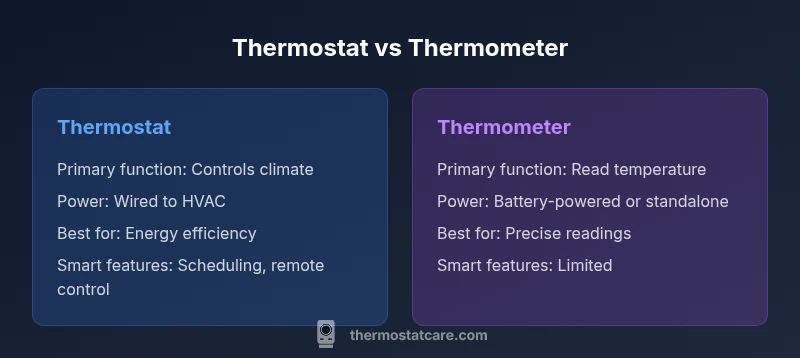
mediaPipeline":{"heroTask":{"stockQuery":"thermostat vs thermometer","overlayTitle":"Thermostat vs Thermometer","badgeText":"2026 Guide","overlayTheme":"dark"},"infographicTask":{"type":"comparison","htmlContent":"<div class="w-[800px] p-8 bg-slate-900 text-white"><h3 class="text-2xl font-bold text-center mb-6">Thermostat vs Thermometer</h3><div class="grid grid-cols-2 gap-6"><div class="p-6 bg-blue-500/20 rounded-xl border border-blue-500/30"><h4 class="text-xl font-bold text-blue-400 mb-4">Thermostat</h4><ul class="space-y-2"><li>Primary function: Control climate</li><li>Power: Wired to HVAC</li><li>Best for: Energy efficiency</li><li>Smart features: Scheduling, remote control</li></ul></div><div class="p-6 bg-purple-500/20 rounded-xl border border-purple-500/30"><h4 class="text-xl font-bold text-purple-400 mb-4">Thermometer</h4><ul class="space-y-2"><li>Primary function: Read temperature</li><li>Power: Battery or standalone</li><li>Best for: Precise readings</li><li>Smart features: Limited</li></ul></div></div></div>","altText":"Comparison infographic showing thermostat vs thermometer features","caption":"Thermostat vs Thermometer: Key Differences"}},
taxonomy":{"categorySlug":"what-is-thermostat","tagSlugs":["thermostat-maintenance","thermostat-troubleshooting","thermostat-setup","smart-thermostats"]}}}*{
response_format_version
Comparison
| Feature | Thermostat | Thermometer |
|---|---|---|
| Primary function | Controls HVAC to maintain setpoints | Measures ambient temperature |
| Measurement vs control | Control device with sensors and logic | Measurement device that reports temperature |
| Power source | Wired to HVAC power and home circuits | Battery-powered or simple digital power |
| Installation complexity | Higher; may require wiring and programming | Lower; typically plug-in or battery-based |
| Price range | Varies by model and features | Generally affordable for basic models |
| Best For | Climate control, energy savings, automation | Precise temperature readings, spot checks |
| Smart features | Remote control, occupancy sensing, learning modes | Limited smart features; basic digital displays |
Upsides
- Clarifies device roles to avoid misconfiguration
- Supports energy savings through smarter control
- Improves comfort with automated scheduling
- Enables remote monitoring and adjustments
- Enhances safety by maintaining stable environments
The Bad
- Potential initial setup complexity
- Need to maintain multiple devices
- Overreliance on one device can overlook environmental factors
- Some models require professional installation
Thermostat wins for climate control and energy management; thermometer remains essential for precise readings.
If you want automated comfort and lower energy bills, prioritize a capable thermostat. Use a thermometer where exact ambient readings are necessary or for calibration checks. Together, they form a robust setup for reliable home comfort.
Questions & Answers
What is the difference between a thermostat and a thermometer?
A thermostat manages heating and cooling to keep spaces at a set point, while a thermometer reports the current temperature. They serve distinct roles in home comfort and energy management.
Thermostats control temperature; thermometers measure it. They’re different tools for different jobs.
Can a thermostat double as a thermometer?
Some thermostats include temperature sensors and can display room temperatures, but they don’t replace a dedicated thermometer when precision is required. Use a thermometer for exact readings and calibration.
Some thermostats show temperature, but for precise readings you still want a thermometer.
Do I need a thermometer if I have a smart thermostat?
A smart thermostat improves climate control, but a separate thermometer can help verify readings in various rooms and detect sensor drift. Consider placement and calibration needs across your home.
A thermometer can still be useful even with a smart thermostat.
How accurate are digital thermometers for home HVAC readings?
Digital thermometers vary by model, but many offer reliable ambient readings suitable for informal checks. For formal verification or calibration, follow manufacturer guidance and compare against a reference.
Accuracy varies by model; for critical readings follow the manual.
How do I install a thermostat safely?
Turn off power to the HVAC system, follow wiring diagrams, and mount the thermostat in a central location away from heat sources. If in doubt, consult a licensed technician to prevent safety hazards.
Turn off power and follow the installation guide, or hire a pro.
What maintenance is required for thermostats and thermometers?
Thermostats typically require firmware updates and occasional sensor checks. Thermometers need battery replacements and periodic calibration checks to maintain accuracy.
Keep firmware updated and replace batteries when needed.
What to Remember
- Prioritize a thermostat for climate control and efficiency
- Keep a thermometer handy for precise measurements
- Choose devices with reliable integration for a smoother experience
- Regularly verify readings and settings to prevent drift
- Plan for maintenance and documentation to maximize lifespan