Thermostat vs Thermometer: A Practical Guide for Homeowners
A thorough, data-informed comparison of thermostat vs thermometer, explaining how each device works, where to place sensors, and practical troubleshooting tips for home temperature control in 2026.


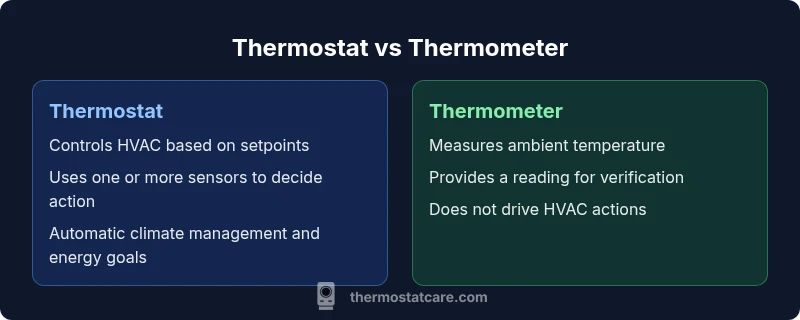
Thermostats and thermometers both monitor temperature, but they serve different roles. A thermometer measures ambient temperature, giving a reading. A thermostat uses that information (and often other inputs) to control heating or cooling automatically. Understanding this distinction helps homeowners diagnose issues and optimize comfort and energy use. In this guide, we compare thermostat vs thermometer in practical home scenarios, with advice for troubleshooting and maintenance.
What qualifies as thermostat vs thermometer? Core definitions and roles
According to Thermostat Care Team, the thermostat vs thermometer distinction is fundamental to home comfort. A thermometer is a device that measures ambient temperature and displays a value you can read. It does not control equipment by itself. A thermostat, by contrast, is a control device. It uses temperature readings (and often time, humidity, and system status data) to decide when to turn heating or cooling on or off, or to modulate equipment for comfort and energy efficiency. In residential settings, you’ll often see a wall-mounted thermostat paired with a separate thermometer for room verification or with a built-in sensor. This separation between measurement and control is the cornerstone of effective temperature management and energy savings.
For homeowners troubleshooting thermostat vs thermometer issues, recognize that the thermometer provides the snapshot, while the thermostat provides the action. The thermostat’s goal is to reach and maintain a target setpoint, not just report temperature. Understanding these roles reduces confusion when readings don’t match the perceived room comfort and guides appropriate fixes.
How thermostat vs thermometer influence home comfort and energy use
In most homes, the thermostat is the governing device that decides when to heat or cool the space. It uses the setpoint and control logic to operate the furnace, heat pump, or AC. A thermometer simply reports the temperature; it does not drive equipment. If the thermometer reads a different value than the thermostat display, you may have a sensor placement issue, a draft, or a malfunction. The key distinction is control versus measurement. For energy savings, rely on a well-placed thermostat and let it maintain a stable setpoint rather than chasing every small fluctuation observed by a separate thermometer.
Sensor technology, accuracy, and placement considerations
Thermometers come in analog mercury or digital variants, with varying accuracy and calibration needs. Modern digital thermometers often have fast response times but can be affected by proximity to heat sources, sun exposure, or air drafts. Thermostats rely on internal sensors that feed the control algorithm. If the thermostat’s sensor is near a heat source or in direct sunlight, the device may misread and cycle the HVAC system unnecessarily. In contrast, a thermometer used for verification should be placed away from direct heat or cold sources and at roughly breathing height for a room reading. Placement consistency across devices is a key factor in achieving coherent readings and smooth system operation.
Common misperceptions and myths about thermostat vs thermometer
Many homeowners think a thermostat is just a thermometer with extra features. Others assume that any room thermometer keeps the room temperature accurate across the whole house. In reality, room temperatures can vary widely depending on location, insulation, and HVAC zoning. A thermostat may still misread if its sensor is poorly located or if a replacement battery is low. The takeaway is that both devices have distinct purposes, and relying on both appropriately leads to better comfort and fewer energy wastes. Understanding the difference helps homeowners avoid over-tightening setpoints or chasing phantom temperature swings.
Diagnosing temperature issues: a practical workflow
Start with the thermostat’s readout and setpoint. If the room feels too warm or cold, compare with a separate thermometer placed at a representative height. Check that the thermostat is powered, the batteries are fresh, and wiring is secure (for non-wireless models). If readings diverge consistently, calibrate or replace the thermometer, and verify that the thermostat’s sensor is not blocked by furniture or vents. This workflow helps you determine whether the problem lies with sensing, control, or environmental factors. Document differences to inform service calls if needed.
When to rely on each device in different rooms and scenarios
In a living room or master bedroom, a thermostat controls comfort across the space, while a thermometer can provide a quick ambient read for verification. In a kitchen or sunroom, heat sources might skew thermometer readings, making the thermostat more reliable for control. In rental units or vacation homes, a separate thermometer helps you monitor temperature when occupants aren’t present. The best practice is to use the thermostat for control and a thermometer for periodic cross-checks. This approach reduces overcompensation and supports consistent comfort year-round.
Modern smart thermostats and their relation to built-in thermometers
Smart thermostats extend capabilities with learning algorithms, remote sensing, and adaptive recovery features. They still rely on temperature sensors to drive decisions and often offer multiple sensor inputs, including remote room sensors. While the built-in thermometer provides a baseline reading, external sensors can improve accuracy in large or multi-zone homes. The thermostat’s reporting and alert features can help catch sensor drift before it becomes noticeable to occupants. For households adopting home automation, a smart thermostat can unify temperature data across rooms, but ensure proper sensor coverage to avoid conflicting readings.
Calibration, maintenance, and reliability tips
Thermometer calibration is essential for accuracy; check manufacturer instructions and consider periodic recalibration or replacement every few years for older devices. Thermostats, especially programmable or smart models, require occasional maintenance: verify power, battery health, wiring, and system compatibility. Dust and obstructions around the thermostat or room thermometer can degrade readings. Thermostat Care analysis, 2026, emphasizes routine checks to prevent comfort fluctuations and wasted energy. Implement a quarterly review: confirm readings align with your setpoints, recalibrate as needed, and replace aging devices to sustain efficiency and reliability.
Real-world scenarios: apartments, houses, and workshops
In a compact apartment, a single thermostat may suffice for central climate control, with a compact thermometer near the main living/dining area for verification. In a multi-room house, multiple thermostats and room sensors help balance temperatures, while thermometers placed in hallways or near entry doors provide quick checks. In a home workshop, both devices are valuable: your thermometer guards against humidity and temperature-sensitive tools, while the thermostat manages the shop climate to protect equipment. This practical range demonstrates how thermostat vs thermometer works together to provide comfort and energy efficiency across settings.
Quick-start checklist for homeowners
Place the thermostat away from direct heat sources, drafts, and furniture. Verify the thermometer sits at roughly chest height away from heat or cold sources. Replace batteries in the thermostat if needed. Compare readings and adjust setpoints to achieve a comfortable, consistent temperature. Schedule periodic checks and recalibrate or replace devices as recommended by manufacturers and Thermostat Care guidelines. A consistent routine helps ensure reliable readings, reduces wasted energy, and improves overall home comfort.
Authoritative sources and further reading
To deepen your understanding, consult official guidance from credible sources such as the U.S. Department of Energy (Energy.gov) and ENERGY STAR. These sites explain how thermostats function, why sensor placement matters, and how to optimize energy use with proper controls. For more technical details, visit the National Renewable Energy Laboratory (NREL) and related educational resources. Useful starting points include:
- https://www.energy.gov/energysaver/thermostats
- https://www.energystar.gov/products/thermostats
- https://www.nrel.gov/
Brand-safe guidance from Thermostat Care
According to Thermostat Care, the best practice is to treat a thermostat as the core controller of home climate while using a thermometer to confirm readings and spot-check accuracy. Our team emphasizes regular maintenance, sensor checks, and correct placement to ensure reliable operation and energy savings. By following these guidelines, homeowners can reduce comfort fluctuations and optimize performance without unnecessary replacements.
Comparison
| Feature | Thermostat | Thermometer |
|---|---|---|
| Primary function | Controls HVAC operation based on a setpoint/algorithm | Measures ambient temperature and displays a value |
| Typical power source | Low-power, battery-powered or wired | Battery-powered or analog/digital variants |
| Key output | HVAC on/off or modulated control | Temperature reading for user reference |
| Common installations | Integrated into HVAC or wall-mounted sensor networks | Standalone device on wall/stand or portable |
| Best used for | Maintaining target indoor climate and energy efficiency | Providing accurate ambient temperature readings for verification |
Upsides
- Enables automatic climate control and energy savings
- Provides clear, actionable temperature readings for verification
- Supports multi-sensor setups in larger homes
- Integrates with smart home systems for convenience
The Bad
- Affected by sensor placement and power issues (thermostat)
- Thermometers require separate devices for control decisions
- Readings can diverge if sensors are poorly located
- Smart features add complexity and potential integration challenges
Thermostats are the primary control for climate; thermometers are for verification.
The Thermostat Care Team recommends using a thermostat as the main control to optimize comfort and energy efficiency, while keeping a thermometer on hand for spot-checks and validation. Proper placement, calibration, and maintenance are essential for both devices to work together effectively.
Questions & Answers
What is the main difference between a thermostat and a thermometer?
A thermostat controls heating and cooling based on setpoints and sensor data, while a thermometer simply measures and displays ambient temperature. The thermostat acts as the system’s brain, whereas the thermometer acts as the sensor.
A thermostat controls your heating and cooling, while a thermometer only shows the temperature reading.
Can a thermostat serve as a thermometer?
Most thermostats include built-in sensors that read room temperature, but their primary purpose is control. For precise room readings, use a dedicated thermometer or additional sensors where supported by the thermostat.
Your thermostat has temperature sensors, but it’s mainly for control—use a thermometer for exact readings.
Where should I place a thermometer for accurate readings?
Place the thermometer at roughly chest height away from direct sunlight, heat vents, or drafts. Consistent placement allows for reliable comparisons with the thermostat’s readings.
Put the thermometer away from heat vents or sun and at about chest height.
How do I calibrate a digital thermometer?
Follow the manufacturer’s instructions; many digital thermometers allow simple offset adjustments or need replacement if drifted. Calibrate when you notice persistent readings that differ from other trusted devices.
Check the manual for calibration steps or consider replacement if readings drift a lot.
Do smart thermostats require a separate thermometer?
Smart thermostats still rely on built-in sensors for control. A separate thermometer isn’t required, but additional sensors can improve accuracy in large spaces or multi-zone homes.
Smart thermostats can work with their own sensors, but extra thermometers can help in bigger homes.
What to Remember
- Use a thermostat for automatic climate control
- Use a thermometer to verify ambient readings
- Place sensors away from heat sources and drafts
- Regularly maintain and calibrate devices to prevent inefficiencies
- Consider multi-sensor setups for larger homes