Difference Between a Thermostat and a Thermistor: A Practical Comparison
Explore the difference between a thermostat and a thermistor, with definitions, how they work, and guidance for selecting components in HVAC and electronics projects. A clear, expert guide for homeowners and DIY enthusiasts.


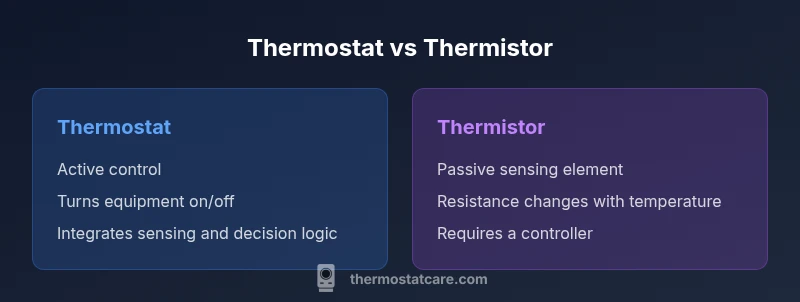
The difference between a thermostat and a thermistor is fundamental: a thermostat is an active control device that regulates temperature by turning heating or cooling on or off, while a thermistor is a passive temperature sensor whose resistance changes with temperature. For homeowners, understanding this distinction helps with troubleshooting, system design, and choosing compatible components.
What is a thermostat?
A thermostat is an active control device designed to regulate temperature by energizing or de-energizing heating or cooling equipment to reach a user-set point. Inside many thermostats, a sensor reports current temperature, and a control circuit decides whether to run the furnace, air conditioner, or other actuators. This combination of sensing, decision logic, and actuation is what distinguishes a thermostat as an active component in a closed-loop climate control system. For homeowners and DIYers, the practical takeaway is that a thermostat does more than measure temperature: it governs how the system behaves. The Thermostat Care team emphasizes that a reliable thermostat balances accurate sensing with robust control logic, energy efficiency, and a user-friendly interface, which makes daily adjustments straightforward while preserving comfort.
What is a thermistor?
A thermistor is a temperature-sensitive resistor used primarily as a sensor. Its electrical resistance changes in a defined way as temperature varies, which allows a controller to infer temperature from a resistance reading. Thermistors can be Negative Temperature Coefficient (NTC) devices, where resistance decreases as temperature rises, or Positive Temperature Coefficient (PTC) devices, where resistance increases with temperature. Unlike a thermostat, a thermistor does not drive actuators or enforce a setpoint; it provides a temperature signal that a separate controller interprets. In many systems, thermistors are the sensing element inside a thermostat or a sensor module, offering compact, inexpensive temperature data for precise feedback.
Core differences in function and purpose
The most fundamental distinction is purpose: thermostats are active controllers that decide when to heat, cool, or vent. Thermistors, by contrast, are passive sensing elements that report temperature through resistance changes. This separation of duties means a thermostat requires power, circuitry, and sometimes network connectivity to operate, while a thermistor alone, without a controller, cannot regulate anything. In practice, a modern home thermostat typically contains both sensing (often via an internal thermistor) and control logic, but the thermistor itself remains a passive component central to accurate temperature measurement and feedback.
How sensors and controllers interact in a system
In many devices, the thermistor serves as the temperature sensor feeding the thermostat’s controller. The controller compares the sensed temperature to the setpoint and issues commands to heating or cooling devices. The loop is closed when the actuators respond to the controller’s signals. This interaction hinges on stable sensor readings and well-tuned control algorithms. In simpler systems, a basic switch-based thermostat uses a fixed threshold rather than continuous control; even here, a temperature sensor (sometimes a thermistor) is essential for detecting when the threshold is crossed.
Sensing characteristics and calibration considerations
Thermistors provide high sensitivity over a narrow temperature range, making them ideal for precise feedback in compact devices. However, their resistance-versus-temperature curve must be well characterized and calibrated. Nonlinear behavior, self-heating from current through the device, and aging can introduce drift. For homeowners, it’s important to understand that a sensor’s accuracy affects overall comfort and energy use. In contrast, a thermostat’s calibration and software can compensate for sensor drift to maintain stable performance, but only if the sensing data is reliable.
How a thermostat regulates temperature: control strategies explained
Thermostats implement a range of control strategies to maintain setpoints. Bang-bang (on/off) control uses simple thresholds to switch equipment. Proportional (P) control adjusts output in proportion to deviation from the setpoint, while Proportional-Integral-Derivative (PID) adds memory and predictive response. The choice of strategy affects heating or cooling speed, overshoot, and energy use. In most residential systems, a balance between comfort and efficiency is achieved through practical control settings and user-adjustable parameters, often aided by learning algorithms in smart thermostats.
Real-world applications: HVAC, appliances, and smart devices
In HVAC, a thermostat is the central control node, coordinating with furnaces, boilers, ducts, and dampers. In electronics and industrial equipment, thermistors provide temperature data to microcontrollers or dedicated controllers, allowing precise feedback and protection features. Smart thermostats combine both roles, using thermistors for sensing and onboard software for adaptive scheduling, remote control, and energy analytics. Understanding the thermostat-thermistor relationship helps DIY enthusiasts design more robust systems and troubleshoot mismatches between sensing, control, and actuation.
Testing, troubleshooting, and common failure modes
Diagnosing issues begins with distinguishing sensing from control. If readings appear erratic, check the thermistor wiring, connector integrity, and any adapter circuitry. If the system fails to reach the setpoint, inspect the thermostat’s control logic, relays, and power supply. Common problems include sensor drift, calibration errors, and stubborn hysteresis that causes overshoot or lag. Practical tests include measuring resistance versus temperature on the thermistor with a multimeter, verifying that the thermostat reads the correct temperature, and ensuring actuators respond when commanded. Regular calibration and clean connections mitigate many problems.
Integration in modern thermostats: smart features and interoperability
Modern thermostats often blend sensing and control in one enclosure, with the thermistor embedded to monitor temperature and a microprocessor to manage decisions. They can connect to Wi-Fi, integrate with smart home ecosystems, and support learning schedules to optimize energy use. For DIYers, this means selecting a device that exposes sensor data and offers programmable controls is valuable. The advantage of integrating thermistor-based sensing with a capable thermostat lies in seamless feedback, reliability, and easier remote diagnostics in case of performance deviations.
Safety considerations and reliability best practices
Always follow manufacturer instructions when wiring thermostats and sensors, especially in high-voltage or heating systems. Use proper connectors, avoid overheating sensors with excessive current, and respect environmental limits (humidity, dust, temperature extremes). Regularly inspect sensors for physical damage, corrosion, or loose connections. Reliability improves when you separate sensing from control—clearly delineating responsibilities helps prevent cascading failures and simplifies maintenance. Thermostat Care emphasizes documenting sensor locations and ensuring compatibility between sensing elements and control logic for long-term safety.
Common misconceptions and clarifications
A frequent misconception is that all thermostats are merely temperature sensors. In reality, a thermostat typically contains both sensing and control capabilities, functioning as an actuator in a closed loop. Conversely, a thermistor by itself does not regulate anything; it only provides a temperature signal. Another misconception is that cheaper sensors are always enough; in practice, sensor accuracy and calibration significantly impact system performance. Finally, some people assume thermostats do not require calibration—you should verify and adjust setpoints, sensor offsets, and compensation parameters to maintain consistent comfort and efficiency.
Practical decision guide for homeowners and DIYers
When deciding between relying on a thermostat or a thermistor component, consider your project goals. If you need automatic regulation, look for a reliable thermostat with robust sensing (often using an integrated thermistor) and a clear interface. If you only need temperature data for a microcontroller or a device with its own controller, a high-quality thermistor paired with a compatible readout circuit is appropriate. In many cases, combining both—a well-specified thermistor as the sensor and a capable thermostat or controller—delivers the best balance of accuracy, control, and energy efficiency. Always verify compatibility, calibration, and safety requirements before installation.
Comparison
| Feature | Thermostat | Thermistor |
|---|---|---|
| What it is | An active controller that regulates temperature by turning equipment on/off | A passive resistance-based temperature sensor used to infer temperature |
| Primary function | Regulate and maintain a setpoint through control logic | Provide a temperature signal to a controller |
| Control type | Closed-loop control with setpoints and thresholds | Passive sensing requiring a separate controller |
| Typical usage | HVAC systems, appliances, and smart home devices | Sensor inputs in microcontrollers, HVAC sensors, and electronics |
| Sensing vs response | Senses and acts to keep environment at target | Measures temperature; no actuation by itself |
| Cost/availability | Typically more complex and priced accordingly | Widely available as sensors and components |
Upsides
- Enables automated temperature control for comfort and efficiency
- Thermistors provide precise, responsive temperature sensing
- Integrated sensing + control in modern devices simplifies setup
- Clear separation of sensing and control improves maintainability
The Bad
- Thermostats can be more expensive and require wiring
- Thermistors can drift or self-heat, affecting accuracy
- Mismatched components can cause control instability
Thermostat is the better choice for active control; thermistors are essential sensors for accurate feedback
Choose a thermostat when you need automatic regulation. Use a thermistor when you require precise temperature sensing in a controller or sensor module, ideally paired with proper calibration and compatible control logic.
Questions & Answers
What is the primary function of a thermostat?
The primary function of a thermostat is to actively regulate temperature by turning heating or cooling devices on and off to maintain a setpoint. It combines sensing, decision logic, and actuation in one unit. This creates a closed-loop control system for comfort and efficiency.
A thermostat actively controls temperature by turning your heating or cooling on or off to reach and hold the target temperature.
What is a thermistor used for in temperature sensing?
A thermistor is a passive temperature sensor whose resistance changes with temperature. It provides a temperature signal that a controller can read and interpret to make decisions, but it does not drive actuators by itself.
A thermistor is a temperature sensor that changes resistance with temperature and needs a controller to act on that data.
Can a thermistor replace a thermostat?
Not by itself. A thermistor cannot regulate temperature; it must be paired with a controller that interprets its signal and drives actuators. Without that controller, the system cannot maintain a setpoint.
No. A thermistor alone cannot regulate temperature; you need a controller to act on its readings.
Are thermistors suitable for precise temperature measurement in HVAC?
Thermistors can provide precise sensing, particularly in controlled environments, but accuracy depends on calibration, layout, and the surrounding circuitry. In HVAC, the sensing element is usually part of a larger thermostat or sensor module.
Thermistors offer precise sensing when properly calibrated and integrated with good circuitry, but accuracy depends on setup.
How do I know if my system uses a thermistor inside the thermostat?
Many modern thermostats designate their sensor type in manuals or product specs. If in doubt, inspect the device documentation or open the unit to identify the sensing element. You can also measure resistance change with temperature if you’re comfortable with electronics.
Check the manual or specs; many thermostats use an internal thermistor, but verify with documentation or a safe inspection.
What tests can I perform at home to differentiate sensing from control parts?
Test by verifying that a sensor (thermistor) changes resistance with temperature while a controller triggers actuators when the setpoint is crossed. A simple check is to observe readings from the sensor while adjusting the environment and confirming actuator response to control signals.
Observe sensor readings as temperature changes, and verify the controller activates heating or cooling accordingly.
What to Remember
- Understand role separation: thermostat = control, thermistor = sensing
- Most systems rely on thermistors as sensors within thermostats
- Select devices based on control needs and sensor accuracy
- Calibration and proper wiring are key to reliable performance