Thermostat Not Turning Furnace On: Troubleshooting Guide
Learn fast checks and step-by-step fixes when your thermostat won't turn on the furnace. This Thermostat Care guide covers common causes, safety tips, and prevention to keep heating flowing.


If your thermostat not turning furnace on, start with a quick power check and wiring inspection. Verify the furnace switch is on, the thermostat display is responsive, and the C-wire is secure; replace batteries if present. If it still won’t ignite, follow the diagnostic flow below. These quick checks cover the majority of early faults. If that doesn’t fix it, move on to the deeper steps below.
Immediate, non-technical checks you can do now
When your heat is suddenly unresponsive, begin with the simplest possibilities. Verify the furnace power switch is on and the circuit breaker hasn’t tripped. Inspect the thermostat display: is it showing any numbers or symbols, or is it completely blank? If the thermostat runs on batteries, replace them with fresh cells. Check that the thermostat is set to Heat and that the setpoint is above the current room temperature. If you have a smart thermostat, confirm it is connected to Wi-Fi and the app shows the system as calling for heat. These quick checks often resolve the issue without tools. According to Thermostat Care, many problems originate from power or simple wiring faults, so start there and proceed methodically. Remember to turn off power before handling any wires to avoid shocks. Safety first!
How a thermostat communicates with your furnace
A thermostat sends a call for heat to the furnace when the user selects Heat and a temperature above the current room temperature. The furnace then powers up the blower and ignites the burner (gas) or activates the electric heating elements. Modern thermostats use different communication protocols (common in smart thermostats) and rely on a continuous 24-volt power supply via the C-wire. If the thermostat loses power, if the C-wire is loose, or if the thermostat sends an incorrect call for heat, the furnace may not start. Thermostat Care notes that a stable common (C) wire and proper wiring are foundational; poor wiring can masquerade as a thermostat malfunction. In this section we’ll unpack the common wiring pitfalls and how to verify them safely.
Safety first: hazards and precautions
Heating systems operate with electrical components and, depending on the setup, natural gas or propane. Before you touch anything, shut off the power to the furnace at the main panel to prevent shocks or accidental ignition. If you notice a gas smell, evacuate and contact your gas supplier or emergency services immediately. Do not attempt to bypass safety switches or disable flame sensors. Always use insulated tools when inspecting wiring, and avoid working alone if you’re unfamiliar with HVAC systems. If at any point you feel unsure, stop and call a professional. Thermostat Care emphasizes that safety is non-negotiable when diagnosing furnace-related issues.
Reading the error signals: interpreting thermostat lights and codes
Some thermostats illuminate error codes or indicator lights when there’s a fault. A blank or unresponsive display can indicate a power issue, a dead battery (for battery-powered units), or a tripped breaker. If the display shows a code, consult the user guide or the manufacturer’s app for the meaning. For many models, codes relate to wiring, sensor faults, or communication failures with the furnace control board. Document any codes before you reset anything so you can track what you’ve tried and avoid repeating steps.
Diagnostic flow overview: symptom to solution
A systematic diagnostic flow helps isolate the cause without guessing. Start with power, then wiring, then thermostat settings, then furnace response. If the thermostat sends a heat call but the furnace doesn’t respond, focus on the furnace’s power supply, control board, and gas valve or ignition system. If the furnace fires briefly but shuts down, you may be dealing with a protective sensor, overheating limit switch, or a restricted vent. Throughout the process, keep safety in mind and avoid any work that feels risky or uncertain.
Step-by-step diagnosis for the most common causes (easy fixes first)
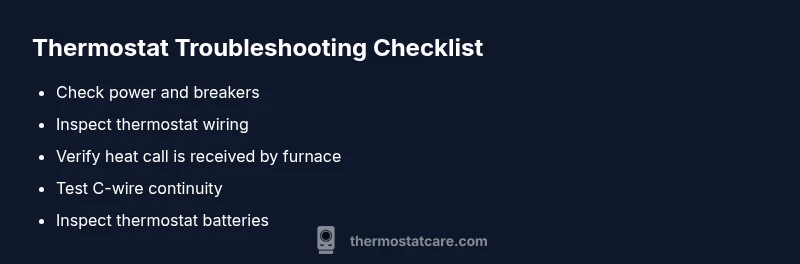
This section outlines actionable steps you can take to fix the most common issues. First, confirm the furnace power switch and the circuit breaker. Next, inspect the thermostat wiring; reseat all terminals and ensure the C-wire is properly connected. If the thermostat uses batteries, replace them. Ensure the thermostat is set to Heat and the setpoint is higher than room temperature. For smart thermostats, check the app status and firmware update. If you still don’t get heat, move to the deeper checks on the HVAC side. When in doubt, call a licensed HVAC tech to verify gas supply, ignition, or control board health.
In-depth checks: wiring, power, and thermostat compatibility
Wiring issues are the most frequent culprits in thermostat-related heat failures. Start by turning off the power, then inspect the thermostat’s terminal strip (R, C, W, Y, G). Re-seat terminals, trim any frayed wires, and confirm there is a solid 24-volt circuit between R and C if you have a power-steady thermostat. Some older systems use different wire colors or nonstandard layouts; rely on the furnace’s wiring diagram or a multimeter if available. Compatibility matters too: not all thermostats are compatible with every furnace or heat source. Reference the thermostat’s compatibility guide and verify the wiring matches the furnace control board’s terminals. Thermostat Care recommends documenting the wiring layout before making changes so you can revert if needed.
Common mistakes to avoid when troubleshooting
Avoid jumping to thermostat replacement before ruling out power and wiring problems. Do not bypass safety controls or test a gas furnace using improvised methods. Don’t neglect the simple possibility that a tripped breaker or a blown fuse is the root cause. If your thermostat is connected to an electrical subpanel, ensure it isn’t isolated from the main panel. Finally, never work on a furnace control board without proper training. A careful, staged approach reduces the risk of damage and injury.
When to call a professional: signs you’ve reached the limit
If you’ve exhausted safe, basic checks and the furnace still won’t turn on, it’s time to involve a pro. Gas furnaces require licensed technicians to inspect gas lines, ignition systems, burners, and venting for safety. Electrical faults on the furnace control board or blower can also be hazardous and require specialized tools. A professional can perform a thorough diagnostic, test the furnace’s airflow and combustion safety, and replace faulty components with the correct parts. Timely professional help prevents carbon monoxide risk and protects your home heating system.
Prevention: tips to keep your heating system reliable
Routine preventive maintenance reduces the likelihood of a sudden heat outage. Schedule annual professional inspections of both the thermostat and furnace, replace batteries in battery-powered thermostats, and keep the thermostat in a stable, temperature-controlled environment. Consider upgrading to a modern thermostat with self-calibration and better diagnostics if your current model is outdated. Finally, maintain clear clearance around the furnace and thermostat, avoid DIY modifications to gas lines, and use fresh air filters to improve furnace efficiency. These practices help ensure smoother operation through heating season.
Steps
Estimated time: 60-90 minutes
- 1
Power check at the furnace
Locate the furnace shutoff switch and the circuit breaker for the furnace. Ensure the switch is in the ON position and the breaker is not tripped. If the breaker was tripped, switch it off completely, then back on to reset, and reattempt heat call from the thermostat.
Tip: If you’re unsure which breaker controls the furnace, label circuits to avoid future confusion. - 2
Inspect thermostat power and display
Look at the thermostat display. If it’s blank, press the power button or replace batteries if applicable. For hardwired models, verify there’s 24 VAC between R and C with a multimeter if you have one.
Tip: Always power down before touching terminals to avoid shocks or shorts. - 3
Check thermostat wiring and C-wire
Carefully remove the thermostat cover and confirm wires are securely connected to their labeled terminals. Re-seat any loose wires; ensure the C-terminal is connected and the wire is intact. Do not mix up wires (R to Rc/Rh, W to W, G to G, Y to Y).
Tip: Take a photo of the wiring before disconnecting to guide reassembly. - 4
Test the heat call
Set the thermostat to Heat and raise the setpoint above the current temperature. Listen for the furnace relay click and watch for ignition or blower activity. If you hear no call for heat from the thermostat, the issue may be the thermostat itself or its wiring.
Tip: If you hear a click but no ignition, stop and inspect the furnace safety switches. - 5
Inspect furnace indicators
Examine any lights or fault codes on the furnace. Record codes and consult the furnace manual or manufacturer site. Some furnaces provide fault codes for ignition or pressure issues that can guide the next steps.
Tip: Never ignore a flashing fault light; it points to a specific fault condition. - 6
Smart thermostat app check
If you use a smart thermostat, open the companion app to confirm it shows Heat requested and that the device is online. Re-sync or forget/re-add the device if needed, and verify firmware is up to date.
Tip: A faulty app connection can masquerade as a thermostat problem. - 7
Advanced checks (if confident)
With power off, test the 24 VAC supply on the furnace control board. Check the thermostat wire continuity and test continuity on the C-wire. Check for corrosion on terminals and replace any damaged conductors.
Tip: If you’re unsure about electricity, skip this step and call a pro. - 8
Call a professional when needed
If none of the above steps resolve the issue, especially with gas furnaces or suspected ignition/gas valve problems, contact a licensed HVAC technician. They can safely diagnose gas supply, ignition, and control board health.
Tip: Schedule promptly in cold weather to avoid a no-heat situation.
Diagnosis: Thermostat not turning furnace on
Possible Causes
- highPower issue (furnace or outlet)
- highTripped breaker or blown fuse
- mediumDead or disconnected C-wire / thermostat battery
- mediumMalfunctioning thermostat or incorrect wiring
- lowFaulty furnace ignition or gas valve problem
Fixes
- easyCheck the furnace power switch and reset any tripped breakers; reset the thermostat as needed
- easyInspect thermostat wiring; reseat terminals and verify the C-wire continuity
- easyReplace batteries if the thermostat is battery-powered and confirm the display is active
- easyFor smart thermostats, re-pair with the app and check firmware updates
- mediumIf the furnace still won’t respond, contact a licensed HVAC tech to inspect ignition, gas valve, and control board
Questions & Answers
What is the most common reason a thermostat won't turn on the furnace?
Power issues or wiring faults are the most frequent culprits. Start with the furnace switch, breaker, and the thermostat’s wiring. If the display is blank, replace batteries or check power. After these checks, consider deeper HVAC inspections.
Power and wiring issues are the most common. Start with the furnace switch, breaker, and thermostat wiring. If the display is blank, replace batteries and retry.
Should I reset the thermostat or power cycle the HVAC system?
Yes, you can perform a soft reset on the thermostat and cycle power to the furnace. For smart models, re-pair with the app and check for updates. If the problem persists, proceed with the diagnostic steps in the middle of this guide.
You can reset the thermostat and cycle power to the furnace. For smart models, re-pair with the app and check updates. If it persists, continue with the guide.
Can a new thermostat fix issues with an old furnace?
A newer thermostat can improve compatibility and diagnostics, but some issues are furnace or gas-ignition related. Always verify compatibility with your furnace model and wiring before upgrading.
A new thermostat may help, but check compatibility with your furnace first.
When should I call a professional?
Call a professional if you smell gas, hear strange noises, see gas or oil leaks, or if ignition fails despite basic troubleshooting. A licensed HVAC tech will safely diagnose ignition systems and control boards.
Call a pro if you smell gas or ignition issues persist after basic troubleshooting.
Is it safe to inspect wiring myself?
Only if you’re confident with basic electrical work and have turned off power. If unsure, stop and call a professional. HVAC wiring can involve dangerous voltages and gas safety concerns.
Only attempt wiring checks if you’re comfortable with electricity; otherwise, call a pro.
Can a non-contact tester help diagnose power issues?
A non-contact tester can confirm whether power is present at outlets or switch points, but it won’t diagnose deeper furnace issues. Use it as a quick utility aid alongside other checks.
A non-contact tester helps verify power presence, but won’t fix deeper furnace issues.
Watch Video
What to Remember
- Start with power and wiring checks before anything else
- Ensure proper thermostat-air handler communication and heat call
- Follow a safe, staged process and call a pro when in doubt
- Regular maintenance reduces future outages