How to Test a Hot Water Thermostat
Learn a safe, methodical approach to testing a hot water thermostat. This guide covers power isolation, continuity checks, and interpreting results to determine if you should repair or replace.


Learn how to test a hot water thermostat safely and accurately. This quick guide covers isolating power, verifying wiring, measuring continuity, and observing the thermostat’s response as water temperature changes. By following the steps, you’ll identify faulty components, confirm normal operation, and decide if replacement is needed to prevent scalding or leaks.
Safety prerequisites for how to test a hot water thermostat
Testing a hot water thermostat involves electrical and water systems. Before you begin, understand the potential hazards: scalding hot water, exposed energized components, and pressure in the tank. This section explains why safety matters and sets the scope for a responsible DIY approach. According to Thermostat Care, taking deliberate safety steps dramatically reduces the risk of shock and burns while you diagnose the thermostat and related controls. Always wear insulated gloves, use a non-contact voltage tester first, and never work on live circuits. If you’re ever uncertain, the Thermostat Care Team recommends pausing and consulting a qualified professional.
Key idea: testing a hot water thermostat should prioritize safety, proper isolation, and accurate measurements over speed or guesswork.
How hot water thermostats work (basics) and why testing matters
A hot water thermostat acts as the control point for heating water to a target temperature. It senses water temperature and switches power to the heating element or burner on or off to maintain the setpoint. When the water gets too hot, the thermostat signals the system to stop heating; when it cools down, it signals to start again. Faulty thermostats can cause overheating, underheating, or intermittent heating, leading to energy waste or safety concerns. Understanding the principle helps you interpret test results and distinguish between thermostat issues and other components like the heating element, wiring, or sensors. Thermostat Care analysis highlights that most thermostat-related problems fall into user-accessible wiring, calibration drift, or a stuck switch. If you’ve confirmed power safety and wiring integrity, testing continuity and response is a reliable diagnostic path.
Planning your test: what you’ll verify and what to expect
Before you touch tools, outline what you’ll check: (1) power isolation to the water heater, (2) physical inspection of thermostat and wiring, (3) basic electrical continuity across thermostat terminals, and (4) how the thermostat responds to simulated temperature changes. In many electric water heaters, the thermostat is a switch that opens or closes a circuit depending on temperature. A successful test shows continuity when cool and a break in continuity when the thermostat trips due to reaching the setpoint. If your model is electronic, you may also observe setpoint adjustments and cycling behavior. This section emphasizes that clarity of your expected outcomes makes the next steps straightforward and reduces guesswork.
Step-by-step testing framework (overview, not the exact steps)
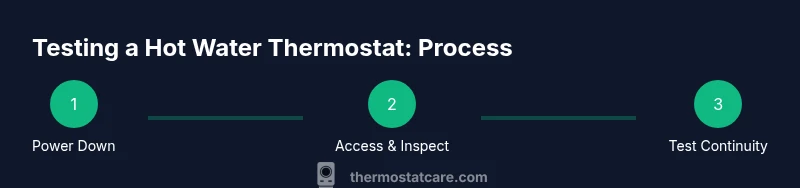
The testing framework combines safety checks with direct electrical tests and functional observation. You’ll verify power shutdown, access the thermostat, measure continuity, and then observe the heating cycle once power is restored. This approach helps you pinpoint whether the thermostat itself is failing, whether wiring is loose or corroded, or if the problem lies with the heating element. The goal is to determine if the thermostat is operating within its intended range and to decide whether a replacement is warranted.
Direct electrical testing: continuity and resistance basics
Electrical testing provides objective evidence of thermostat health. By measuring continuity across the thermostat’s terminals when cool, you can confirm the switch is closed. If you gently apply heat to the sensing area (or allow the system to heat naturally), you should see the switch open (no continuity) when the water reaches the setpoint. These are standard checks for most residential hot water thermostats. Some models require checking resistance across the sensor element; consult the manufacturer documents for your unit. Always document readings for comparison if you replace components later.
Interpreting results: what readings mean and next steps
Continuity present when cool and open when warmed typically indicate a healthy thermostat. No continuity at room temperature suggests the switch may already be stuck open or there is an internal fault. Continuous continuity with a high temperature without switching off is a red flag, potentially indicating a stuck-closed switch or a failed sensor. If readings are unclear or do not match the expected pattern, test again after cooling the system fully, inspect wiring for looseness, and verify that the thermostat is the correct setpoint for your household needs. In many cases, the issue lies in wiring or element connections rather than the thermostat itself.
When to call a pro and practical follow-up steps
If you observe inconsistent readings, damaged wiring, corrosion, or if the thermostat is integrated with a gas control or complex electronic module, it’s prudent to contact a licensed technician. A pro can safely test with specialized equipment, verify calibration against local code requirements, and replace components as needed. As part of maintenance, consider labeling thermostat wires, keeping a spare thermostat compatible with your model, and scheduling periodic checks to prevent unexpected failures. Thermostat Care suggests documenting the model, setpoint, and test results for future reference.
Tools & Materials
- Digital multimeter with continuity setting(Set to the lowest resistance/ohms range; test on a known good circuit first)
- Non-contact voltage tester(Use to confirm no live voltage before touching terminals)
- Screwdriver set (Phillips and flat-head)(To remove access panel and thermostat cover)
- Insulated gloves(EMI-rated gloves for extra protection when working near hot water gear)
- Flat non-conductive mat or dry work surface(Prevents grounding and keeps tools dry)
- Water heater manual or model specific wiring diagram(Important for model-specific steps and safety limits)
- Flashlight or headlamp(Good visibility in the aging cabinet or panel space)
Steps
Estimated time: 30-60 minutes
- 1
Power down and isolate the water heater
Turn off the circuit breaker that feeds the water heater and, if applicable, close the gas shutoff valve. This ensures there is no live current while you inspect wiring or measure resistance. After securing power, confirm no voltage is present at the terminal strip using a non-contact tester.
Tip: Double-check the main power switch on the heater itself if present; some units have external disconnects. - 2
Access the thermostat and identify wires
Remove the outer access panel and insulation to expose the thermostat and its wiring. Take a photo or label each wire so you can reattach them correctly after testing. Note the thermostat’s model and any identifying numbers for later reference.
Tip: Work in a dry area and keep metal tools away from exposed terminals to avoid shorting circuits. - 3
Verify no current and inspect visually
Use the non-contact voltage tester to confirm there is no voltage at the thermostat terminals. Look for loose connectors, signs of corrosion, or damaged insulation. A loose connection can mimic thermostat failure.
Tip: If you find damaged wiring, do not attempt a DIY repair; replace damaged sections or call a pro. - 4
Test continuity with the thermostat cool
With wires detached from the thermostat, set the multimeter to continuity. Place the probes on the two terminals. If the meter beeps or shows a low resistance, the thermostat is closed at room temperature. Record the reading and compare with your model's expected behavior.
Tip: Only touch the metal probes to the terminals; avoid touching bare wires during measurement. - 5
Simulate heat and observe switch behavior
If your model allows, gently apply heat to the sensing area or allow the system to heat up to its setpoint and watch for a change in continuity. The thermostat should open (no continuity) when the temperature reaches the setpoint, then close again as it cools.
Tip: Do not overheat or force temperatures beyond the rated limits; overheating can damage components. - 6
Reassemble, restore power, and verify operation
Reconnect the wires exactly as labeled, replace insulation and the access panel, and flip the breaker back on. Observe the water heater’s heating cycle and verify the setpoint maintains the desired temperature without erratic cycling.
Tip: If you notice abnormal cycling, a professional evaluation may be necessary to avoid energy waste or safety risks. - 7
Document results and plan next steps
Record the thermostat model, tested readings, and whether the unit passed the test. If readings were abnormal, plan for a replacement or professional diagnostic. Keep these notes for future maintenance.
Tip: Keep a spare thermostat compatible with your model so you’re ready if a replacement is needed.
Questions & Answers
Do I need to cut power to test the thermostat?
Yes. Always shut off power at the breaker and confirm no voltage at the terminals before touching wiring. This reduces the risk of shock and injury.
Yes. Always cut power and check for voltage before touching any wires.
Can I test the thermostat without draining the water heater?
In most cases you can perform electrical tests without draining. Visual inspection and continuity checks after power is removed do not require draining. Functional testing of heating cycles may involve water temperature and should be done with caution.
Electrical checks can be done without draining, but testing heating cycles involves water temperature and safety considerations.
What does it mean if there is continuity when cool and no continuity when warm?
That pattern generally indicates the thermostat is functioning as a normally closed switch that opens at the setpoint. If the pattern does not appear, the thermostat or wiring may be faulty.
Continuity when cool and no continuity when warm usually means the thermostat is switching as expected; if not, it may be faulty.
Is bypassing a faulty thermostat safe?
No. Bypassing a thermostat removes a critical safety control and can cause scalding or energy hazards. Replace or repair the thermostat instead.
No. Bypassing safety devices is dangerous and should be avoided.
How long do thermostats typically last in a hot water system?
Thermostats vary by model and usage, but regular maintenance can extend life. If you notice frequent cycling or temperature drift, consider testing and possibly replacing.
Thermostats vary in lifespan; watch for drift or unusual cycling and replace as needed.
What tools do I need to test the thermostat?
A digital multimeter, a non-contact voltage tester, screwdrivers, and proper safety gear are essential. Always follow the manufacturer’s wiring diagram for your model.
You’ll need a multimeter, a non-contact tester, screwdrivers, and safety gear.
Watch Video
What to Remember
- Power off before touching any thermostat components
- Continuity should be present when cool and disappear as the thermostat trips
- Label wires and document readings for future maintenance
- If results are unclear or safety seems uncertain, contact a licensed technician
- Regular inspection reduces risk of overheating and energy waste