Furnace Won't Shut Off: Urgent Troubleshooting Guide
If the furnace won't shut off even when the thermostat is off, use this urgent troubleshooting guide to diagnose wiring, limit switches, and control-board faults, plus safety steps and when to call a pro.


Most likely, a stuck limit switch or a fault in the control circuit keeps the furnace running after the thermostat is off. Immediate steps: cut power at the main breaker, shut off the gas valve if applicable, and inspect thermostat wiring for loose or damaged connections. If you smell gas or feel unsure, call a professional now.
Why the problem can happen: furnace won’t shut off even when thermostat is off
According to Thermostat Care, the situation furnace won’t shut off even when thermostat is off describes a common safety and reliability issue in homes. This happens when a control component continues to signal heat despite the thermostat being set to off. The root cause can be mechanical, electrical, or a simple miscommunication between devices. Recognizing the signs early can prevent escalating damage and save energy. In most homes, the problem surfaces during peak winter when the furnace runs longer than intended. By understanding common failure points, homeowners can approach fixes methodically and safely. Thermostat Care’s guidance emphasizes starting with the simplest checks before diving into the furnace cabinet.
In many cases, the offender is not a mysterious fault in the thermostat itself but a downstream component that ignores the off signal. The learning here is that a disciplined, safety-first approach works best: power down, isolate circuits, and then test components one at a time. This keeps you safe and helps you identify whether the issue lies with the thermostat, the wiring, or the furnace controls themselves. For readers of this guide, the keyword furnaces and thermostats is a frequent source of confusion; thankfully, a clear diagnostic path helps you sort signal from noise.
Thermostat Care’s analysis shows that most on/off failures are triggered by a stuck relay, a compromised limit switch, or wiring faults. These parts are accessible in many systems with basic tools, but diagnosing control-board faults or gas-valve issues requires caution and, often, professional service. This article is designed for homeowners and DIY enthusiasts who want a practical, safe path to resolving the symptom while knowing when to escalate to an expert.
Immediate safety steps you can take now
- Power down the system: switch off the furnace at the main breaker and, if present, the service disconnect. If you can safely reach the furnace, cut power to the unit before touching any internal components.
- Shut off gas carefully: if your furnace uses natural gas or propane and you can safely access the shutoff valve, close it. Do not attempt any gas work beyond turning off the valve.
- Check basic signals: verify the thermostat is set to OFF, and ensure the thermostat display isn’t showing a fault code. If your thermostat is wireless, check for battery issues or repeater interference.
- Ventilate and observe smells: if you detect a gas odor or hissing, evacuate immediately and call emergency services or your gas utility. Do not operate electrical switches near the source of a gas leak.
- Do not bypass safety switches: never jump wires or tape over limits or relays as a workaround. Modern furnaces have safety interlocks that protect you from fire or carbon monoxide risk.
These steps are essential to reduce risk while you perform diagnostics. If you feel unsure at any point, stop and call a pro. Thermostat Care emphasizes safety first when dealing with heating equipment.
Common causes behind a furnace that won't shut off
There are several frequent culprits behind this symptom, arranged from simplest to most complex:
- Stuck or failed limit switch: the limit switch tells the blower to run or the furnace to stay on. If it sticks in the “heat on” position, the system may never turn off.
- Thermostat wiring fault: loose, frayed, or miswired wires can keep calling for heat even when the thermostat is off.
- Faulty furnace relay or control board: a relay stuck closed or a damaged control board can bypass the off signal from the thermostat.
- Gas valve or ignition issue (gas furnaces): a valve or ignition fault can sustain heat generation regardless of thermostat state.
- Sensor or safety interlock problems: flame sensor or pressure switch faults may trigger safety circuits that behave unpredictably.
Understanding these causes helps you test in a logical order without jumping into high-risk fixes. Thermostat Care recommends starting with the simplest checks (wiring and settings) and progressing to component tests only if you’re comfortable. Remember that some failures involve high voltages or natural gas—prioritize safety and know when to stop and call a professional.
How to test thermostat wiring and the thermostat itself
A misbehaving thermostat often masquerades as a furnace problem. Here’s a safe, structured way to verify the thermostat’s role:
- Power off first: shut down power to the furnace and thermostat to prevent accidental signals while you inspect wiring.
- Check the thermostat wires: remove the cover and look for loose, discolored, or frayed conductors. Reconnect any loose wires to their corresponding terminals (R, W, Y, G, C) according to your model’s wiring diagram.
- Confirm thermostat settings: ensure the thermostat isn’t set to a continuous heat mode or a ‘hold’ setting that keeps the furnace on by design.
- Test with a multimeter (optional and only if you’re confident): verify continuity on the R and W circuits when you toggle the thermostat. A constant call for heat indicates a thermostat issue rather than the furnace.
- Consider replacing the thermostat: older or damaged models can misinterpret sensor data and fail to off-signal properly. A modern, compatible thermostat with a fresh battery reduces future faults.
If these checks show no wiring faults and the furnace still won’t shut off, the problem likely lies in the furnace controls or gas valve—schedule a pro visit. Thermostat Care notes that a healthy thermostat should not be the sole cause of persistent heat.
What to inspect inside the furnace: relays, fan limits, and control board
Entering the furnace cabinet requires caution and, if you’re not comfortable, a professional presence. Inside, you may find:
- Control board and relays: a relay stuck in the closed position can keep heat active regardless of thermostat signals. Inspect for scorch marks, melted plastic, or loose ribbon cables.
- Fan-limit switch: a faulty limit switch can keep the blower running or keep the furnace firing without stopping the cycle. Look for signs of wear and test connections for firmness.
- High-limit switches and sensors: varistors and sensors can drift with age, causing improper signaling. If you test components and find inconsistent readings, replacement is often the right path.
- Wiring harness: damaged insulation or loose connectors can create cross-talk between circuits, causing a continuous heat call.
Safety reminder: do not touch live wires or power supplies while the panel is open. If you find obvious damage, replace components only with a compatible part and following the manufacturer’s guide. When in doubt, call a licensed HVAC technician for an accurate diagnosis and safe repair.
Special cases: gas furnaces, oil furnaces, and heat pumps
Gas furnaces, oil furnaces, and heat pumps each have distinct failure modes that can produce the same symptom: heat that continues after the thermostat is off. Gas valves can stick open or signals to the ignition system can fail, while oil furnaces rely on oil valve controls that can malfunction. Heat pumps may exhibit defrost or reversing valve issues, leading to unintended heat or resistance cycles. In all cases, do not attempt risky repairs on gas components or high-voltage circuits without proper training. For many homeowners, the safer course is a professional inspection when the fault involves gas lines, ignition modules, or the control board. Thermostat Care recommends documenting any codes or odd sounds, as they help technicians pinpoint the root cause quickly.
When to call a professional and what to expect
If the furnace won’t shut off after basic checks, it’s time to involve a pro. A licensed HVAC technician can safely isolate electrical power, test the control board, verify gas valve operation, and assess safety interlocks. Expect a diagnostic visit to include panel access, component testing with appropriate meters, and potential part replacement. The technician may test the thermostat in place, swap in a known-good thermostat, or replace faulty relays, limit switches, or the control board. Always ask for an upfront estimate and a clear description of the work involved. For safety, ensure the area is well-ventilated and keep children and pets away from the work zone. The Thermostat Care team emphasizes that timely professional help can prevent CO exposure, gas leaks, and costly damage from prolonged running.
Prevention tips and routine maintenance to prevent this issue
Prevention starts with regular maintenance and mindful operation:
- Schedule annual furnace maintenance with a licensed technician to inspect the control board, relays, limit switches, and safety interlocks.
- Replace air filters regularly to reduce strain on the blower and improve overall system signaling.
- Test the thermostat annually, ensuring the keypad or app responds correctly to OFF signals and that the C-wire remains solid.
- Keep the thermostat wiring tidy and connections tight at the furnace control board and thermostat terminals.
- Document and monitor any odd behaviors, codes, or power fluctuations. Early signs often indicate wear or impending failure in the control components.
By following these practices, you reduce the likelihood of future instances where the furnace continues to run after the thermostat is set to off. Thermostat Care’s ongoing guidance emphasizes proactive care to maintain safe, efficient heating and to reduce emergency repairs.
Quick diagnostic checklist to keep handy
- Confirm power and gas shutoffs are accessible and clearly labeled.
- Inspect thermostat wiring for loose or damaged conductors.
- Check the furnace’s control board for burn marks or damaged relays.
- Ensure the blower and limit switches operate correctly during a test call for heat.
Steps
Estimated time: 60-90 minutes
- 1
Prioritize safety and power down
Shut off power to the furnace at the main breaker and shut off the gas valve if you can safely access it. This prevents accidental startup while you inspect components.
Tip: Always wear protective gloves and avoid touching live electrical parts. - 2
Check thermostat settings and wiring
Verify the thermostat is OFF and inspect wiring for loose or damaged connections. Reconnect wires to the correct terminals and ensure twist-on connectors are secure.
Tip: Take a photo of wire colors before detaching from terminals for reference. - 3
Inspect the furnace control area
Open the panel and look for obvious signs of damage: scorch marks, melted insulation, or loose cables. Check relays and the fan-limit switch for signs of sticking.
Tip: Do not touch internal components with the power on. - 4
Test the safety interlocks
If you have a multimeter and proper training, test key interlocks to confirm they’re signaling the furnace to stop. Look for a stuck relay that remains closed.
Tip: Only perform meter tests if you’re confident in electrical work. - 5
Swap in a known-good thermostat (optional)
If you have access to a spare thermostat, temporarily install it to see if the problem persists. If the issue clears, the thermostat was likely the culprit.
Tip: Use a compatible, modern model for reliability. - 6
Call a pro for complex issues
If you identify a faulty control board, gas valve issue, or persistent symptoms after the checks, schedule professional service. They can safely diagnose and replace components as needed.
Tip: Ask for written estimates and warranty coverage on parts.
Diagnosis: Furnace won't shut off even after thermostat is set to off
Possible Causes
- highStuck limit switch or blower relay
- mediumThermostat wiring fault or misconnection
- lowControl board fault or shorted relay
- lowGas valve sticking or ignition fault
Fixes
- easyPower down the system and inspect wiring for loose connections
- easyTest thermostat wiring and replace damaged leads; reseat terminals
- mediumInspect the control board and replace faulty relays/board as needed
- hardCall a licensed HVAC technician for gas-valve or ignition issues
Questions & Answers
Why won't my furnace shut off even when the thermostat is off?
Common causes include a stuck limit switch, faulty thermostat wiring, a failed relay, or a control-board fault. Start with safety steps, then test wiring and components. If the issue persists, seek professional help to avoid safety risks.
A stuck switch or wiring fault is usually to blame. Start with safety steps, test wiring, and if unresolved, call a pro.
Is it dangerous if my furnace won’t shut off?
Yes. A furnace that won’t shut off can overheat, risk carbon monoxide exposure, or cause gas leaks. Shut off power and gas if safe, and call a professional immediately if you smell gas or notice unusual furnace sounds.
Yes, it can be dangerous. Shut off power and gas if safe, and call a pro if you smell gas or hear unusual noises.
What should I check first if the furnace runs after turning off the thermostat?
Check the thermostat display and wiring, verify the OFF setting, and ensure the breaker is truly off. If wiring looks damaged or the issue persists, stop and call a pro.
Check the thermostat and wiring first, then turn off power if needed. If it continues, get a professional to check the control board.
Can I replace the thermostat myself?
If you’re comfortable with basic wiring and the thermostat is plainly compatible, you can swap it. Ensure power is off and follow the manufacturer’s wiring diagram. If unsure, have a pro handle it.
You can replace it if you’re comfortable with electrical work, but if in doubt, get a pro.
What parts are commonly replaced for this issue?
Most common fixes involve replacing the limit switch, control board relays, or the thermostat. In gas furnaces, a faulty gas valve or ignition module may need replacement.
Often the limit switch or control board needs replacement; gas valves may also require service.
When should I call a professional?
If you smell gas, can’t safely shut off power, or the issue persists after basic checks, call a licensed HVAC technician. Complex electrical or gas-related problems require professional handling.
Call a licensed HVAC tech if gas is involved or the problem continues after basic checks.
Watch Video
What to Remember
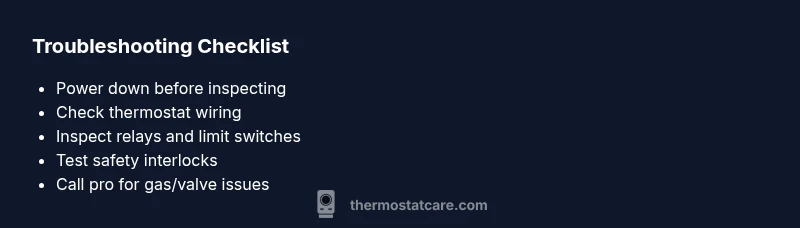
- Power down before inspection and never bypass safety interlocks
- Test thermostat wiring to rule out signals from the device
- Inspect relays and limit switches for sticking or damage
- Call a pro for gas, ignition, or control-board faults
- Maintain annual furnace maintenance to prevent recurrence