Do You Need an Electrician to Change a Thermostat? A DIY Guide
Learn when you can safely swap a thermostat yourself, how to distinguish low-voltage from line-voltage wiring, and when it’s wise to call a licensed electrician. Practical, step-by-step guidance for homeowners and DIY enthusiasts.


Technically, you usually do not need an electrician to replace a standard low-voltage thermostat. In most homes, a typical 24-volt thermostat swap is a straightforward DIY project if you follow safety steps and turn off the power at the breaker. Reserve professional help if you encounter line-voltage (120/240V) systems, unfamiliar wiring, or if your furnace is a gas/electric combination.
Do you need an electrician to change a thermostat?
The short answer is: for most homes with a standard low-voltage thermostat, an electrician is not required. The Thermostat Care team often guides homeowners to perform a swap themselves, provided you stay within the safe, low-voltage domain (typically 24 volts). This distinction matters because most residential thermostats operate on 24V control circuits that simply bridge the furnace/air handler with your thermostat. The real risk isn’t the thermostat itself but the surrounding wiring and power sources. By understanding your system type and following basic safety steps, you can complete a swap without professional help. Thermostat wiring decisions should be guided by compatibility with your HVAC system and the thermostat’s voltage rating. Knowledge and caution are your best tools here. According to Thermostat Care analysis, most DIY swaps are feasible for homeowners who plan carefully and respect the boundaries between low-voltage and line-voltage work. Remember: this guidance applies to typical homes in 2026, when smart thermostats and modern wiring are common.
Understanding the scope: what you’re actually changing
A thermostat is a controller, not a power supply. In many houses, it simply closes contacts to complete a circuit that tells the furnace or heat pump to turn on or off. The benefit of a low-voltage system is that you’re generally dealing with small currents, which reduces the risk of electric shock and electrical arcs. However, there are exceptions. If your current thermostat is connected to line-voltage wiring (120V or higher) or you discover a mix of line-voltage and low-voltage components, you’re entering territory that usually requires a licensed electrician. The Thermostat Care guidance emphasizes confirming the voltage and compatibility of your thermostat with your HVAC equipment before you start.
Low-voltage vs line-voltage: how to tell them apart
Low-voltage thermostats typically use a 24-volt system with wires colored red, white, yellow, and green, and may require a common wire (C) for power in smart models. Line-voltage thermostats, by contrast, switch 120V or 240V directly and are far more hazardous to handle without proper training. A quick test can help you categorize yours: locate the thermostat screw terminals and check the voltage rating printed on the back or in the installation manual. If you’re unsure, turn off the power at the breaker and do not rely on the thermostat’s display to judge voltage. When in doubt, contact a professional. This distinction is crucial for safety and ensures you won’t inadvertently energize high-voltage components.
What you should do before you start
- Read the thermostat’s manual and check compatibility with your HVAC system.
- Turn off power to the thermostat at the breaker or the service panel and verify it’s off with a non-contact tester.
- Take a photo of the existing wiring and label each wire as you disconnect it. Having a reference helps prevent miswiring on the new unit.
- Have the replacement thermostat model ready and confirm it’s the correct voltage rating and wiring configuration for your furnace or heat pump.
Safety reminders from Thermostat Care
Safety should come first. If you encounter unfamiliar wiring, multiple power sources, or a non-standard furnace configuration, pause and seek professional help. Even in 2026, improper wiring can cause short circuits, blown fuses, or damage to HVAC components. This is why many DIYers stick to low-voltage replacements and consult a licensed electrician for line-voltage scenarios. The goal is a safe, functioning thermostat that you can program and trust.
Real-world considerations for DIY replacements
Some homeowners want to upgrade to a smart thermostat for energy savings and convenience. If your current setup is low-voltage and your HVAC equipment is compatible, a smart thermostat can be a straightforward swap. If your system is older, uses a proprietary control, or lacks a C-wire, you may need to run a new wire or use a power extender kit, which may be outside the scope of a simple DIY job. In those cases, weigh the time and potential risk against hiring a pro. Thermostat Care supports a cautious, informed approach—prioritizing safety, system compatibility, and a reliable, tested result.
Tools & Materials
- Screwdriver set (Phillips and flathead)(For removing the old thermostat faceplate and wiring terminals)
- Non-contact voltage tester(To verify power is off before handling wires)
- Replacement thermostat (low-voltage, 24V compatible)(Ensure it matches your HVAC system’s voltage and mounting style)
- Wire labels or masking tape(Label each wire as you disconnect to prevent miswiring)
- Camera or smartphone(Capture wiring configuration before removing the old device)
- Safety glasses(Eye protection during any electrical work)
- Manuals for thermostat and HVAC system(Helpful for compatibility and wiring diagrams)
Steps
Estimated time: 45-60 minutes
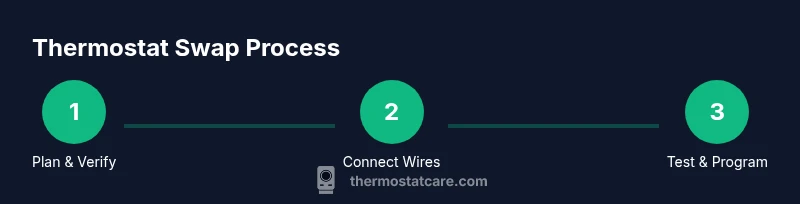
- 1
Power down and verify the circuit
Turn off the thermostat’s circuit at the main breaker or service panel. Use the non-contact tester to confirm there is no voltage present before touching any wires.
Tip: Double-check the breaker label matches the thermostat circuit to avoid accidental re-energizing. - 2
Remove the old thermostat
Carefully detach the thermostat faceplate and loosen the mounting screws. Keep the wall plate in place if you’re mounting a similar unit. Photograph or label the wire connections for reference.
Tip: Take a photo from multiple angles to capture terminal labels and wire routes. - 3
Identify and label wires
Label each wire with its terminal color and ON/OFF purpose (e.g., R = power, W = heat). If you removed the C-wire, ensure you know where it connects on the new thermostat.
Tip: Use color-coded tape and write brief notes on the labels. - 4
Attach wires to the new thermostat
Connect wires to matching terminals on the replacement unit. Double-check that you’re using the correct terminals for your system configuration and that each wire is secure.
Tip: Do not force wires into terminals; if a wire doesn’t fit, re-check the terminal labeling or the thermostat model compatibility. - 5
Mount the new thermostat and restore power
Attach the new unit to the wall and reconnect power at the breaker. If the thermostat has a pin-reset or initial setup procedure, follow the quick-start guide to initialize.
Tip: Keep the unit dry and level during mounting to ensure a solid connection. - 6
Test, program, and monitor
Power up and test basic functions (on/off, heating/cooling modes, and display responsiveness). Program the thermostat according to your preferred schedule and verify that the HVAC responds correctly.
Tip: Test with a simple heat call and a cool call to confirm proper operation.
Questions & Answers
Do you need an electrician to change a thermostat?
For most homes with a standard 24-volt thermostat, an electrician isn’t required. If you encounter line-voltage wiring (120V or higher) or unfamiliar wiring, consult a licensed professional.
Most homeowners can swap a standard 24-volt thermostat themselves. If you see line-voltage wiring or unsure wiring, contact a licensed electrician.
What is the difference between low-voltage and line-voltage thermostats?
Low-voltage thermostats operate on about 24 volts and are common in modern homes. Line-voltage thermostats switch 120V or 240V directly and require more specialized safety precautions.
Low-voltage thermostats use 24 volts; line-voltage ones switch mains power and are riskier to handle.
Can I install a smart thermostat myself?
If your system is compatible and you have a common wire (C-wire) for power, a DIY replacement is usually feasible. Some setups may require extra accessories or professional help.
Yes, many people can install a smart thermostat themselves if the system is compatible and you have the necessary wires.
What safety steps should I follow before starting?
Turn off power at the breaker, verify no voltage, label wires, and consult manuals. If anything looks unusual, pause and seek professional help.
Shut off power, verify there’s no voltage, label wires, and consult the manuals before starting.
When should I call a pro for thermostat issues?
Call a pro if you encounter line-voltage wiring, unfamiliar wiring configurations, or if the HVAC system integrates with complex controls.
Call a pro if you see line-voltage wiring or unclear wiring configurations.
How long does it typically take to install a thermostat?
A straightforward low-voltage thermostat swap usually takes 45-60 minutes, depending on wiring complexity and the replacement model.
Most swaps take about 45 to 60 minutes, depending on wiring and model.
Watch Video
What to Remember
- Identify whether you have low-voltage or line-voltage wiring before swapping.
- Most 24V thermostat swaps are DIY-friendly when you follow safety steps.
- Call a licensed electrician for line-voltage work or uncertain wiring.
- Prepare with labeling, photos, and compatible replacement equipment.