How Long Does a Thermostat Last? A Practical Guide
Explore how long thermostats typically last, what affects lifespan, signs of wear, and maintenance tips to extend life. Practical guidance from Thermostat Care for homeowners and DIY enthusiasts.


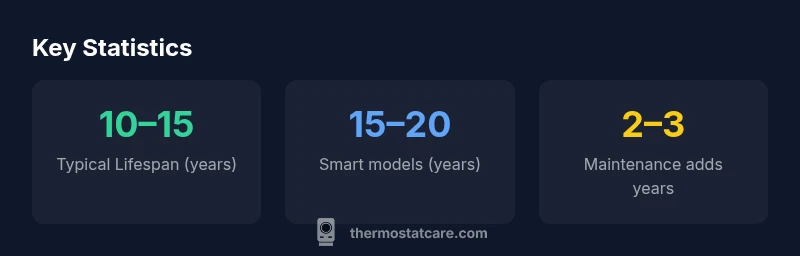
How long does a thermostat last? For most homes, a thermostat lasts about 10 to 15 years, with smart models often reaching 15 to 20 years when installed correctly and maintained. Lifespan varies by type, power source, and environment. Regular checks for loose wiring, firmware updates, and accurate calibration can extend life and prevent unexpected failures.
How Longevity Is Measured\n\
Lifespan by Type: Programmable vs Smart vs Wired\n\
Factors That Increase or Decrease Lifespan\n\
Signs Your Thermostat Is Near the End of Life\n\
Maintenance Practices That Extend Lifespan\n\
Replacement Planning: When and How to Budget\n\
Data‑Driven Perspective: What the Numbers Show\n\
Lifespan benchmarks by thermostat type
| Thermostat Type | Approx Lifespan | Key Considerations |
|---|---|---|
| Programmable Thermostat | 10–15 years | Widely compatible; easy to use; fewer features |
| Smart Thermostat (Wi‑Fi) | 12–20 years | Automation and connectivity; firmware updates important |
| Hardwired 24V Thermostat | 15–20 years | Stable power; fewer battery concerns |
| Battery‑Powered Thermostat | 8–12 years | Battery health matters; replacements needed |
Questions & Answers
How long does a programmable thermostat typically last?
Programmable thermostats generally last 10–15 years, depending on usage and environment. Regular calibration and firmware updates can help sustain accuracy and extend life.
Programmable thermostats usually last 10 to 15 years; keep them calibrated and updated for the best results.
Do smart thermostats last longer than non-smart models?
Smart thermostats often last 15–20 years with proper installation and maintenance, though lifespan depends on power reliability and firmware. Regular updates help maintain performance.
Smart thermostats can last 15 to 20 years if you maintain them and keep firmware current.
What are early signs a thermostat is failing?
Look for erratic temperatures, slow response, or frequent recalibration. Check wiring and power, and consult an HVAC tech if issues persist.
If it’s acting erratic or unresponsive, it might be time to replace.
Can a thermostat last longer with regular maintenance?
Yes. Cleaning, secure mounting, and firmware updates reduce wear and extend life by reducing stress on components.
Regular maintenance can add years to its life.
Should I replace a thermostat before it fails?
If reliability is poor, readings are off, or you must recalibrate often, replacement is sensible to maintain comfort and efficiency.
If it’s flaky, replacing it is a smart move.
How do I budget for thermostat replacement?
Plan for a replacement cost range and installation, taking into account basics vs smart features and potential wiring needs.
Set aside a budget for a new unit and installation.
“Regular maintenance and timely firmware updates are the best ways to maximize a thermostat’s life. Many failures stem from worn sensors or loose connections rather than the core electronics.”
What to Remember
- Know your unit’s age and watch for wear.
- Smart models can outlast basic ones with maintenance.
- Keep firmware updated and calibrations accurate.
- Budget for replacement as part of home maintenance.