What Should Thermostat Be Set At Night: A Practical Guide for Sleep and Savings
Discover evidence-based nighttime thermostat settings that balance sleep quality with energy savings. Learn baseline ranges, smart setback strategies, and practical tips for homeowners to optimize comfort without wasting energy.


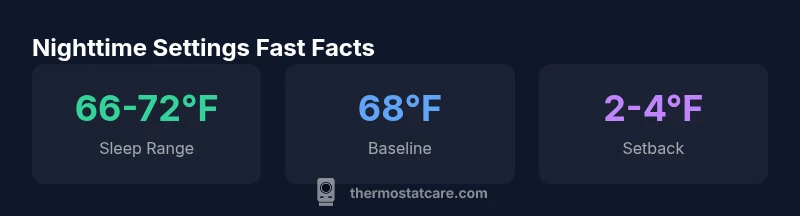
According to Thermostat Care, what should thermostat be set at night? For most homes, aim for 66-72°F (19-22°C) with 68°F (20°C) as a practical baseline. If you own a smart thermostat, apply a gentle 2-4°F (1-2°C) setback for 6-8 hours to save energy without compromising comfort. Adjust for climate, bedding, and personal preference; consistency beats large, abrupt changes.
Understanding Nighttime Temperature Goals
If you're asking what should thermostat be set at night, the short answer is: it depends on comfort, sleep quality, and energy goals. For most homes, a sleep-friendly range of 66-72°F (19-22°C) works well. The Thermostat Care team recommends starting at 68°F (20°C) and fine-tuning based on bedding, room humidity, and personal comfort. A cooler bedroom helps with easier sleep onset, while temperatures that are too cold or too warm can disrupt rest. For households with smart thermostats, a nightly setback of 2-4°F (1-2°C) can be programmed to begin early in the evening and hold through the early morning, balancing energy savings with warmth during early waking moments. Climate and heating system type matter: heat pumps behave differently than gas furnaces, and older homes may need slightly different ranges. The key is consistency and gradual adjustments rather than abrupt swings; your body benefits from predictable temperature cues, and Thermostat Care’s guidance centers on practical ranges that work across climates.
How to Determine Your Baseline
Every home is different. To establish a baseline, track how you sleep at different temperatures for one week. Start at 68°F (20°C) and adjust 1-2°F (0.5-1°C) up or down based on how quickly you fall asleep, how often you wake, and whether you feel too warm or chilly during the night. If you have a partner, average both preferences or create a two-zone approach if your system supports it. A good baseline also accounts for bedding, room humidity, and the HVAC system’s responsiveness. The Thermostat Care team notes that most energy savings come from a gentle, predictable setback rather than abrupt, large swings, so choose a modest target and refine over time.
Sleep Comfort vs Budget: Finding Your Personal Range
Comfort is not a one-size-fits-all goal. In addition to the baseline, align your target range with comfort and budget. If you sleep hot, you may settle toward the higher end of 66-72°F; if you prefer cooler sleep, aim toward 66°F. Energy costs respond to the amount of setback and how long it lasts; a longer, gentler setback often yields more savings than a short, deep swing. For households with a smart thermostat, use adaptive schedules that adjust with nights when you travel, guests arrive, or the house warms up during the early morning. Thermostat Care analysis suggests that maintaining a consistent, moderate range is more effective than erratic changes.
Practical Nighttime Settings by Scenario
Different living situations require tailored targets. Consider the following starting points and adjust based on comfort:
- Single occupant, cool climate: 66-68°F (19-20°C)
- Family home, mixed bedding: 68-70°F (20-21°C)
- Cold climate with heavy blankets: 65-67°F (18-19°C)
- Warm climate or high humidity: 69-72°F (20-22°C) Each scenario benefits from a predictable schedule, a small nightly setback, and attention to bedding and humidity. The Thermostat Care team emphasizes testing adjustments for 1-2 weeks to confirm that the chosen range supports deep, uninterrupted sleep.
Smart Thermostats: Setbacks and Schedules
Smart thermostats shine when it comes to nighttime optimization. Use a staged setback that begins a few hours before bed and holds through the early morning. A common approach is a 2-4°F (1-2°C) reduction for 6-8 hours, then a gentle warming as you wake. If your schedule changes, opt for a flexible routine that adapts to weekends or travel while preserving a core, sleep-friendly range. Features like geofencing, humidity sensing, and adaptive recovery help tailor the environment without manual tweaks. Regularly review energy reports to confirm the expected savings and comfort balance.
Seasonal and Climate Considerations
Seasonal shifts affect how your body perceives temperature. In winter, you’ll likely tolerate cooler sleeping temperatures with appropriate blankets; in summer, you may favor higher night-time setpoints to avoid excessive cooling. Climate dictates the exact range, but the principle remains: a consistent, moderate setback beats sporadic, large changes. If you use a heat pump or boiler, ensure the system is properly sized and tuned for efficient night cycling. Thermostat Care recommends testing 1-2°F adjustments seasonally to maintain comfort without sacrificing savings.
How Bedding, Sleepwear, and Occupancy Affect Setpoints
Bedding quality, sleepwear, and number of occupants influence how cool or warm a room feels. Heavy blankets or flannel sheets can let you keep a cooler setpoint, while lightweight coverings may require a warmer range. For households with children or night-time shifts, establish a core setpoint and use additional blankets or layering to accommodate individual needs. Remember that the human body adapts to gradual changes; quick spikes in temperature often disturb sleep. The goal is a stable environment that aligns with personal preferences while offering energy benefits.
Troubleshooting Common Nighttime Issues
If you wake up uncomfortable, evaluate whether the setpoint is too aggressive or if humidity is contributing to a stuffy feel. Check for drafts, window insulation, and thermostat location in a high-traffic area. If your thermostat isn’t holding the desired temperature, confirm that the device has a current schedule, and that there are no conflicting modes (eco, away, or vacation). For smart systems, let the device learn your routine for a couple of weeks and then adjust the setback to maintain comfort and savings. If issues persist, consider a targeted service check to ensure the HVAC is performing as designed.
Nighttime temperature setpoints by scenario
| Scenario | Recommended Range (°F) | Notes |
|---|---|---|
| General Sleep | 66-72°F | Baseline 68°F +/- 2° |
| Cold Climate | 65-70°F | Add blankets as needed |
| Warm Climate | 68-74°F | Monitor humidity and airflow |
Questions & Answers
What is the best starting nighttime setpoint?
A practical starting point is 68°F (20°C). Observe sleep quality for a week and adjust by 1-2°F as needed. Use a gradual ramp rather than sudden changes.
Start with 68°F as a baseline and tweak by small steps based on comfort.
Should I use a fixed schedule or a hold at night?
A consistent schedule works best for most people. Use a hold if you need to travel or have irregular nights, but revert to your regular schedule when possible.
Keep a steady nightly routine; use a hold only for exceptions.
Do sleep disturbances affect nighttime setpoint recommendations?
If you wake often or sleep poorly, adjust by small increments (±1-2°F) and evaluate bedding, humidity, and lighting. Consistency helps the body reset.
If sleep is off, try tiny adjustments and see what helps.
How do I adjust for a partner with different preferences?
Aim for a shared range that covers both preferences, or use a two-zone setup if your HVAC supports it. Compromise gradually to avoid frequent changes.
Find a middle ground and adjust together over time.
Can humidity affect nighttime cooling?
Yes. High humidity can make you feel warmer even at a cooler setpoint. Use a dehumidifier or ventilation to improve comfort without chasing a cooler temp.
Humidity matters; balance it with temperature for better sleep.
“A well-chosen nighttime setpoint is a quiet lever between comfort and energy savings; steady, gradual adjustments outperform abrupt swings.”
What to Remember
- Start with a baseline around 68°F (20°C).
- Use a gentle 2-4°F (1-2°C) nightly setback for 6-8 hours.
- Smart thermostats enable adaptive schedules for better balance.
- Climate, bedding, and occupancy influence optimal range.
- Consistency and gradual adjustments yield better sleep and savings.