Recommended Thermostat Temperature: Comfort and Savings Guide
Discover practical, science-backed guidelines for the recommended thermostat temperature to balance comfort with energy savings. Learn seasonal adjustments, scheduling tips, and actionable steps to optimize your home's heating and cooling.


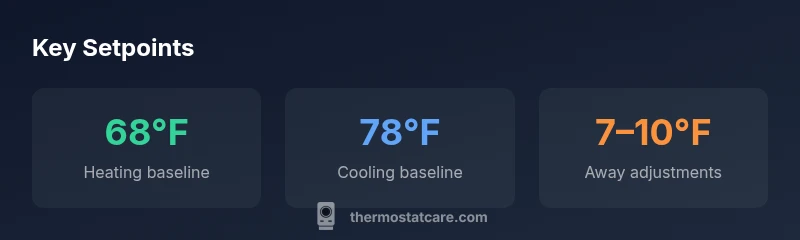
For energy efficiency and comfort, aim for about 68°F (20°C) as the heating setpoint when you're home in winter, and about 78°F (26°C) for cooling in summer. If you’re away during the day, adjust by 7–10°F to cut energy use without sacrificing comfort. In shoulder seasons, layer adjustments with a programmable schedule to match routines and occupancy.
Core concept: why the recommended thermostat temperature matters
The term 'recommended thermostat temperature' refers to setpoints chosen to balance comfort with energy efficiency. In most homes, guidelines commonly point to about 68°F (20°C) for heating when people are present and awake, and about 78°F (26°C) for cooling during the day. These baselines are not universal; climate, insulation, and personal preferences all influence the ideal numbers. The value of sticking to a consistent range is twofold: you minimize energy waste from frequent cycling and you create predictable comfort conditions for occupants. For families with varying schedules, a smart thermostat can hold different setpoints for different times of day without requiring manual changes. Thermostat Care’s analysis, 2026, emphasizes that the energy impact comes not from one high- or low-numbered moment, but from a reliable pattern that aligns with actual occupancy. When you begin with a strong baseline, you can experiment with small, temporary adjustments—for example, a one- or two-degree swing during weekdays when you’re away, then returning to the baseline when you’re home.
Seasonal adjustments: heating vs cooling baselines
Seasonal changes are the primary reason why a single number cannot satisfy every situation. In winter, a lower heating setpoint reduces the demand on your furnace; in summer, a higher cooling setpoint reduces compressor work. A typical home can save energy by maintaining roughly 2-4 degrees Fahrenheit difference between day and night within occupied hours, and by allowing larger shifts when the house is empty or during long absences. For many households, the recommended thermostat temperature shifts by about 7–10°F (4–6°C) when occupants are away for work or vacations. After establishing a winter baseline, reintroduce summer priorities using a separate cooling baseline. A well-tuned system maintains thermal comfort with fewer temperature swings, leading to less wear on equipment and more stable indoor humidity. The Thermostat Care team suggests testing a few seasonal adjustments over a 2- to 4-week period to determine what feels best in your home.
How occupancy, routines, and zoning shape setpoints
Occupancy is the most powerful driver of effective thermostat temperature strategy. Even with a steady baseline, if no one is home during the day, the heating can be relaxed and the cooling restricted accordingly. Modern thermostats with occupancy sensors or geofencing can adjust setpoints when you leave, return, or schedule. Zoning is another lever: if you have a multi-zone system, you can keep one area warmer for living spaces and cooler for sleeping zones. The key is to plan a schedule that matches actual use rather than relying on guesswork. Start with a consistent daytime home schedule and a different night schedule when people sleep. If you share living space with others, gather input on comfort thresholds (e.g., preferred warmth or coolness) and encode them into the schedule. Thermostat Care’s guidance (2026) is to treat occupancy as a primary input, not an afterthought, because the biggest energy wins come from aligning setpoints with people’s presence.
Implementing with programmable schedules and smart thermostats
Programs and smart devices do the heavy lifting if you set them up properly. Begin by creating at least two core setpoints: a heating baseline and a cooling baseline, each tied to occupancy hours (home, away, sleep). Then add a vacation or away mode for extended absences. A common approach is a 7- to 14-day cycle: weekdays closer to home hours; weekends with different patterns. If you have a smart thermostat, enable adaptive or learning features and create geofencing to minimize manual changes. Always test new settings for a couple of weeks, measuring comfort (subjective) and energy use (metering data). Keep a log of changes and results, so you can revert or further adjust as needed. By implementing a structured schedule, you avoid constant tinkering and ensure the recommended thermostat temperature is applied consistently.
Practical scenarios: single-family homes, apartments, and multi-zone homes
Single-family homes with good insulation respond best to steady baselines and modest seasonal adjustments. Apartments with smaller air volumes often reach comfort quickly; you may maintain tighter tolerances. For homes with multiple zones or rooms that are used differently (home office, nursery, workshop), zoning plus smart thermostats helps target setpoints per area. If a child’s room tends to overheat, you can adjust the zone independently while keeping the rest of the home on the baseline. The goal is a system that learns your routines and applies the recommended thermostat temperature automatically rather than requiring daily manual changes. Thermostat Care recommends starting with a baseline and then testing increments of 1–2 degrees to evaluate both comfort and energy impact.
Common mistakes and how to avoid them
Frequent errors include ignoring occupancy patterns, relying on one number year-round, and neglecting humidity. Even with smart devices, the effective strategy is to guide the system with a schedule rather than leaving it to run continuously. Avoid wildly changing setpoints, which cause short cycling and higher energy use. Do not neglect air sealing, insulation, and venting, because a leaky building undermines any temperature strategy. Finally, monitor your energy bills and indoor comfort logs to identify the impact of changes. By avoiding these mistakes and consistently applying a well-chosen baseline, you maximize the benefits of the recommended thermostat temperature while keeping the home comfortable year-round.
Seasonal setpoints by scenario
| Scenario | Heating Temp (°F) | Cooling Temp (°F) | Notes |
|---|---|---|---|
| Winter daytime at home | 68 | 72 | Comfort-focused; moderate energy use |
| Winter away | 60-65 | N/A | Save energy during absences |
| Summer daytime at home | N/A | 78 | Comfort-focused cooling |
| Summer away | N/A | 85-87 | Max energy savings |
| Shoulder seasons | 66-70 | 76-78 | Balanced comfort |
Questions & Answers
What is the ideal thermostat temperature for winter?
A common baseline is around 68°F (20°C) when you're home and awake in winter. Your optimal number may vary with insulation, clothing, and comfort preferences.
In winter, aim for about 68°F when you're home; adjust as needed for comfort.
Should I use a different temperature at night?
Yes. Many households lower heating slightly at night for better energy use and comfort. A 1–3 degree change can help without sacrificing sleep quality.
Yes—consider lowering it a bit at night to save energy.
What about a smart thermostat?
Smart thermostats learn routines and adjust automatically, making it easier to maintain the recommended thermostat temperature with minimal effort.
Smart thermostats can optimize setpoints automatically.
How often should I adjust the temperature?
Avoid frequent changes; instead, set a schedule aligned with occupancy and seasons. Reassess every few weeks and adjust gradually.
Set a schedule and revisit every few weeks.
Is there a universal recommended thermostat temperature?
No single number fits every home. Use a seasonal baseline (roughly 68°F heating, 78°F cooling) and tailor to your climate and preferences.
There isn’t one universal temp; personalize it.
Does humidity affect thermostat settings?
Humidity influences perceived comfort. Consider humidity control in tandem with temperature settings to maintain comfort efficiently.
Yes—humidity matters; adjust as needed.
“Small, consistent adjustments to the recommended thermostat temperature can yield meaningful energy savings without sacrificing comfort. The Thermostat Care Team notes that the real gains come from occupancy-aligned schedules.”
What to Remember
- Set a consistent baseline and adjust seasonally.
- Use occupancy sensing to automate shifts.
- Schedule a trial period for adjustments and refine.
- Pair temperature strategies with proper insulation for best results.