Is a Lower Temperature Thermostat Better? A Practical Guide
A balanced analysis of lower vs moderate thermostat settings, highlighting energy savings, comfort trade-offs, and practical setup tips for homeowners and DIY enthusiasts.


Is a lower temperature thermostat better? In many homes, a cooler baseline reduces energy use and helps maintain consistent comfort, but climate, insulation, and occupancy matter. The Thermostat Care team finds that meaningful gains come from gradual adjustments and solid schedules rather than aggressive cuts. A balanced approach—moderate lowering, smart programming, and good insulation—often yields the best overall results.
Is a lower temperature thermostat better? Key Question
Is a lower temperature thermostat better? For many households, this question frames energy-saving decisions, because cooler baselines can reduce heat loss and stabilize room temperatures. According to Thermostat Care, the answer is not universal: the benefits depend on climate, insulation, and how you manage schedules. The Thermostat Care team emphasizes gradual changes and monitoring results to avoid comfort shocks. In practice, a well-tuned lower baseline works best when paired with proper weatherization and a clear programming strategy. This nuanced view respects daily life needs—sleep, work, and activity patterns—while pursuing energy efficiency. The goal is to achieve a reliable balance where savings don’t come at the expense of comfort. By focusing on long-term behavior changes and better thermostat control, homeowners can often realize improvements without sacrificing livability. This section introduces the core trade-offs and sets up a framework for evaluating your home’s unique conditions.
Energy savings vs comfort: a practical balance
Energy savings from lowering temperature settings typically come from reducing heating demand during unoccupied hours or overnight. However, the actual impact depends on how well the home is sealed, how efficiently the HVAC system operates, and how people use space. The Thermostat Care analysis shows that small, staged reductions—coupled with predictable schedules—tend to outperform large, sudden drops that trigger user overrides. Comfort remains a finite resource; if the space becomes uncomfortably cold, occupants may raise the thermostat more often, negating savings. A calibrated approach, using programmable features and adaptive scheduling, helps sustain savings while maintaining acceptable comfort. This section explains how occupancy, insulation quality, and climate interact to shape the optimal baseline setting for your home.
Climate, insulation, and occupancy: shaping the decision
Your climate and insulation levels largely determine whether a lower baseline makes sense. In milder climates with good insulation, a lower baseline can yield noticeable energy savings with minimal discomfort. In harsher climates, the risk of cold spots or uneven heating increases unless you compensate with better weather sealing and zoning. Occupancy patterns also matter: homes with long work days or frequent absences benefit more from lowered settings during unoccupied periods. The takeaway is that there isn’t a universal rule; your decision should reflect how your house loses heat, how well it retains warmth, and when people are in spaces. Thermostat behavior, such as smart scheduling and learning capabilities, can help adapt the baseline to changing conditions without constant manual tweaks.
Room-by-room implications: where lower baselines matter
Different rooms behave differently under a lower baseline. Living areas with good sunlight and thermal mass may stay comfortable at modest reductions, while bedrooms with cooler drafts can tolerate lower temps more readily. Kitchens and bathrooms, where moisture and humidity interact with heating, require careful calibration to avoid dampness or overheating when doors are opened or closed. If a family member has specific comfort needs, such as light sleepers or young children, a targeted approach—lowering temperatures at night but keeping daytime temperatures modestly higher—can improve satisfaction. The practical message is to avoid a one-size-fits-all strategy; instead, implement zone-based settings or smart schedules that accommodate the characteristics of each space.
The role of smart thermostats in lowering baselines
Smart thermostats elevate the effectiveness of a lower baseline by learning routines, predicting occupancy, and adjusting settings automatically. In practice, a smart system can lower temperatures gradually during the night and pre-warm spaces before occupants return, reducing the risk of discomfort. Connectivity with humidity sensors and weather data helps prevent humidity buildup when heating is reduced for long periods. For DIY homeowners, starting with a simple schedule and then enabling adaptive recovery features can yield tangible benefits. The Thermostat Care team notes that the right combination of sensors, zoning, and remote control is crucial for reliable savings without sacrificing convenience.
Practical steps to implement a lower baseline safely
Begin with a home energy audit to identify heat losses and insulation gaps. Close the loops by sealing leaks around doors, windows, and outlets, then choose a moderate baseline that aligns with your climate and daily routine. Program gradual reductions, such as lowering during nighttime and extended absences, then monitor comfort and energy usage for two to three weeks before adjusting further. Use a programmable thermostat or a smart model to enforce schedules and ensure the system recovers quickly when you re-enter a space. If you have a multi-zone system, consider assigning a lower baseline to unoccupied zones to maximize efficiency without sacrificing comfort in the main living areas. This approach reduces the likelihood of overcooling or overheating and makes it easier to maintain consistent conditions across your home.
Common myths about low-temperature settings
A frequent misconception is that lower settings always deliver bigger savings. In reality, the reality is more nuanced: savings depend on insulation quality, heating system efficiency, and how consistently you use the space. Another myth is that sleeping at a cooler temperature is always better; while many people sleep more soundly in cooler bedrooms, extreme drops can disrupt sleep for some. Some assume that smart thermostats automatically solve all comfort issues; they help, but only when paired with good zoning, ventilation, and user behavior. By debunking these myths, homeowners can make more informed decisions and avoid unnecessary changes that offer little value.
Measuring impact: energy use, humidity, and sleep quality
Tracking the effects of a lower baseline requires a simple measurement plan. Record monthly energy consumption, note any shifts in indoor humidity, and keep a short diary of comfort levels and sleep quality. A successful approach balances energy savings with occupant satisfaction. If humidity rises in damp spaces, you may need dehumidification, improved ventilation, or targeted temperature adjustments in affected rooms. Thermostat settings should be paired with air sealing, insulation improvements, and proper HVAC maintenance to maximize long-term benefits. This section highlights practical methods for evaluating success beyond a single metric.
When not to lower too far: safety and comfort considerations
There are circumstances where lowering temperatures too aggressively can backfire. In homes with poor insulation, a dramatic reduction can lead to cold spots and higher thermostat resets. In households with vulnerable occupants or pets, comfort and safety may take precedence over marginal energy savings. Weather fluctuations and equipment limitations should also guide decisions; if your heating system takes too long to recover, you risk discomfort during peak usage times. Always implement changes gradually and reassess regularly to avoid unintended consequences.
A framework for deciding: your home, your baseline
To decide whether a lower baseline is right for you, start with a simple framework: evaluate climate and insulation, review occupancy patterns, and consider health and comfort priorities. Build a tiered plan: (1) set a conservative reduction for unoccupied periods, (2) test a moderate drop during sleep, and (3) adjust based on two to four weeks of feedback. Use zone controls or smart scheduling to refine the approach, and document outcomes to guide future decisions. The result is a tailored baseline that respects both energy goals and daily life needs, with built-in flexibility to respond to weather and occupancy shifts.
Comparison
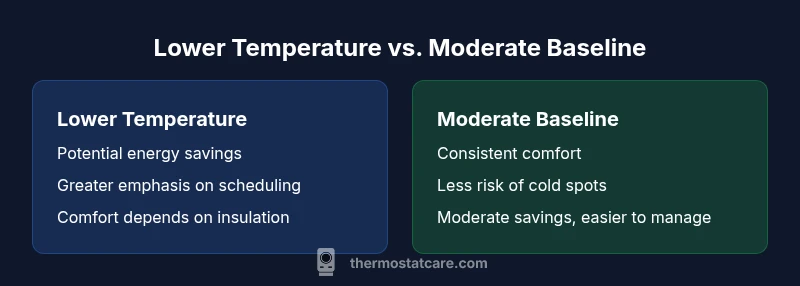
| Feature | Lower Temperature Baseline | Moderate Baseline |
|---|---|---|
| Energy Savings Potential | High (climate dependent) | Moderate |
| Comfort Consistency | Variable; may improve in drafts but risk in extreme nights | Generally stable comfort with less risk of cold spots |
| Control & Scheduling | Requires careful scheduling; benefits from automation | Easier with standard schedules and adaptive features |
| Impact on Sleep | Can improve sleep in very warm rooms; too cool can disrupt some sleepers | Typically neutral to positive for most sleepers when well-balanced |
| System Compatibility | Broadly compatible; depends on sealing and zoning | Broadly compatible; benefits from multi-zone or smart features |
| Best For | Energy-conscious homes in cooler or well-insulated climates | Homes prioritizing steady comfort with minimal management |
Upsides
- Potential energy savings with climate-appropriate baselines
- Improved nighttime thermal consistency in well-insulated homes
- Better alignment with programmable or smart schedules
- Supports longer HVAC life when paired with good maintenance
The Bad
- Comfort risk if the space is not well-insulated
- Possible cold spots in poorly sealed homes
- Requires meticulous scheduling or zoning to maximize gains
- Not universally better in very cold climates without adjustments
Lower baseline settings are usually better for energy savings when the home is well-insulated and occupancy is predictable.
A moderated, well-scheduled lower baseline often yields the best overall results, balancing energy savings with comfort. In very cold climates or poorly sealed homes, a moderate or staged approach may be preferable to avoid comfort penalties.
Questions & Answers
Is a lower temperature thermostat better for energy savings?
Often yes, particularly when you carefully schedule reductions during unoccupied times. The actual savings depend on insulation, climate, and usage patterns. Start small and monitor results over a few weeks.
Yes, lower temps can save energy, especially when you schedule reductions during unoccupied periods. Start small and monitor results.
What is a comfortable lower temperature range?
Comfort varies by person and space; aim for a modest reduction while keeping rooms comfortable. Use gradual adjustments and check in with sleepers and activity levels to avoid discomfort.
Comfort varies; aim for a modest reduction and adjust gradually based on how people feel.
Can lowering temps affect humidity?
Lower temperatures can influence indoor humidity, often reducing moisture rise in heated air but potentially concentrating humidity if poorly ventilated. Ensure adequate ventilation and consider supplemental dehumidification if needed.
Lower temps can change humidity; ensure ventilation and monitor moisture.
What are common mistakes when lowering temps?
Over-lowering without insulation upgrades, ignoring occupancy patterns, and not using scheduling features can erode savings and comfort. Start with small changes and rely on automation to maintain consistency.
Don’t over-lower without insulation, and use scheduling to stay consistent.
Should I use a smart thermostat for lower temps?
Smart thermostats help by learning routines and automating reductions. They’re most effective when paired with zoning and good insulation. Start with a basic schedule and then enable adaptive features.
Smart thermostats help automate reductions and improve consistency.
How do I decide between lower and moderate baselines?
Evaluate climate, insulation, occupancy, and comfort priorities. A phased approach with testing and measurement typically yields the best result.
Consider climate, insulation, and daily use; test in steps to find your best baseline.
What to Remember
- Assess climate and insulation before lowering temps
- Use staged reductions with smart scheduling
- Leverage zoning to target unoccupied spaces
- Monitor energy, humidity, and comfort after changes
- A balanced approach often beats extremes in most homes