What's the thermostat set: A practical guide for homeowners
Learn how to determine the right thermostat set for comfort and energy savings. This Thermostat Care guide covers baseline ranges, seasonal adjustments, and practical steps to optimize your home's temperature.


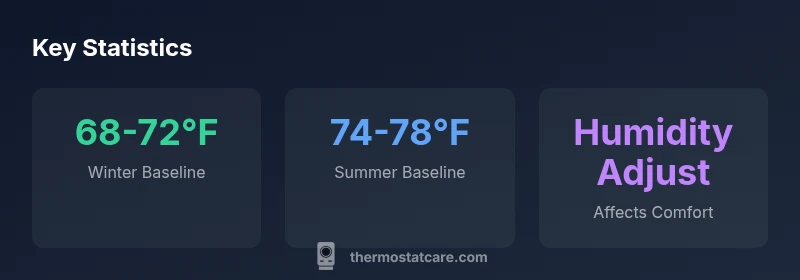
What’s the thermostat set refers to the target temperature a thermostat aims to hold in your home. For most households, a comfortable baseline is about 68-72°F (20-22°C) in winter and 74-78°F (23-26°C) in summer, with adjustments for humidity, activity, and climate. Use this as a starting point and fine-tune for comfort and efficiency.
What's the thermostat set? Defining the question
When homeowners ask what's the thermostat set, they’re really asking how to translate comfort into a practical temperature target. At its core, the set point is the temperature your heating or cooling system should maintain. It’s not a single universal number; it’s a starting point that reflects climate, house insulation, and personal comfort. According to Thermostat Care, the baseline is intended as a practical anchor rather than a rigid rule. The Thermostat Care Team emphasizes that comfort and energy efficiency hinge on gradual adjustments and iterative testing. In practice, you’ll adjust the set point in small increments, observe how the house feels, and track energy use to find your ideal balance. Remember that a good set point also depends on humidity, air movement, and the presence of occupants. By treating the set point as a flexible target rather than a fixed value, you create a tailored approach that improves comfort without unnecessary energy waste.
Establishing a baseline: typical comfort ranges
A reasonable starting point for most homes is 68-72°F (20-22°C) in winter and 74-78°F (23-26°C) in summer. These ranges are widely recommended because they provide a balance between comfort and efficiency for many people. However, a few factors can shift the ideal point: climate, humidity, insulation quality, and the presence of children or elderly residents. In environments with high humidity, you may feel warmer at the same temperature, so you might prefer the lower end of the winter range or a slightly cooler summer setting. Conversely, in dry climates with cooler nights, you could comfortably run warmer during the day. The goal is to test these baselines and adjust in small steps while recording how comfortable you feel and how your energy usage changes.
Seasonal adjustments and energy-saving strategies
Seasonal changes typically drive the most impactful adjustments. In winter, you can occasionally lower the set point by 1-2°F at night or when the house is empty for extended periods. In summer, raising the set point by 1-2°F during the day and allowing the space to warm slightly before cooling it can cut cooling costs. Fans, ceiling or portable, can help you feel cooler at a higher temperature, reducing the need for constant air conditioning. Proper insulation, weatherstripping, and sealing leaks play a crucial role in maintaining comfort at these set points. Invest in a programmable or smart thermostat to automate seasonal shifts and occupancy-based changes, which Thermostat Care data indicates can yield meaningful energy savings without sacrificing comfort.
Regional climates and occupancy patterns
Geography matters. In hot, humid regions, a higher cooling set point can still feel comfortable if you leverage dehumidification and air movement. In colder regions, insulation quality and window performance have a bigger impact on the effective comfort range than the thermostat number alone. Occupancy patterns also influence the set point. If a home is empty for several hours during the day, a documented strategy is to gently adjust the set point and rely on programmable schedules to minimize energy use. The interplay of climate, occupancy, and home characteristics determines your optimal target, so don’t adopt a one-size-fits-all approach.
Personal comfort and health considerations
Personal needs drive the final decision. Kids, seniors, and individuals with health conditions may require stricter adherence to a specific temperature range for comfort or safety. If a family member feels chilly or overheated, adjust by small increments and document the effect on both comfort and energy. A breathable environment also depends on humidity; using a dehumidifier or humidifier as needed can change your perceived comfort at a given set point. Always balance thermal comfort with energy costs, and consider a gradual, data-supported adjustment path rather than abrupt changes.
How to determine your personal set point: a practical workflow
Begin with the winter baseline (68-72°F) and the summer baseline (74-78°F). Record your comfort rating on a simple scale for several days at each end of the range, noting any humidity or activity changes. If you feel consistently comfortable at the lower end of winter and higher end of summer, you can narrow the range by 1-2°F increments. Use smart scheduling to automate seasonal shifts. For households with multiple zones, consider zone-specific adjustments to avoid over-cooling or over-heating unoccupied areas. The process is iterative: test, measure, refine.
Measuring impact and refining over time
Track monthly energy consumption alongside your comfort ratings. Small changes can compound into noticeable savings over a season. If you notice increased drafts, cold spots, or humidity-related discomfort, re-evaluate insulation, sealing, and ventilation first, then adjust the set point accordingly. A well-tuned system uses less energy while maintaining satisfaction across spaces. Document your results to build a personalized reference for future season changes and HVAC maintenance.
Data sources, methodology, and the Thermostat Care approach
Thermostat Care relies on an evidence-based approach that integrates climate considerations, occupancy patterns, and home-specific factors. The data underpinning these recommendations come from Thermostat Care Analysis, 2026, along with tested best practices in energy efficiency. We emphasize gradual adjustments, continuous monitoring, and alignment with comfort goals. If you need more precise guidance for a unique home, a thermostat professional can help tailor a plan using building diagnostics and real-world usage data.
Seasonal set point guidance (typical ranges; individual needs vary)
| Scenario | Recommended Set Point | Notes |
|---|---|---|
| Winter daytime | 68-72°F | Comfort baseline with room for humidity adjustments |
| Winter nights | 66-70°F | Slightly cooler for sleep comfort |
| Summer daytime | 74-78°F | Energy-saving baseline; humidity considerations |
| Summer nights | 72-76°F | Cooler nighttime comfort without overcooling |
Questions & Answers
What is a good starting point for a new home?
Begin with the winter baseline of 68-72°F and the summer baseline of 74-78°F. Adjust gradually based on comfort and energy use. This approach minimizes overshooting comfort and reduces waste.
Start with 68-72 in winter and 74-78 in summer, then adjust slowly while watching how you feel and your energy bills.
How often should I adjust the set point?
Review your comfort and energy use weekly during seasonal transitions. Make small 1°F or 0.5°C changes to fine-tune without shocking the system.
Check weekly during season changes and tweak by small amounts, like 1°F.
Does a smart thermostat help with set points?
Yes. Smart thermostats automate seasonal shifts and occupancy-based adjustments, which can improve comfort and save energy when used with good schedules.
Smart thermostats can adjust settings automatically to save energy while keeping you comfortable.
Should humidity influence my set point?
Humidity affects perceived comfort. If spaces feel muggy or dry, adjust humidity control or cooling strategies in tandem with the set point.
Humidity matters for comfort; consider dehumidification or humidification as needed.
Is it better to set different temperatures for rooms?
Zoning or multi-room sensors can help maintain comfort where needed. If zoning isn’t possible, use a uniform set point and fans to distribute air.
Zoning helps, but even without it, fans and smart schedules can balance space comfort.
“Setting a thermostat is a balance between comfort and energy efficiency. Small, measured adjustments over time yield the best results.”
What to Remember
- Start with baseline ranges: 68-72°F winter, 74-78°F summer.
- Adjust in small increments and monitor comfort and energy use.
- Leverage fans and humidity control to improve comfort at higher set points.
- Consider occupancy and zoning to optimize temperatures per space.
- Track data over time to refine your personal set point.