Thermostat vs Coolant Temperature Sensor: A Practical Look
A clear comparison of a home thermostat and a coolant temperature sensor. This Thermostat Care guide explains how each device works, signs of failure, testing tips, and replacement considerations for homeowners and DIYers.


Thermostats and coolant temperature sensors serve different jobs: a home thermostat regulates indoor climate, while a coolant temperature sensor monitors engine temperature for vehicle control. In this comparison, we explain how each device functions, typical failure signs, safe testing approaches, and replacement considerations to help homeowners and DIYers avoid misdiagnosis.
Key distinctions: thermostat vs coolant temperature sensor
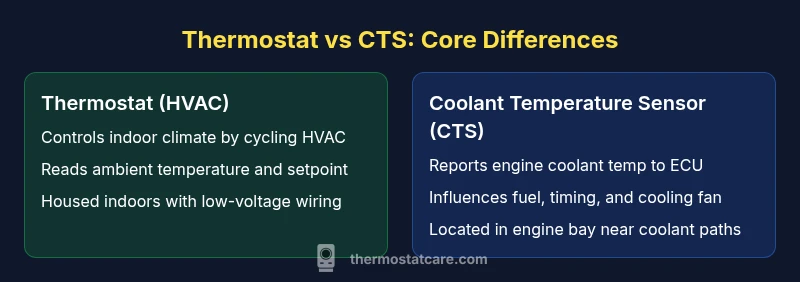
According to Thermostat Care, homeowners often face the phrase thermostat vs coolant temperature sensor in discussions that blend home comfort with automotive maintenance. The two devices share a basic idea—temperature sensing and control—but they operate in radically different environments. A home thermostat is part of an HVAC control loop. It reads ambient air temperature, compares it to a user-setpoint, and signals the furnace or air conditioner to turn on or off to bring the space into range. A coolant temperature sensor (CTS), by contrast, lives inside an automobile engine. It reports the engine coolant’s temperature to the vehicle's engine control unit (ECU), influencing fuel delivery, ignition timing, and cooling fan behavior. The thermostat used in most cars regulates coolant flow, while the CTS informs the ECU about current engine temperature. Both pieces contribute to system efficiency and longevity, but their domains and failure modes are distinct. This is why clear context matters: diagnosing a HVAC issue is not the same as diagnosing an engine temperature problem. The Thermostat Care approach emphasizes distinguishing the system at hand, then applying methodical testing so you aren’t chasing the wrong root cause.
How sensing and control differ in practice
Both devices rely on temperature data, but they translate that data into action in very different ways. A home thermostat typically employs a temperature sensor (often a thermistor) to gauge room conditions and then use a switch or electronic relay to start or stop the heat pump, furnace, or air conditioner. Some modern thermostats also implement learning algorithms and energy-saving modes that anticipate occupancy and weather patterns. The CTS, on the other hand, is usually an NTC (negative temperature coefficient) device that changes resistance (or a voltage signal) as the coolant warms or cools. The ECU interprets this signal to adjust fuel injection timing, idle speed, and cooling fan activity. In short, the thermostat is a loop controller for dwell-time in a building, while CTS is a sensor input feeding an engine management loop. Understanding these core roles helps prevent cross-domain confusion when troubleshooting symptoms like erratic indoor temperatures or temperature-related engine concerns.
Locations, installation, and compatibility considerations
A home thermostat is mounted on an interior wall or integrated into a smart-home hub, connected to the HVAC system through low-voltage wiring. It may rely on ambient sensors, humidity readings, and internal batteries or power via a C-wire. By contrast, a CTS sits in the engine bay, attached to the cooling system or near the thermostat housing. It typically wires back to the vehicle’s ECU via specialized automotive connectors and is designed to endure high heat, vibration, and automotive fluids. Compatibility matters: HVAC thermostats must match your furnace or heat pump, while CTS replacements must be compatible with your vehicle’s make, model, and year. The hardware differences mean that home and car diagnostics require distinct tools, safety precautions, and service environments. Treat them as separate subsystems even if the terminology overlaps in casual conversations.
Failure modes and symptoms: HVAC vs automotive indicators
HVAC thermostats commonly fail by sticking, drifting, or losing calibration. Symptoms include slow or no heating, rooms that don’t reach setpoints, temperature swings, or an entire system cycling too frequently. Battery issues in non‑powered smart thermostats can also mimic a broader control failure. CTS failures often manifest as inaccurate coolant temperature readings, engine overheating, extended warm-up times, or a check engine light. Inconsistent gauge readings or abnormal fan behavior can also point to CTS problems. Remember that a symptom in one domain (household comfort) is not a proven sign of a CTS problem, and vice versa. Accurate diagnosis hinges on confirming which subsystem is actually affected and avoiding the temptation to treat the symptom as if it were the other device.
Testing and diagnostics: safe, practical steps for DIYers
Testing a home thermostat often begins with basic checks: ensure power supply, verify batteries in non‑powered units, inspect wiring for corrosion or disconnections, and confirm that the thermostat is communicating with the HVAC system (e.g., light indicators, beeps, or on-screen statuses). Calibrate or reprogram according to the manual, and consider professional calibration if readings remain inconsistent. Automotive CTS testing requires specific tools and safety protocols. Do not attempt live engine testing without proper equipment and training. Start with noninvasive diagnostics: scan for OBD-II codes, inspect for obvious wiring wear, and check temperature readings against vehicle operating data with a service manual or manufacturer guidelines. When in doubt, involve a qualified technician to avoid potential risks to the engine or electrical system.
Impact on performance and energy decisions: what matters most
The thermostat primarily affects energy use and comfort. A well‑calibrated HVAC thermostat can deliver consistent temperatures and lower energy bills, while a faulty thermostat can cause oversized heating or cooling cycles, leading to wasted energy. The CTS affects engine efficiency, reliability, and emissions controls. A failing CTS can contribute to poorer fuel economy, improper fuel-air mixture, or engine overheating, which can be costly to repair. In both cases, timely diagnosis and replacement when needed preserve system longevity and prevent cascading issues. The key is recognizing that thermostat vs coolant temperature sensor issues belong to different ecosystems, requiring domain-specific remedies and professionals when necessary.
Maintenance and replacement considerations: planning ahead
HVAC thermostats benefit from periodic checks of wiring connections, sensor accuracy, and software updates for smart devices. Replacement often involves selecting a compatible model for your furnace or heat pump and ensuring proper wiring and mounting. CTS replacement is typically more involved due to engine design, vehicle age, and compatibility with the ECU. If you’re working on a modern vehicle with an adaptive ECU, the sensor calibration and replacement may require dealer or specialist tools. Routine maintenance like checking for corrosion on connectors, replacing aged wiring, and following manufacturer guidance minimizes the risk of CTS or thermostat failure. Always consider the total cost of ownership, including labor, when deciding between a DIY approach and professional service.
Practical decision framework: when to fix, replace, or upgrade
To decide between repair or replacement, start by confirming the device’s role in your system and the severity of symptoms. For HVAC thermostats, prioritize replacements that preserve compatibility with your furnace and energy goals. For CTS-related concerns, focus on engine reliability and the potential impact on fuel economy and emissions. If you’re unsure, consult the service manuals or seek a professional assessment. The guiding principle is to treat each device within its own ecosystem, and avoid cross-applying diagnostic logic across home and vehicle systems. This disciplined approach saves time and reduces the risk of incorrect repairs.
Comparison
| Feature | Thermostat (HVAC control) | Coolant Temperature Sensor (CTS) |
|---|---|---|
| Primary role | Regulates indoor climate by controlling HVAC cycles | Monitors engine coolant temperature to inform engine management |
| Installation environment | Residential, indoor wall-mounted device | Vehicle engine bay connected to ECU |
| Data output / signal type | Aggregates ambient temperature; may drive setpoint logic | NTC thermistor or voltage signal to ECU |
| Common failure indicators | Inaccurate readings, sticking or drifting, uneven heating | Incorrect readings causing overheating or misfueling |
| Maintenance needs | Battery checks, calibration, mounting stability | ECU diagnostics via OBD, sensor testing |
| Replacement considerations | HVAC technician/DIY replacement; panel replacements possible | Automotive part replacement; often requires professional service |
| Best for | Home comfort and energy savings | Vehicle reliability and engine protection |
Upsides
- Clarifies how different temperature sensors work in separate domains
- Helps prevent misdiagnosis when diagnosing HVAC vs automotive issues
- Encourages methodical troubleshooting and safe handling
- Supports better replacement decisions and maintenance planning
- Promotes context-aware fixes rather than guesswork
The Bad
- Can overwhelm readers with automotive concepts
- Not all aspects are directly comparable; risk of over-analogizing
- Requires separate expertise for accurate automotive diagnostics
Context matters: HVAC thermostats drive home comfort, CTS governs engine temperature; neither is universally better.
Choose a thermostat for indoor climate control and energy savings, and a CTS for engine protection and reliable performance. The Thermostat Care team notes that understanding the system domain helps prevent misdiagnosis and costly mistakes.
Questions & Answers
What is the main difference between a thermostat and a coolant temperature sensor?
A home thermostat controls HVAC cycles by reading ambient temperature and comparing it to a setpoint, while a CTS reports engine coolant temperature to the ECU to manage fuel delivery, timing, and cooling. They operate in different systems and are not interchangeable.
The thermostat controls home climate, and the CTS informs engine management; they serve different systems.
Where is each sensor located?
The home thermostat is mounted on an interior wall and wired to the HVAC system. The CTS sits in the engine bay, near coolant lines or the thermostat housing, connected to the vehicle's ECU.
House thermostat on interior wall; CTS in the engine bay connected to the ECU.
Can a faulty thermostat affect CTS readings?
Not directly; they operate in separate systems. However, misdiagnosis can occur if you assume automotive symptoms are HVAC-related or vice versa.
They don’t directly affect each other, but misdiagnosis can happen if you mix up the symptoms.
What are common symptoms of a failing thermostat in HVAC?
Common signs include slow heating or cooling, temperature swings, or a furnace running continuously. Some units may show an indoor temperature that won’t reach the setpoint.
Look for cold drafts, hot rooms, or cycling that won’t stop.
What are common CTS failure symptoms in vehicles?
Symptoms include erratic gauge readings, poor temperature regulation, longer warm-up times, or engine overheating warnings. A check engine light may also appear in some cars.
Engine readings can go hot or cold unexpectedly; the check engine light may come on.
Is it safe to test a thermostat or CTS at home?
Testing a home thermostat is generally safe when you power down and follow the manufacturer’s instructions. Automotive CTS testing should be left to professionals or done with proper tools and manuals.
Power down HVAC devices before testing; automotive work is best left to pros.
How should I approach replacements?
Replace a thermostat with a model compatible with your system, and replace CTS with the correct part for your vehicle. When unsure, consult manuals or a professional.
Match parts to your system and vehicle; seek professional help if unsure.
Where can I find reputable guides on thermostat vs CTS?
Look for manufacturer manuals and trusted sources from Thermostat Care and official educational publications. Cross-reference automotive service manuals for CTS-related guidance.
Start with official manuals and trusted guides for both HVAC and automotive topics.
What to Remember
- Define the system you’re diagnosing first
- Differentiate HVAC control from engine sensing
- Check manufacturer manuals for testing guidance
- Use professional help for automotive CTS issues
- Avoid cross-applying diagnostics between home and vehicle systems