Thermostat and Temperature Sensor: A Clear Comparison
Explore a thorough, analytical comparison of a thermostat and temperature sensor options, including integrated built-ins vs. separate sensors, to optimize home comfort, energy use, and setup.


For most homes, a thermostat with a built-in temperature sensor offers simpler setup and reliable control, while separate sensors provide room-by-room coverage and redundancy. The integrated option is typically best for single-zone comfort and straightforward maintenance, whereas a multi-zone household benefits from adding discrete sensors. In short: choose integrated when you want ease and consistency; choose separate sensors for flexibility and precision.
What are the thermostat and temperature sensor, and how do they work together?
A thermostat and temperature sensor form the backbone of modern home climate control. The thermostat is the decision-maker: it interprets the sensor data, compares it to your target setpoint, and sends commands to the HVAC system. The temperature sensor provides the actual current temperature reading, which can be built into the thermostat or placed in a separate location. When the two work in concert, the system can maintain a comfortable environment with minimal energy use. In many setups, the thermostat and temperature sensor communicate via wireless or wired connections, ensuring updates to readings can trigger timely adjustments. This pairing is especially critical in homes with variable occupancy, sun exposure, or multiple zones where readings at one point in the house may not reflect the entire space. According to Thermostat Care, choosing the right arrangement depends on layout, goals, and how you use rooms day-to-day. A thoughtful configuration reduces temperature swings and helps HVAC components run more efficiently over time.
Integrated vs. separate: core concepts and what to expect
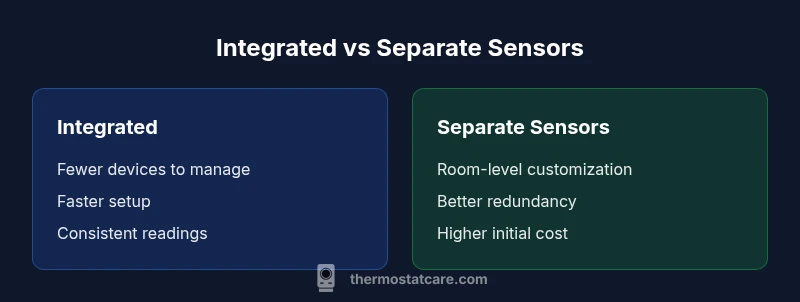
There are two primary architectural choices: an integrated thermostat with a built-in temperature sensor, and a thermostat paired with one or more separate temperature sensors. An integrated unit places the sensing element inside the same device that controls the HVAC, which simplifies installation, reduces the number of devices, and streamlines software updates. A system with separate sensors, meanwhile, distributes sensing across rooms and zones. This can improve comfort in multi-room homes and reduce the impact of a single hotspot (like a sunny living room) on overall climate control. The decision often comes down to how many rooms you want to monitor, how precise you need readings to be, and whether you value simple setup over granular control. In both cases, accuracy hinges on proper placement and the right balance between sensing locations and control logic.
How placement affects performance: a practical guide
Where you place sensors matters just as much as the hardware you choose. For an integrated setup, place the thermostat where you spend the most time or near central airflow so readings reflect typical conditions. For separate sensors, aim to distribute one sensor per major zone or frequently occupied room to capture variations in sunlight, occupancy, and heat transfer. Avoid placing sensors directly next to heat sources such as ovens, radiators, or drafts from doors and windows. The goal is to minimize lag between a real temperature change and the system’s response, which leads to steadier comfort and fewer temperature swings. Thermostat Care emphasizes the importance of a balanced layout that represents how space is actually used, rather than how the house is laid out on paper.
Energy efficiency and cost considerations at a glance
Energy efficiency depends on how accurately the system reads and responds to changes in temperature. An integrated thermostat typically provides a cost-effective, streamlined option with fewer devices to maintain and fewer potential misreadings due to mismatched sensors. Separate sensors can be worth the extra upfront cost when you have a large home with diverse occupancy patterns or you want to optimize cooling and heating in specific zones. In many cases, the incremental cost of additional sensors is offset by better comfort and targeted energy savings. Thermostat Care highlights that the long-term value hinges on smart scheduling, occupancy patterns, and how well you leverage data from either configuration.
Installation paths: turnkey vs modular approaches
Turnkey installations focus on one device that does most of the work, which minimizes wiring and simplifies setup. Modular approaches use multiple sensors that you position around the home and pair with a central controller. The turnkey route is often quicker and less complex for single rooms or straightforward layouts. The modular path shines in larger homes with diverse zones and a need for high-precision readings in living spaces, bedrooms, and home offices. Regardless of approach, follow clean wiring practices where applicable, label each sensor, and ensure your hub or thermostat supports the number and type of sensors you plan to deploy. A well-planned installation reduces post-install tweaks and yields better long-term performance.
Multi-zone homes: when separate sensors provide clear benefits
If your home has distinct living zones or uses multiple rooms with different occupancy patterns, separate sensors can significantly improve comfort. Each zone can be tuned to its own setpoint or schedule without sacrificing overall system efficiency. For example, bedrooms may favor cooler temperatures at night, while living areas may stay a bit warmer during the day. With a modular sensor setup, you gain redundancy and tissue-level control: if one sensor fails or is temporarily blocked, others continue to provide data that keeps the system operating smoothly. Thermostat Care’s guidance is to map zones first, then decide whether a single sensing point is enough or if multiple sensors are warranted for precise zoning.
Data integrity, connectivity, and privacy implications
Both configurations rely on stable data flow between sensors and the thermostat or hub. Wireless connections add flexibility but require reliable network coverage and secure pairing to prevent interference or unauthorized access. A wired setup can be more robust but demands careful routing. In either case, keep firmware up to date and monitor sensor health indicators from the app. Privacy considerations modernize as devices collect more environmental data; review your vendor’s data policies and choose options that offer local processing or transparent cloud handling. Thermostat Care advises balancing convenience with privacy, especially in shared or rental spaces where device access may be broader than in a private residence.
Real-world scenarios: choosing based on home layout and goals
Consider the following situations as you evaluate options. A small apartment with a single living area and a consistent routine may benefit most from an integrated thermostat, delivering reliable climate control with minimal setup. A multi-bedroom house with sun-exposed living spaces and busy mornings likely gains from one or more dedicated room sensors to maintain comfort where it matters most. A retrofit project in an older home may favor modular sensors because you can adapt gradually, replacing or relocating sensors as you evaluate performance. In all cases, plan for energy savings by combining a thoughtful sensor layout with adaptive schedules and smart features such as occupancy sensing and weather-based adjustments.
Compatibility and future-proofing: plan for growth
Technology evolves quickly, and thermostat ecosystems are increasingly compatible with voice assistants, smart home platforms, and energy-management services. When evaluating options, check compatibility with your existing HVAC equipment, the availability of future sensor expansions, and the ability to add new features like geofencing, adaptive recovery, or energy dashboards. An integrated thermostat may offer tighter integration with future firmware enhancements, while a modular system could give you flexibility to swap sensors without replacing the entire device. Thermostat Care recommends choosing a path that aligns with your anticipated needs over the next five to ten years, rather than making a purely short-term decision.
Shopping checklist: questions to guide your decision
- Do you operate a single-zone or multi-zone home, and how important is room-level control?
- Is installation time a priority, or do you prefer incremental expansion over time?
- How critical is data privacy and network reliability for your household?
- What is your budget for hardware and ongoing maintenance?
- Do you need compatibility with existing smart home ecosystems?
- How comfortable are you with potential repositioning in the future?
Answering these questions helps you decide between an integrated thermostat with a built-in sensor and a modular setup with separate sensors. The choice is not merely a price decision—it’s about how you live in your home and how you want it to respond to your routine.
Quick-start guide for homeowners ready to upgrade
- Map your space: identify zones and high-usage rooms.
- Decide on the level of control you want in each area (single setpoint vs. zone-based control).
- Check compatibility with your HVAC system and existing smart home devices.
- Choose a configuration: one device with built-in sensors or multiple room sensors.
- Plan sensor placement and wiring (if applicable) to maximize coverage.
- Install and configure the thermostat and sensors, then run a test cycle and adjust schedules for comfort and efficiency.
- Monitor performance over a few weeks and refine as needed.
A pragmatic takeaway: match the solution to your home and habits
The best choice balances ease of use with the level of control you want. Start with a conservative configuration and scale up if you notice gaps in coverage or comfort. Keep in mind that excellent placement and thoughtful scheduling often deliver more benefit than chasing the smallest sensor differences. Thermostat Care’s approach is to provide a clear framework you can adapt to your home’s unique pattern of occupancy and sunlight exposure.
Comparison
| Feature | Integrated Thermostat with Built-in Sensor | Thermostat + Separate Temperature Sensor |
|---|---|---|
| Sensor Placement Flexibility | Limited to thermostat location | Room-by-room coverage with individual sensors |
| Setup and Maintenance | Simpler setup, fewer devices | More complex setup with multiple devices |
| Response Time and Accuracy | Comparable response and accuracy | Can offer higher accuracy per room with dedicated sensors |
| Cost and Value | Typically bundled; lower hardware count | Possible higher upfront cost but targeted value in zones |
| Best For | Single-zone, straightforward control | Multi-zone homes needing room-level control |
| Reliability/Redundancy | Single device governs readings | Redundancy across sensors improves resilience |
Upsides
- Fewer devices to install and manage
- Simplified troubleshooting and updates
- Consistent readings from a single source
- Easier wiring and integration with HVAC
The Bad
- Potentially less precise room-level comfort without multiple sensors
- Less flexibility if you need sensor coverage beyond thermostat location
- Dependency on one device for climate data
- Possible higher upfront cost for bundled solutions
Integrated systems suit simple setups; separate sensors excel in multi-zone homes
Choose integrated when you want easy setup and consistent readings. Opt for separate sensors if you need targeted comfort across multiple rooms and zones.
Questions & Answers
What is the difference between an integrated thermostat and separate temperature sensors?
An integrated thermostat combines the sensing and control in one device, simplifying installation. Separate sensors distribute temperature readings across rooms, enabling more precise zoning and comfort. Your choice depends on how many areas you want to monitor and control.
Integrated thermostats combine sensing and control in one unit for simplicity; separate sensors spread readings across rooms for finer zoning control.
Can I add room sensors to an existing thermostat?
Many modern ecosystems support add-on room sensors or compatible hubs. Confirm compatibility with your current thermostat and whether the sensors require a dedicated receiver or hub. Some systems support expansion without replacing the main device.
Yes, in many setups you can add room sensors to expand coverage, just check compatibility with your thermostat.
Are integrated systems more energy-efficient than modular sensor setups?
Efficiency comes from accurate readings and scheduling. Both configurations can be energy-efficient when paired with smart schedules and occupancy-aware features. The key is proper placement and using data-driven adjustments.
Both options can be energy-efficient if you use smart scheduling and accurate readings.
What installation steps are common to both configurations?
Common steps include selecting sensor locations, ensuring proper mounting, connecting to power or batteries, linking to the HVAC system or hub, and configuring setpoints and schedules in the app. Calibrating after installation helps ensure readings match actual room temperatures.
Key steps are choosing locations, wiring or powering devices, connecting to the hub, and setting up schedules.
How do I decide between integrated vs modular for a multi-room home?
For multi-room homes, weigh the importance of room-level comfort against installation simplicity. If you value precise control and redundancy per room, go modular. If you want a faster setup and a single point of management, integrated is often best.
If you need room-by-room control, choose modular; otherwise, integrated is faster to deploy.
What maintenance is required for either setup?
Maintenance involves updating firmware, replacing batteries if needed, and occasionally recalibrating sensors. Regularly verify sensor placement and test the system with a few temperature excursions to ensure consistent response.
Keep firmware updated, check batteries, and test readings to ensure consistent response.
What to Remember
- Assess your home's zoning needs before choosing
- Place sensors strategically for accurate readings
- Balance upfront costs with long-term energy savings
- Plan for future expansion if your home layout may change