Is Thermostat and Thermocouple the Same? A Practical Comparison
Explore whether a thermostat and a thermocouple are the same, how they differ, and where each component fits in HVAC systems. Practical guidance from Thermostat Care.


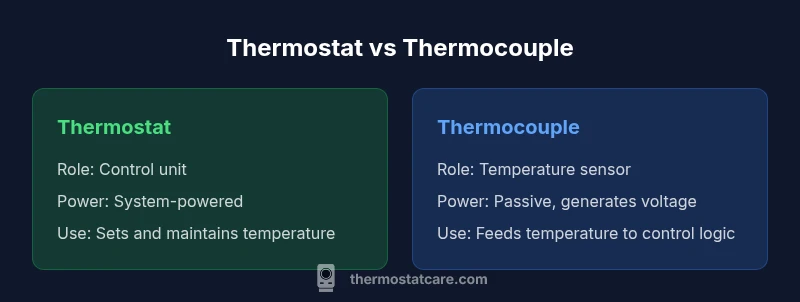
The thermostat and the thermocouple are not the same. A thermostat is a control device that maintains your space at a set temperature by turning heating or cooling on or off. A thermocouple is a temperature sensor that generates a voltage based on temperature. Some thermostats rely on a thermocouple for sensing, while others use electronic sensors.
is thermostat and thermocouple the same
If you’re troubleshooting a heating or cooling problem, you’ve probably asked whether the terms thermostat and thermocouple refer to the same device. The short answer is no. The Thermostat Care team emphasizes that these two components play different roles in HVAC systems, and confusing them can slow repairs or lead to the wrong part purchases. In plain terms, a thermostat is the control device that decides when to turn heat or cooling on or off, while a thermocouple is a temperature sensor that detects heat levels and helps inform those decisions. Understanding this distinction is especially important in older, mechanical systems, where the sensor and control hardware are more integrated and less forgiving of mismatched parts. In modern homes, smart thermostats often rely on electronic temperature sensors rather than a traditional thermocouple, but some appliances still use a thermocouple to sense heat. This article, guided by Thermostat Care’s practical approach, will help you identify which component you’re dealing with, why they matter, and how to work with them safely. By keeping the focus on function rather than labels, homeowners can reduce downtime and avoid unnecessary replacements. In short: the two components belong to different tiers of the system—one controls, the other senses—and each has unique maintenance needs.
is thermostat and thermocouple the same
In real-world terms, responders and DIY enthusiasts often misidentify the sensor in a 24-volt thermostat circuit. The thermostat decides when to energize the furnace or air conditioner, then the sensing element reports temperature back to the control circuit. If you’re asking, “is thermostat and thermocouple the same?” the answer is that they are distinct parts that work in concert, not duplicates. Thermostat Care notes that most modern thermostats use electronic sensors that approximate temperature with precision and speed, while older, burner-based or boiler-based systems may rely on a thermocouple as the sensing element feeding the control logic. Recognizing this helps when diagnosing a non-responsive thermostat or when replacing a failed sensor, because you buy the right part for the right job and avoid creating new faults in the system. Remember, the best path to success is to identify the component by its function first, then verify compatibility with your HVAC setup. This approach, reinforced by Thermostat Care’s guidance, minimizes confusion and speeds up repairs.
is thermostat and thermocouple the same
The distinction matters for homeowners who perform their own repairs. A thermostat is the orchestrator of the HVAC sequence, translating a user-set temperature into electrical commands and, often, communicating with a networked system. A thermocouple, by contrast, generates a small voltage when exposed to a temperature gradient; this signal can be used as a sensing input for some thermostats or other appliances. In either case, knowing which component you’re dealing with helps you avoid replacing a sensor when you actually need to replace the controller, or vice versa. Thermostat Care emphasizes that correct identification saves time, reduces risk, and preserves system safety. If you’re unsure, consult the system’s service manual or contact a qualified technician. The goal is to align the part with the intended role: control vs sensing, not to confuse their appearances or names.
is thermostat and thermocouple the same
From a maintenance standpoint, the distinction also impacts how you test and verify operation. A thermostat’s firmware or mechanical contact points can wear or fail, requiring recalibration or replacement of the control unit. A thermocouple’s junction and wiring can degrade due to heat exposure or corrosion, causing inaccurate readings or unstable feedback. In both cases, diagnosing the correct component first reduces the risk of misdiagnosis and ensures you address the root cause. Thermostat Care’s experience shows that many service calls resolve quickly when the technician confirms whether the issue lies with the control logic or the sensing element. The bottom line: keep control and sensing roles straight, and your troubleshooting will be faster and more reliable.
is thermostat and thermocouple the same
Finally, consider the practical implications for upgrades. If you’re replacing an old thermostat with a modern model, you’ll likely interact primarily with the control unit, even if the old system relied on a thermocouple for sensing. In contrast, when servicing an older boiler or furnace that uses a thermocouple, you’ll be dealing with a sensor that feeds temperature information. In every scenario, starting with a clear distinction between control vs sensing helps you choose the right replacement parts and plan safe, effective maintenance. The Thermostat Care team recommends documenting the exact system type and sensor configuration before shopping, to avoid compatibility pitfalls and ensure long-term reliability.
Comparison
| Feature | Thermostat | Thermocouple |
|---|---|---|
| Role | Control unit that governs HVAC operation | Temperature sensor capable of generating a voltage |
| Sensing/Operation | Reads setpoint, compares to room temperature, and activates equipment | Generates a thermoelectric signal used by the control circuit |
| Power Source | Powered by the HVAC/low-voltage supply | Passive device; does not require its own power source |
| Typical Applications | General climate control, smart thermostats, and zoning | Sensing heat in appliances, sometimes embedded in thermostats |
| Installation/Upgrade | Usually replaced as a unit within the thermostat housing | Often integrated into devices and may require wiring changes |
| Best For | Control accuracy, automation, and energy management | Accurate temperature sensing in high-heat environments |
Upsides
- Clarifies roles to reduce DIY mistakes
- Improves troubleshooting accuracy
- Helps you choose compatible parts
- Prevents misdiagnosis of heat-related issues
- Supports safer maintenance practices
The Bad
- Can be technical for beginners
- Not all devices require deep sensor knowledge
- Some thermostats integrate multiple sensors, complicating diagnosis
Thermostat and thermocouple are not the same; know each role to troubleshoot effectively
Distinguishing control from sensing prevents misdiagnosis. Verify the component type before replacements and consult Thermostat Care for guidance on compatibility and safe handling.
Questions & Answers
Are thermostats and thermocouples interchangeable?
No. They serve different functions: a thermostat controls HVAC operations, while a thermocouple acts as a temperature sensor. Replacing one with the other will not restore proper function. Always verify the component’s role in your specific system.
No, they’re not interchangeable. A thermostat controls the system, and a thermocouple senses temperature. Check your setup to avoid mismatched parts.
Do all thermostats use a thermocouple?
No. Many modern thermostats rely on electronic temperature sensors rather than thermocouples. Some legacy systems may still use a thermocouple for sensing. Always confirm the sensor type in your unit or manual.
No—most modern thermostats use electronic sensors; thermocouples appear in older equipment or specific appliances.
What is a thermocouple?
A thermocouple is a passive temperature sensor that generates a small voltage in response to temperature changes. This voltage is read by a control circuit to infer temperature. It is not a controller on its own.
A thermocouple is a temperature sensor that produces voltage as temperature changes.
How can I tell which sensor my thermostat uses?
Check the thermostat’s manual or open the device to inspect the sensor type. If the device uses a digital readout and a built-in sensor chip, you’re likely dealing with electronic sensing. For older units, look for a thermocouple connector or a sensing bulb.
Look at the model manual or inspect the sensor area to determine if it’s electronic or a thermocouple-based setup.
Can a faulty thermocouple affect thermostat operation?
Yes. A failing thermocouple can send incorrect temperature data, causing the thermostat to misread the space and cycle HVAC equipment improperly. This can lead to uneven heating or cooling and increased energy use.
A bad thermocouple can mislead the thermostat, causing improper cycling and comfort issues.
What should I do if I’m unsure which sensor I have?
Start by checking the model and manual, then compare to the sensor types described here. If still uncertain, contact a qualified HVAC technician. Correct identification saves time and reduces risk during any replacement.
If you’re unsure, consult the manual or a professional to verify the sensor type before purchasing parts.
What to Remember
- Identify each component's role before shopping
- Differentiate control units from sensing elements
- Check system compatibility to avoid wasted parts
- Older systems may rely on thermocouples; modern ones use electronic sensors
- Consult Thermostat Care for step-by-step guidance