Will a Thermostat Cause Overheating? A Troubleshooting Guide
Urgent guide: discover if the thermostat is causing overheating, how to diagnose safely, and steps to fix or upgrade. Learn to protect your HVAC and home in 2026 with clear checks, a diagnostic flow, and when to call a pro.


Overview: Will a thermostat cause overheating?
If you notice rooms feeling unusually warm or the system staying on longer than it should, you may wonder, "will thermostat cause overheating?" The short answer is: yes, in many cases a thermostat that reads temperature incorrectly or is miswired can drive the HVAC into a cooling/heating loop that overheats parts of the ductwork or surrounding spaces. In 2026, Thermostat Care sees overheating incidents often traced back to thermostat issues, not only worn components. This section outlines how to assess whether the thermostat is the root cause and what to do next.
- Look for symptoms: rooms warming up despite a set point, the system running excessively, or unexplained temp swings.
- Remember: safety codes require turning off power before touching wiring.
- This guide will help you determine if the thermostat is at fault and how to address it quickly.
How thermostats influence system heat and safety
A thermostat acts as the control brain for your HVAC. When readings are off, it can keep the system engaged beyond what the space requires, or fail to disengage when cooling or heating is unnecessary. Proper calibration, placement, and wiring are essential to avoid overheating and unnecessary energy use. The goal is precise control so the blower and compressor run only as needed, preserving comfort and equipment life.
Key factors that affect readings include sensor location (not near vents or sunlight), the thermostat’s aging or firmware status, and whether the wiring is secure and correctly terminated. Malfunctions here often mimic dangerous conditions, but they’re usually solvable with basic checks and resets rather than wrenching the furnace.
Common culprits when overheating occurs
- Faulty or miscalibrated thermostat: Reads wrong temperature and keeps the system running.
- Poor sensor placement: Direct sun, draft from the vent, or near a heat source skews readings.
- Wiring or power issues: Loose connections or a blown fuse can cause erratic calls for heat or cooling.
- Airflow or filter problems that mask thermostat cues: A clogged filter makes the system work harder, amplifying heat build-up.
Each cause has a distinct set of fixes, which we cover in the diagnostic flow and step-by-step sections. Remember that safety comes first; if you’re not confident with electrical components, skip ahead to professional help.
Quick checks you can perform safely
- Power off at the breaker before inspecting any wiring or electronics.
- Confirm the thermostat is in the correct mode (heat or cool) and set point is reasonable for the season.
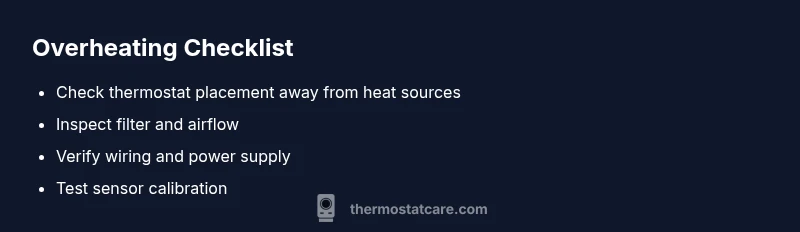
- Check location: move sensors away from heat sources or direct sun, and ensure the thermostat is mounted at the right height for typical living conditions.
- Inspect the air filter and blower accessibility: a dirty filter can cause the system to work harder and overheat internal components.
If these checks don’t resolve the issue, continue to the diagnostic flow to identify the root cause and a safe path to repair.
Diagnosing thermostat vs HVAC system: a fast flow
Begin with the simplest explanations and advance toward the more involved fixes. The goal is to determine whether the thermostat is driving the heating cycle or if the HVAC itself has a fault.
- Step 1: Compare room temperature to thermostat reading. If the reading diverges by more than a few degrees, suspect sensor or calibration.
- Step 2: Verify wiring integrity at both the stat and furnace/air handler. A loose wire can cause intermittent signals that overheat or overcool.
- Step 3: Test with a known good thermostat if available. If overheating stops, the original thermostat is likely faulty.
- Step 4: Check airflow and duct issues separately from the thermostat. A restricted airflow can appear as overheating even when thermostat is correct.
If you still see abnormal heat buildup after these steps, it’s time to move to targeted fixes and consider professional evaluation for safety.