Why Would a Thermostat Lose Power: Quick Troubleshooting Guide
Urgent troubleshooting guide to diagnose why a thermostat loses power, with safe checks, diagnostic flow, and step-by-step fixes from Thermostat Care.


Most often, a thermostat loses power due to a simple power issue rather than a defective unit. Start by checking the breaker or fuse, then inspect the thermostat’s batteries (if it uses them) and the wiring at the furnace control board. If power returns briefly but drops again, the transformer or control board may be failing.
Why would a thermostat lose power
If your thermostat suddenly stops controlling your home's heating or cooling, you’re likely facing a power issue. The question many homeowners ask is: why would a thermostat lose power? There isn't a single culprit; most cases begin with simple, addressable problems. According to Thermostat Care, the most common causes are power supply interruptions, a tripped breaker or blown fuse, and worn batteries in battery-powered models. Before you assume a failed thermostat, rule out those basics. This quick check helps you get back to comfortable temperatures faster and reduces the risk of electrical damage. Stay vigilant about safety, and remember that power issues in the HVAC system can affect furnace ignition and heat call routines as well.
Quick checks you can do safely
Before tearing into wiring, perform a safe, staged check:
- Verify the thermostat display is on. If it’s blank, batteries may be dead or power to the device may be interrupted.
- Switch off the circuit breaker that serves the HVAC system for 30 seconds, then turn it back on to reset power paths.
- If your thermostat uses batteries, replace them with fresh, high-quality alkaline cells and clean the battery contacts.
- Inspect the HVAC furnace/air handler area for obvious signs of power issues (fuses, breakers, loose wires). Do not touch live wires; use a non-contact tester if available.
- Document any blinking lights or error codes on the thermostat display, and note whether the control board within the furnace shows status indicators. These cues help narrow the cause and speed up diagnostics.
Understanding the power path in thermostat systems
Most modern thermostats rely on a 24-volt supply from the furnace or air handler. Some thermostats are battery-powered backups, while others are fully wired into the control circuit. If the 24V supply is interrupted—due to a tripped breaker, blown fuse, loose wiring, or a faulty transformer—the thermostat will lose power or reset intermittently. The power path also includes the thermostat's internal battery (if applicable) and the control board at the furnace. A weak or failing transformer can produce a momentary voltage drop that the thermostat perceives as a power loss. Understanding this flow helps you diagnose without replacing parts unnecessarily.
Diagnostic flow overview (symptom-to-diagnosis)
When the thermostat shows a blank display or ignores user input, start with the simplest checks:
- Symptom: No power to thermostat or blank screen.
- Diagnosis: Power issue at the thermostat or furnace.
- Likely causes: Broken breaker, loose wire, dead batteries, faulty transformer.
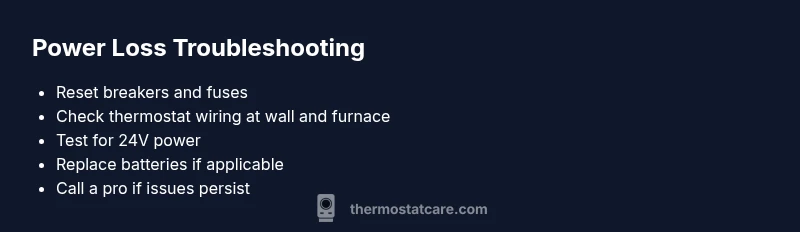
- Action: Reset breakers, reseat wires, replace batteries, test the 24V circuit.
If the issue persists after these steps, the transformer or control board may be failing and could require a professional assessment.
Step-by-step: common fixes for power loss (see STEP-BY-STEP below for a detailed procedure)
A large portion of power-loss cases resolve with straightforward steps:
- Reset the HVAC power by flipping the breaker off, waiting 15–30 seconds, then turning it back on.
- Check and reseat any thermostat wires at the terminal block and the furnace control board.
- Replace batteries if the thermostat is battery powered; ensure the battery contacts are clean.
- Verify there is 24V power at the furnace control board using a multimeter or a non-contact voltage tester.
- If you don’t see 24V, the transformer or control board could be faulty. This often requires a professional assessment.
- Document error codes or blinking sequences to guide the service visit.
Note: If you smell burning, hear buzzing, or see melted insulation, shut off power immediately and call a professional.
Safety and professional help
Working with live electrical components can be dangerous. Always power down the HVAC circuit before inspecting wiring and never bypass safety controls. If you’re unsure about anything, stop and contact a licensed HVAC technician. A pro can confirm transformer health, verify the 24V circuit, and test for wiring faults without risking equipment or personal injury.
Preventing future power loss
Preventive steps reduce future outages:
- Schedule routine HVAC maintenance so power components remain reliable.
- Keep thermostat wiring organized and free from moisture or dust that can cause corrosion.
- Use a surge protector or power conditioner for sensitive electronics near the thermostat.
- Replace old transformers or control boards before they fail, especially in systems older than 10–15 years.
- Regularly check for error codes and address them promptly, rather than letting issues accumulate.
Next steps after basic power is restored
If the thermostat powers back on after a reset but loses power again, plan a diagnostic run: check for voltage stability at the furnace, inspect terminal connections, and review any changes to the electrical circuit (such as new appliances on the same circuit). If power loss recurs, avoid stalling; schedule a professional assessment to prevent emergency heating or cooling failures.
Steps
Estimated time: 45-75 minutes
- 1
Power off and verify safety
Locate the HVAC service panel and switch off the corresponding circuit breaker. Wait 30 seconds to discharge residuals. This ensures safe handling when you inspect the thermostat and wiring.
Tip: Use a non-contact tester to confirm that no voltage is present before touching wires. - 2
Check thermostat display and batteries
If the thermostat uses batteries, replace them with fresh ones and inspect contacts for corrosion or looseness. If there’s a power indicator, note any warning lights or error codes.
Tip: Keep old batteries aside in case you need to compare voltage readings later. - 3
Inspect thermostat wiring at the wall and furnace
Remove the thermostat cover and verify that the wires are securely connected to their terminals. At the furnace, confirm that wires to the control board are tight and not damaged.
Tip: Take a photo of wiring before unplugging anything to aid reassembly. - 4
Test for 24V power
Use a multimeter or a voltage tester to check that the 24V supply exists between R and C at the thermostat and at the furnace control board.
Tip: If you’re unsure how to test, consider a quick video guide to avoid misreading volts. - 5
Assess the transformer and control board
If 24V is absent at the thermostat but present at the panel, the transformer may be faulty. If 24V is absent at both, wiring or board fault is likely.
Tip: A professional should replace a transformer or control board to avoid incorrect wiring. - 6
Reconnect, power up, and test system
Reconnect all components securely, restore power, and test the thermostat by cycling heat and cooling commands. Confirm the thermostat responds consistently.
Tip: If it still fails, document readings and codes for the technician visit.
Diagnosis: Thermostat display blank or no response when power is expected
Possible Causes
- highTripped circuit breaker or blown fuse
- highLoose or disconnected thermostat wiring at the furnace/control board
- mediumDead or weak batteries in battery-powered thermostats
- lowFaulty 24V transformer or control board
- lowDamaged thermostat backplate or wiring insulation
Fixes
- easyReset the breaker/fuse and confirm power is restored to the HVAC system
- easyDisconnect and re-seat thermostat wires at both the thermostat and furnace terminals
- easyReplace batteries and clean contact surfaces if applicable
- mediumTest for 24V at the thermostat and furnace; replace transformer or repair board if voltage is absent
- mediumInspect insulation and wiring for damage; replace components as needed
Questions & Answers
What should I check first when my thermostat loses power?
Start with the basics: reset the HVAC breaker, inspect thermostat batteries if present, and confirm thermostat wiring at both the wall and furnace is secure. These steps fix the majority of power-loss cases without professional help.
First check the breaker and batteries, then verify wiring on the wall and at the furnace.
Can a blown fuse cause a thermostat to lose power?
Yes. A blown fuse in the furnace circuit cuts power to the thermostat. Replace the fuse only if you know the correct rating, and reset the system to test if power is restored.
A blown fuse can cut power; replace it only with the proper rating and test.
Is it safe to work on thermostat wiring myself?
Only if you disconnect power to the entire HVAC circuit first. If you’re unsure about wiring or testing voltages, hire a licensed HVAC technician to avoid shock or equipment damage.
Power down first, and if unsure, call a professional.
Will replacing the thermostat fix a power loss?
Not always. Power loss can be due to the furnace transformer or control board. If a new thermostat does not resolve the issue, focus on the 24V supply and wiring at the furnace.
A new thermostat might not fix it if the issue is in the furnace’s power path.
How can I tell if the transformer is failing?
Testing with a voltmeter between R and C can reveal if the transformer is producing 24V. If voltage is absent at both thermostat and furnace, the transformer or board is likely at fault.
Check for 24V between R and C; no voltage means transformer or board fault.
When should I call a professional for thermostat power loss?
If you’re unsure about electrical testing, or if the power loss persists after basic checks, contact a licensed HVAC technician to diagnose transformer, wiring, or board faults safely.
Call a pro if basic checks don’t restore power or you’re uncomfortable testing electrical components.
Watch Video
What to Remember
- Identify power issues early to avoid HVAC outages
- Check breaker, fuses, and wiring before replacing parts
- Battery-powered thermostats require fresh batteries and clean contacts
- If 24V is absent, transformer or control board health is likely the fault
- Call a professional for transformer, board, or complex wiring problems