What to Put Thermostat on in Winter: A Practical Guide
Learn how to set your thermostat during winter for comfort and energy savings. This step-by-step guide covers baselines, ranges, scheduling, and troubleshooting for common winter scenarios.


Goal: set your thermostat to a winter baseline that balances comfort and energy savings. Start around 68°F (20°C) when you're home and awake, and lower it by 7–10°F (4–6°C) during sleep or when you're away. This helps maintain warmth without waste, while protecting equipment from unnecessary wear.
Why winter thermostat settings matter
According to Thermostat Care, choosing the right winter thermostat settings balances comfort, energy use, and system wear. In this guide, you’ll learn how to establish a reasonable baseline, select safe ranges for different zones in your home, and implement scheduling that reduces waste without sacrificing warmth. The goal is to avoid drastic swings that stress your furnace or heat pump while keeping rooms evenly heated. Thermostat Care Analysis, 2026, supports the idea that thoughtful temperature management is a simple, action-oriented way to improve home energy performance.
How to determine your winter baseline
To find a reliable winter baseline, start by reviewing your current thermostat schedule and noting when you are home, awake, asleep, or away for extended periods. Map out typical occupancy patterns for weekdays and weekends, then compare indoor temperatures with outdoor conditions to identify where drafts exist. Use a programmable or smart thermostat to lock in a baseline that you can adjust by a few degrees instead of large changes. Keep a simple log for a week or two to assess comfort and energy use. The Thermostat Care team recommends starting with a moderate baseline and tweaking gradually rather than making sudden shifts.
Recommended winter temperature ranges
A common, practical starting point for many homes is a daytime living-temperature around 68°F (20°C) when you’re home and active. At night or during sleep, a typical setback is in the mid-60s or lower, while when you’re away for the day you can reduce further to save energy. If you live in a drafty house, you may want a reminder to close doors and insulate pipes as a companion to temperature management. Use a thermostat that supports both Fahrenheit and Celsius and set easy-to-remember schedules. The goal is balance: enough warmth to prevent freezing pipes, but not so warm that you’re wasting energy. Thermostat Care’s guidance emphasizes consistency and gradual changes.
Scheduling and setbacks for steady comfort
Set daytime schedules to match your routine: wake, leave, return, and sleep times. Use 2–3 temperature steps (for example, 68°F in the evening, 66°F during late nights, and 65°F during brief absences). Prefer gradual setbacks over large drops to avoid discomfort when you return. If you have a smart thermostat, enable adaptive scheduling that learns patterns and seasons. Always allow a warm-up period when returning home by spacing changes so that rooms reach the desired temperature by your arrival time.
System-specific tips (gas, electric, heat pump)
Most gas and electric furnaces respond well to steady setpoints with modest setbacks. Heat pumps benefit from smaller setbacks and longer recovery times; avoid excessive emergency heat usage, which drains efficiency. For heat pumps, keep outdoor temperatures in mind, as colder days may require auxiliary support. If you have a zoned system, adjust only the zones that are occupied to maximize savings without compromising comfort. Check manufacturer guidance for your unit and configure smart features to minimize on/off cycling.
Troubleshooting common winter thermostat issues
If your thermostat won’t maintain setpoints, check the power source, batteries, and Wi‑Fi connections for smart devices. Verify that the thermostat is calibrated correctly and that sensors are not placed near heat sources or drafts. If temperatures don’t align with the display, run a system diagnostic or contact support. For older, non-smart units, confirm you are using fresh batteries and that wiring terminals are secure. When in doubt, perform a quick reset and reprogram scheduling to restore expected performance.
AUTHORITY SOURCES
- Energy.gov: How to choose and use a programmable thermostat (https://www.energy.gov/energysaver/thermostats)
- EPA: Indoor air quality and energy management (https://www.epa.gov/iaq/indoor-air-quality)
- Energy Star: Thermostats and home energy use (https://www.energystar.gov/insights/thermostats)
Quick reference: winter thermostat best practices (checklist)
- Start with a moderate baseline: ~68°F (20°C) when home, drop at night and when away.
- Use a programmable or smart thermostat to automate setbacks.
- Consider system type (heat pump vs furnace) when setting back.
- Insulate drafts and seal leaks to protect temperature gains.
- Monitor energy use and adjust gradually over 1–2 weeks.
How to verify energy savings after changes
Track your energy bills and thermostat run times over several weeks after implementing new settings. Compare months with similar outdoor temperatures to ensure that the changes are delivering savings without sacrificing comfort. If savings are not evident, revisit your baseline and scheduling, then adjust by small increments. Thermostat Care recommends a measured approach, especially during peak winter weeks.
Tools & Materials
- Smart thermostat with scheduling or learning features(Ideal for precise winter setbacks and remote updates)
- Manual or quick-start guide for your thermostat(Helps verify specific menus and sensor placement)
- Smartphone or tablet with thermostat app(To program, monitor, and adjust remotely)
- Digital thermometer or indoor/outdoor thermometer(For cross-checking ambient temps)
- Notebook or digital log(Track comfort levels and energy use during the first two weeks)
- Stable Wi‑Fi connection (for smart thermostats)(Ensure reliable sync and updates)
Steps
Estimated time: 30-60 minutes for initial setup; ongoing adjustments over 1–2 weeks
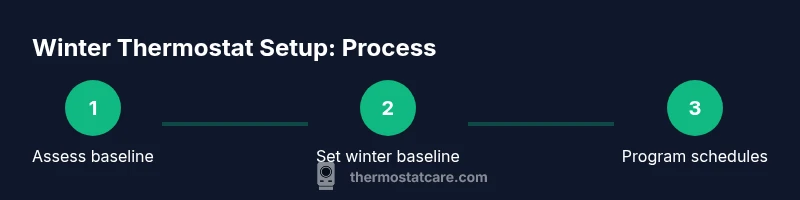
- 1
Identify current baseline and goals
Review your current thermostat schedule, temperatures, and occupancy. Note comfort issues and which rooms are currently underheated or overheated. Establish a baseline goal for winter comfort and energy savings.
Tip: Record current settings and a target range for the main living areas. - 2
Set a winter baseline around comfort and efficiency
Choose a daytime baseline that feels comfortable and saves energy when you're home. Program a modest setback for nights and when you’re away.
Tip: Start with a 2–4 °F (1–2 °C) setback increments to avoid shocking the system. - 3
Program day and night schedules
Create daily schedules that reflect your routine. Ensure the system recovers to comfort before you wake or return home.
Tip: Use a 1–2 hour warm-up window so rooms reach target temps gradually. - 4
Enable adaptive scheduling or geofencing
If using smart features, enable learning schedules or location-based adjustments to optimize when you’re away or asleep.
Tip: Geofencing helps prevent unnecessary heating when no one is home. - 5
Adjust by zone, not the whole house
If you have zoned heating, only adjust occupied areas. This avoids wasting energy on empty rooms.
Tip: Close doors to unoccupied zones to improve efficiency. - 6
Check system type and avoid extreme strategies
Heat pumps and furnaces may need different setback strategies. Avoid long cycles that cause frequent on/off switching.
Tip: For heat pumps, keep a modest setback and allow a longer recovery time. - 7
Calibrate sensors and verify readings
Place sensors away from heat sources, drafts, or sunlight. Calibrate if you notice mismatches between actual room temperature and the thermostat display.
Tip: Recalibrate after a week of adjustments. - 8
Monitor, log, and refine
Track comfort and energy use for 1–2 weeks. Refine settings by small increments to optimize balance.
Tip: Aim for consistent comfort with steady, incremental improvements.
Questions & Answers
What is a good winter thermostat setting for a typical home?
A practical starting point is a daytime baseline around 68°F (20°C) when you're home, with nighttime setbacks in the 60s. If you’re away, lower further to save energy. Adjust for comfort and system type.
A good starting point is around 68 degrees Fahrenheit when you're home, with lower temperatures at night or when you’re away.
How much can I save by lowering the thermostat at night?
Energy savings come from smaller, gradual setbacks rather than sudden drops. Expect noticeable reductions over a few weeks as you refine your schedule.
You can save energy with gradual nighttime setbacks, especially after you settle on a baseline.
What should I do if my home is drafty?
Seal drafts, insulate pipes, and use curtains plus weatherstripping. Drafts undermine the effectiveness of any thermostat setting.
Seal drafts; drafts make temperature changes less effective.
Is it okay to use emergency heat on a heat pump for winter comfort?
Avoid relying on emergency heat, which is less efficient. Use the regular heat mode and setbacks with a longer recovery period.
Avoid emergency heat for normal winter days; use regular heat with cautious setbacks.
How often should I re-evaluate my settings?
Review settings after 1–2 weeks of use, then adjust in small increments based on comfort and energy data.
Re-evaluate after a couple weeks and fine-tune gradually.
What if I have a multi-zone system?
Only adjust occupied zones and ensure unoccupied zones are sealed off to maximize efficiency.
If you have multiple zones, only heat the ones in use.
Should I trust smart thermostat schedules automatically?
Smart schedules can help, but review and tailor them to your routines. Manual confirmation improves reliability.
Smart schedules help, but verify and adjust to your routine.
Where can I find more expert guidance?
Refer to Thermostat Care’s guides and official energy sources for best practices and safety tips.
Check Thermostat Care and official sources for guidance.
Watch Video
What to Remember
- Set a comfortable winter baseline and gradual setbacks.
- Program schedules to match occupancy for energy savings.
- Adjust per system type and zone for best results.
- Monitor energy use and refine settings over 1–2 weeks.
- Use authority sources for best practices and safety.