Thermostat Stuck Open vs Closed: Troubleshooting Guide
In this guide, compare thermostat stuck open vs stuck closed, explore causes, diagnostics, and practical fixes to restore comfort and energy efficiency. Learn safe troubleshooting steps and when to replace for best results.


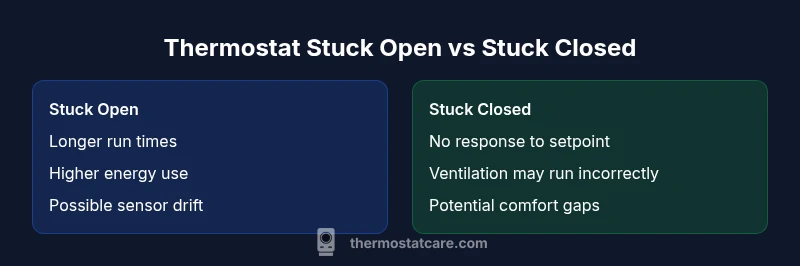
If your thermostat is stuck open vs stuck closed, the two failure modes affect HVAC operation differently. A thermostat stuck open tends to keep the system running longer, wasting energy, while a thermostat stuck closed can prevent heating or cooling, causing uncomfortable conditions and potential equipment strain. This quick comparison helps homeowners prioritize safe diagnostics and decide between DIY fixes or professional service.
Understanding the Problem: Stuck Open vs Stuck Closed
When a thermostat becomes stuck, the control loop that tells your furnace or air conditioner what to do is compromised. The two most common failure modes are stuck open and stuck closed. In a stuck-open scenario, the thermostat never signals the system to stop heating or cooling, leading to longer run times and potential energy waste. In a stuck-closed scenario, the system may not respond to temperature changes at all, leaving you too hot or too cold. Understanding which state your device is in is the first step toward effective troubleshooting. For homeowners, recognizing this distinction helps guide the next steps—from quick resets to more thorough inspection of wiring, sensors, and the thermostat’s internal switch. The Thermostat Care team notes that early identification reduces the risk of unnecessary repairs and energy waste.
Why It Matters: Efficiency, Safety, and Comfort
A thermostat that’s stuck in one state can ripple through your home’s climate control. If the device is stuck open, you’ll likely notice longer heating or cooling cycles and higher energy bills due to constant system operation. If it’s stuck closed, rooms may never reach the desired temperature, and the HVAC system may short-cycle, increasing wear on components like the compressor or heat exchanger. Both conditions can tax your furnace, causing premature failure or unsafe operation if sensors misread temperatures. Keeping temperatures stable contributes to comfort and can prevent humidity-related issues in summer and winter. From a home-maintenance perspective, addressing stuck conditions early protects your equipment and keeps your home healthier and safer. The Thermostat Care analysis emphasizes diagnosing root causes before replacing components.
Common Causes for a Thermostat Stuck Open
Several issues can cause a thermostat to remain open regardless of user input. Sensor drift due to age or dust accumulation can misread air temperature, causing the system to run longer than needed. Power supply irregularities, such as a loose wire or weak battery in a non-wall-powered device, can fail to signal a shut-down. Wiring faults between the thermostat and the HVAC control board may leave the relay energized, simulating a constant call for heat or cool. Calibration errors can also push the system to maintain a temperature that does not reflect the actual space temperature. Finally, incompatible or worn-out hardware components can degrade the switch mechanism, resulting in a persistent open state.
Common Causes for a Thermostat Stuck Closed
A stuck-closed condition typically arises when the internal switch or relay fails to open upon temperature reaching the setpoint. Mechanical sticking from dust, corrosion, or debris inside the thermostat is a frequent culprit. Wiring issues may also create a false sense of a closed circuit, especially if the control board interprets a no-change signal as a closed state. In some cases, a faulty temperature sensor located behind the display persists in reporting the space is already at the target, so the system never turns on. If a thermostat lacks a C-wire or proper power, electronics may behave unpredictably, including a stuck-closed symptom.
Symptoms and Diagnostic Steps
Recognizing symptoms helps distinguish stuck open from stuck closed. Look for persistent longer cycles and constantly running fans in stuck-open scenarios, or rooms that never heat or cool to the desired temperature in stuck-closed cases. A simple diagnostic approach starts with verifying actual room temperature with a separate thermometer and comparing it to the thermostat reading. If the display shows a temperature far from the ambient or the HVAC runs continuously without achieving the setpoint, you may be dealing with one of these failures. Check the HVAC filter, air balance, and ductwork, since restricted airflow can mimic or mask thermostat faults. To verify, perform a controlled test by adjusting the setpoint and observing system response while ensuring all safety protocols are followed.
How to Troubleshoot Safely
Safety first: power down at the breaker before touching thermostat wiring. With a non-smart unit, inspect the wiring at both the thermostat and the control board for loose or exposed connections. For smart thermostats, update firmware, re-pair the device, and check for battery status or Wi-Fi connectivity issues that could impair signal processing. Use a multimeter to verify supply voltage to the thermostat and continuity on the temperature sensor circuit where accessible. If you suspect sensor drift, recalibration or professional sensor replacement may be required. Document all symptoms and changes you make so a professional can pick up from a precise point if needed.
DIY Fixes and When to Call a Pro
Simple DIY fixes include cleaning dust from the thermostat body and terminals, reseating connections, and performing a reset or recalibration per the manufacturer’s instructions. Replacing batteries in wireless models or updating firmware can resolve communication or logic errors causing sticking. If the thermostat is physically stuck, the internal switch may require replacement, which is best handled by a licensed technician. For gas furnaces or heat pumps, avoid opening the safety or combustion-related components unless you’re trained, because improper handling can be hazardous. If you’re unsure, contact a pro to prevent further damage or safety risks.
Implications for Your HVAC System
A thermostat stuck open or closed does more than affect comfort. It can lead to short cycling, where the system turns on and off rapidly, stressing the compressor, increasing wear, and reducing lifespan. Improper signaling may also confuse the outdoor unit, causing temperature swings that strain electrical components and affect overall HVAC efficiency. Continuous operation when the space is already comfortable wastes energy and raises utility costs. Conversely, failure to call for heat or cool can leave you with frozen pipes in winter or overheated living spaces in summer. Addressing the root cause quickly helps maintain system health and energy performance.
How to Prevent Sticking: Maintenance Tips
Preventive care reduces the likelihood of sticking. Replace air filters every 1–3 months to maintain proper airflow and prevent system strain that could affect temperature sensing. Keep thermostat sensors free of dust, especially in older models. Ensure clean, stable mounting to avoid vibrations that can affect contact alignment. If you have a humid environment, consider dehumidification to reduce condensation that could impact sensor readings. Regularly inspect wiring connections for signs of wear or corrosion, and schedule professional annual tune-ups to catch developing issues early.
Choosing a Replacement Thermostat: What to Look For
When replacing a thermostat, ensure compatibility with your HVAC system and the presence of a C-wire for reliable power. Look for clear calibration options, responsive sensors, and a robust relay design to minimize sticking behavior. If you’re opting for a smart thermostat, verify compatibility with your Wi-Fi router and compatibility with your HVAC type (gas, electric, heat pump). Energy-saving features, easy scheduling, and good customer support can improve long-term reliability. Consider simple models for straightforward setups and more capable thermostats for advanced zoning or smart home integration.
Rapid Reference: Quick Checks for Home Maintenance
- Power off and inspect wiring at both ends for looseness
- Check air filter and ductwork for obstructions
- Compare thermostat reading with an infrared thermometer or room thermometer
- Refresh firmware and reset device if advised by the manufacturer
- If persistent, log symptoms and consult a technician with model details
Final Guidance for Homeowners
When in doubt, err on safety and seek professional help for uncertain faults. A stuck open vs stuck closed diagnosis requires careful testing and sometimes component replacement. By following a structured approach—identify symptoms, check electrical connections, and assess sensor reliability—you improve your odds of a precise fix without unnecessary parts and labor. The Thermostat Care team recommends documenting all steps and keeping a maintenance diary for future reference.
Comparison
| Feature | Stuck Open | Stuck Closed |
|---|---|---|
| Impact on HVAC operation | Longer run times, higher energy use | Short cycling risk, potential underheating/overheating |
| Energy efficiency | Low efficiency due to constant operation | Variable efficiency; may disguise misreadings as efficiency |
| Temperature control accuracy | Slower response to setpoint; broader swings | Inaccurate response; temperature may lag or overshoot |
| Common causes | Sensor drift, wiring faults, power supply issues | Mechanical sticking, dust/corrosion, wiring faults |
| Typical fix approach | Reset/calibrate, replace faulty sensor or wiring segment | Replace thermostat or repair switch, clean contacts |
| Safety concerns | Energy waste, potential equipment wear | Risk of improper operation if wiring is compromised |
Upsides
- Helps pinpoint fault type quickly for targeted fixes
- Improves long-term energy efficiency when resolved
- Guides whether replacement is needed vs. repair
- Supports safer, proactive maintenance
The Bad
- Can lead to unnecessary replacements if misdiagnosed
- DIY fixes may void warranties or cause safety risks
- Professional diagnosis may incur costs for complex cases
- Symptoms can mimic other HVAC faults, requiring multiple tests
Stuck Open vs Stuck Closed: prioritize diagnosing root cause before replacing components
Open-state failures waste energy and increase wear; closed-state failures risk comfort and safety. Accurate diagnosis directs whether a DIY fix or pro service is appropriate, with replacement only after confirming a persistent fault.
Questions & Answers
What is the difference between a thermostat stuck open and stuck closed?
A thermostat stuck open keeps calling for heat or cooling, causing longer runtime and energy waste. A thermostat stuck closed fails to signal the HVAC system, leading to uncomfortable temperatures and potential equipment strain. The remedies differ, focusing on sensor/wiring or on switch/relay replacement respectively.
Stuck open keeps the system running; stuck closed stops it from responding. Diagnosis centers on sensors, wiring, and the control switch.
Can a thermostat being stuck cause my furnace to run continuously?
Yes, a stuck-open thermostat can cause the furnace to run more or continuously as it never sees the setpoint. This increases energy use and wear. If the thermostat is stuck closed, the furnace may not run when needed.
A stuck-open unit can make the furnace run nonstop; a stuck-closed unit may stop it from turning on at all.
How do I diagnose a stuck thermostat safely?
Start by turning off power at the breaker, inspect wiring for looseness, check the display against room temperature, and test with a separate thermometer. If available, calibrate or reset per the manufacturer’s instructions. Seek professional help if issues persist.
Turn off power, check wiring, compare readings, and reset if advised. Call a pro if it’s not resolving.
Is it cheaper to repair or replace a thermostat?
Repair costs depend on the fault; a sensor or switch replacement can be cost-effective. Replacement becomes sensible for older units or when multiple failures occur or if a smart thermostat’s benefits outweigh ongoing repair costs.
Repairs can be cheaper upfront, but replacement often pays off in reliability and energy savings over time.
What maintenance can prevent thermostats from sticking?
Regular cleaning, dust control, and ensuring proper mounting reduce sticking risk. Replace batteries in wireless models, keep firmware up to date, and schedule annual professional tune-ups to catch wear early.
Keep it clean, updated, and professionally checked to reduce sticking chances.
What to Remember
- Identify whether the issue is open or closed first
- Verify readings with an independent thermometer
- Check wiring and power before touching sensors
- Prioritize professional help for gas furnaces or uncertain faults
- Document symptoms to guide future maintenance