Thermostat Not Communicating With Furnace: Troubleshooting Guide
Urgent guide to fix a thermostat not communicating with furnace. Diagnose power, wiring, and settings, then follow a step-by-step plan from Thermostat Care to restore reliable heating.


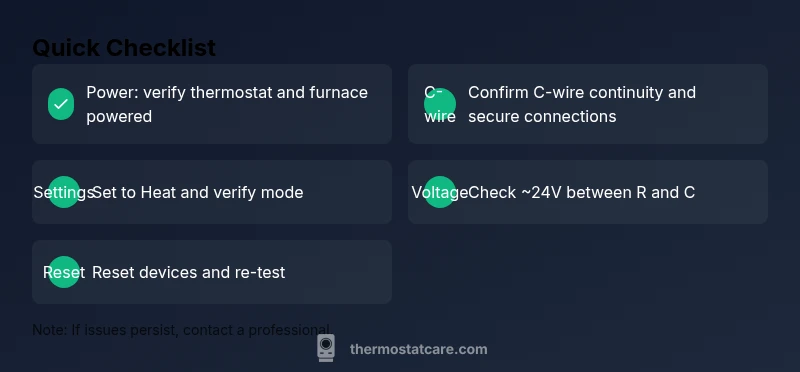
The most likely cause is power or wiring issues between the thermostat and furnace. Start by confirming the furnace is powered, check the C-wire continuity, and reset the thermostat and furnace. If the display or lights flicker, power issues or wiring faults are likely; contact a pro if safety concerns arise.
Why thermostat not communicating with furnace happens
According to Thermostat Care, when a thermostat cannot talk to the furnace, the issue is almost always electrical power, wiring, or configuration. The most common symptom is a non-responsive display or a thermostat that doesn't call for heat even when the room is warm or cold. Start with the simplest checks: confirm the system has power, the thermostat is wired correctly, and the C-wire is intact. Recognizing these patterns quickly can prevent needless part replacement and get you back to comfortable temperatures sooner. Remember: safety first; if you ever feel unsure about exposed wiring, stop and seek professional help.
First checks you should perform before calling for help
Begin with safety and visibility checks: look for tripped breakers, blown fuses, or a furnace that is quiet when you command heat. Ensure the thermostat has power (battery or hardwired) and the display is readable. Confirm the thermostat is set to heat, not off or a different mode, and that the schedule or hold settings aren’t preventing calls for heat. If the room remains cold, try cycling power to the furnace and thermostat by turning the breakers off for 10 seconds and back on. These quick checks catch the majority of simple failures without tools, and they are the fastest path back to warm rooms.
Understanding the thermostat-furnace link: power, wiring, and settings
The thermostat and furnace communicate via low-voltage wires. If any portion of that path is disrupted, signals fail. Common culprits include a nonworking C-wire, loose terminals, corroded connections, or a blown fuse in the furnace control board. Temperature readings on the thermostat should reflect actual room temperature when it’s working. Misconfigured settings, such as incorrect heat anticipator or fan mode, can also prevent proper calls for heat. By understanding the link, you can target the right area during diagnosis and avoid unnecessary replacements. When this link fails, the goal is to restore a solid electrical path and faithful control signals.
Safety considerations and when to call a pro
Electrical work carries risk. If you’re uncomfortable with live wiring, or if you must open the furnace cabinet, turn off power at the breaker and follow proper lockout procedures. Never bypass safety protections, and if you smell burning or see damaged wiring, stop immediately and contact a professional. Thermostat not communicating with furnace is often fixable with basic checks, but certain issues (like furnace control board faults or gas connections) require licensed technicians. If your furnace is older or you lack the right tools, it’s safer to hire help rather than risk an unsafe situation.
How to verify power at the furnace and thermostat
Power verification steps are straightforward but critical. Check the thermostat’s display for power and replace any weak batteries if applicable. At the furnace, ensure the power switch is on and the dedicated breaker is not tripped. If the furnace uses a dedicated 24V transformer, measure between R and C with a multimeter when the system is powered; you should see approximately 24V AC. If the voltage is absent or unstable, there is a power issue that must be addressed before continuing. After restoring power, re-test the thermostat to verify communication has returned.
Testing the C-wire and thermostat wiring
Inspect the C-wire at both ends for corrosion, loose screws, or damaged insulation. If you have a separate thermostat cable, ensure an uninterrupted, continuous C-wire from the furnace control board to the thermostat. Use a multimeter to test continuity between the C terminal on the furnace and the C terminal on the thermostat. If continuity is good but 24V is still unstable, the issue may be a fluttering transformer or shared power circuit. In homes with older wiring, installing a new dedicated C-wire or using a power extender kit can resolve the problem without replacing major components.
Reset procedures for thermostat and furnace
Sometimes a clean reset clears stale configurations. Start by powering off both devices for 60 seconds, then power them back on. On many thermostats, navigate to settings and select Reset to defaults, then re-enter your preferred schedule and heat settings. For the furnace, cycle power by turning off the breaker for 30 seconds and turning it back on, then run a test heat cycle. After resets, watch the status indicators closely to confirm the thermostat and furnace establish communication again.
Prevent future issues with proactive maintenance
Regular inspection of wiring and terminals can prevent communication failures. Check the thermostat mounting plate for secure attachment, clean any dust from the thermostat and furnace openings, and replace worn batteries on a schedule. Keep the C-wire connections tight and clean, and ensure the furnace is on a consistent power supply protected by a dedicated circuit. Document any irregular behavior, and review your settings after any seasonal changes.
When to call Thermostat Care for professional help
If you’ve performed the basic checks, verified power, and still see no reliable communication between the thermostat and furnace, it’s time to involve a professional. The Thermostat Care Team can diagnose deeper issues, such as control board faults, gas valve concerns, or transformer problems, safely and efficiently. Contact us for a precise assessment and to ensure your system operates safely and efficiently.
Steps
Estimated time: 15-30 minutes
- 1
Verify power to both devices
Check that the furnace is powered on and the thermostat display is lit. If the breaker is off, switch it on and observe for a response. If there is no display, address power first before proceeding.
Tip: Always start with the power source to rule out a simple supply issue. - 2
Inspect wiring and C-wire
Turn off power, then inspect the wiring at both ends for loose screws, corrosion, or damaged insulation. Confirm the C-wire is connected to C at the thermostat and to C on the furnace control board.
Tip: Label wires if you need to disconnect them; this helps reassembly. - 3
Reset thermostat and furnace
Power down both devices for 60 seconds, then power back up. Reset the thermostat to defaults, re-enter schedules, and perform a heat call. If the furnace has a reset option, use it as directed in the manual.
Tip: Avoid multiple rapid power cycles; give each device time to initialize. - 4
Test and confirm communication
After resets, set the thermostat to heat and observe if the furnace responds. Check for 24V between R and C at the thermostat. If the signal returns, monitor for a full heating cycle.
Tip: If the issue recurs, document the exact symptoms and voltage readings for the technician.
Diagnosis: Thermostat won't respond to heat calls or displays show faults
Possible Causes
- highPower issue (tripped breaker, blown fuse, dead transformer)
- mediumLoose or damaged thermostat wiring, especially the C-wire
- lowIncorrect thermostat settings or mode (off,eco, or heat anticipator)
Fixes
- easyRestore power to the furnace and thermostat; replace fuses or reset breakers if needed
- easyInspect and reseat all wires at the thermostat and furnace terminals; test continuity on the C-wire
- easyReset both devices to default settings and reconfigure heating schedule
Questions & Answers
Why won't my thermostat communicate with the furnace even when the display is on?
Power or wiring faults are the most common causes. Check that the thermostat has power, inspect the C-wire, and verify all terminals are tight. If issues persist, proceed with the diagnostic flow.
Most communication failures come from power or wiring issues. Start with power, then check the C-wire and terminals.
Could a low battery cause communication failure?
Yes. A weak battery can prevent a thermostat from sending signals. Replace the batteries and re-test. If communication still fails, move on to wiring checks.
A weak battery can stop communication; replace it and test again.
Is the C-wire required to communicate with the furnace?
In most modern setups, the C-wire provides a return path for the thermostat's signals. Without a solid C-wire, you may experience intermittent or no communication. If you lack a C-wire, consider installing one or using a power extender kit.
Yes, the C-wire is typically needed for reliable communication.
What does a blinking thermostat light mean?
Blinking patterns can indicate power loss, wiring error, or configuration problems. Note the pattern and consult the manual or Thermostat Care for guidance.
Blinking usually means a power or wiring issue or a setting problem.
When should I call a professional?
If basic checks fail or you encounter gas lines, burner issues, or burnt wiring, call a licensed HVAC professional. For safety and code compliance, professional help is wise.
If you’re unsure or smell gas or see damaged wiring, call a pro.
Can incorrect thermostat settings affect heating after a fix?
Yes. After any fix, ensure the thermostat is set to heat, the schedule is correct, and the fan is in the desired mode. Re-run a heat call to confirm proper operation.
Make sure heat is enabled and settings are correct after any fix.
Watch Video
What to Remember
- Power and wiring first: fix most issues quickly
- Secure C-wire and terminals to restore signals
- Reset devices and test after each step for clarity
- Call Thermostat Care for complex or unsafe fixes