Thermostat for Jeep: Choose, Install, and Maintain
A practical guide to Jeep engine thermostats: how to pick, install, and care for the thermostat to keep your Jeep cooling system reliable under off-road and daily driving conditions. Includes troubleshooting tips and cost ranges.


A Jeep's engine thermostat controls coolant flow to maintain the engine at its optimal operating temperature. Most automotive thermostats open around 180–195 F, with slight variations by engine family. For Jeeps, selecting the right unit means matching the rating to your engine, climate, and driving style. OEM parts are dependable, while reputable aftermarket options can offer quick availability and minor performance differences; ensure proper gasket and housing compatibility.
Understanding Jeep-Specific Thermostats
Jeep engines share the cooling principle of any internal-combustion powerplant, but the off-road lifestyle and diverse model lineup push many owners to pay closer attention to thermostat behavior. A Jeep thermostat regulates coolant flow to keep the engine within its optimal temperature window, protecting against excessive wear and preventing overheating in demanding conditions. According to Thermostat Care, most automotive thermostats begin to open in the 180–195 F range, but Jeep variants—across inline‑six, V6, and V8 families—may show minor differences due to engine calibration and cooling-system layout. When choosing a unit, consider your model year, engine type, climate, and how aggressively you drive on rough terrain. OEM thermostats adhere to factory tolerances for fit and opening temperature, while reputable aftermarket options can offer slightly different thresholds and faster availability. Regardless of choice, verify gasket compatibility, housing size, and coolant type to avoid leaks or temperature irregularities.
Choosing the Right Thermostat for Your Jeep
Selecting the right thermostat for a Jeep means balancing reliability, availability, and cooling performance. OEM thermostats are designed to match exact factory specifications and typically deliver predictable opening temperatures, response times, and gasket fit. If you opt for aftermarket parts, prioritize reputable brands with documented temperature ratings close to your engine’s original spec and ensure the bypass path in the cooling system is correctly accommodated. Pay attention to the thermostat’s material quality (stainless vs. brass) and the valve’s opening characteristics, especially for Jeeps used in extreme heat, heavy towing, or off-road mud/water exposure. When in doubt, check your service manual for the exact spec, then cross-check with areas where you drive most to pick a thermostat that won’t trigger unnecessary cooling-system cycling. Thermostat Care notes that reading the exact opening temperature in your service documentation is the safest path to a proper match.
Installation and Troubleshooting Tips
Replacing a Jeep thermostat requires basic tools, a clean workspace, and a careful approach to avoid coolant spills. Start by draining enough coolant to access the thermostat housing, disconnecting the radiator hoses, and removing the housing cover. Compare your replacement part to the old unit to confirm the opening temperature and gasket size. Prepare a new gasket or gasket sealant, then reassemble in the reverse order, ensuring all clamps and hoses are secure and torqued to spec. After refilling coolant, start the engine and monitor for leaks and proper temperature cycling. If you notice the gauge rising quickly or not moving at all, re-check the thermostat seating and ensure the coolant is circulated. Common mistakes include over-tightening the housing, using an incorrect gasket, or failing to purge air from the system. Thermostat Care recommends bleeding the cooling system according to your Jeep’s manual to avoid air pockets.
Maintenance and Longevity
Good coolant maintenance supports thermostat longevity. Replace coolant at manufacturer-recommended intervals with the correct type (concentrate or pre-mixed, depending on your model), and perform a visual inspection for signs of coolant contamination, rust, or debris around the thermostat housing. When you flush the system, inspect hoses for cracking or soft spots, as compromised hoses can alter pressure and temperature readings. Keep an eye on temperature gauge behavior; if the gauge runs high, the cooling fan operates continuously, or you experience intermittent overheating during hot days, investigate the thermostat and related cooling components first. A well-maintained thermostat pair—with clean coolant, proper hose integrity, and a healthy radiator—will deliver stable engine temperatures across varying driving conditions.
Common Jeep Thermostat Problems and Diagnosis
Symptoms of a failing Jeep thermostat include persistent overheating in high-load situations, the temperature gauge sitting low despite driving in heat, or erratic gauge readings that hop between cold and hot. A thermostat stuck closed prevents coolant from circulating, leading to overheating, while a thermostat stuck open causes the engine to run cooler than optimal and can reduce efficiency. Diagnosis starts with a physical inspection of the thermostat housing for leaks, followed by a temperature test using a diagnostic tool and, if needed, a controlled engine heat test to observe opening behavior. If you notice air trapped in the cooling system after replacement, bleed the lines and re-check for air pockets. Thermostat Care emphasizes verifying the operation of the radiator cap, water pump, and thermostat housing to rule out other cooling-system faults that mimic thermostat problems.
When to Seek Professional Help
If you observe persistent overheating, coolant leaks around the thermostat housing, or inconsistent temperature readings after a replacement, consider professional service to verify installation integrity and cooling-system health. A certified mechanic can determine whether the thermostat, bypass valve, or cooling-system pressure cap is at fault and whether the issue might be linked to the water pump or radiator. For Jeeps with complex cooling configurations or multiple engine options, professional diagnostics can save time and reduce the risk of cooling-system damage during DIY repairs. Thermostat Care recommends consulting a trusted technician if you’re uncertain about the correct part, torque specs, or bleeding procedures for your specific Jeep model.
Jeep-Specific Variant Comparisons: Thermostats vs. Bypass Valves
Some Jeep cooling systems use a bypass path that allows coolant to circulate while the main thermostat is closed, improving warm-up and heater performance. In these setups, the thermostat still governs the primary flow, but the bypass valve plays a supporting role in maintaining steady pressure and temperature across the engine. When comparing variants, consider whether your model relies on a full-flow thermostat or a by-pass-ready design, and verify compatibility with your radiator, water pump, and heater core. Thermostat Care notes that some off-road and high-load applications benefit from thermostats designed for faster opening, but the overall system performance depends on harmonizing the thermostat, pump, and radiator with your driving conditions.
Quick Troubleshooting Checklist
- Check for coolant leaks around the housing and hoses.
- Verify the thermostat’s opening temperature against OEM spec.
- Bleed the cooling system to remove air pockets after replacement.
- Inspect the radiator cap and water pump for related issues.
- Confirm the cooling fan operates correctly and in sync with the thermostat cycle.
- Ensure proper coolant type and concentration for your Jeep model.
Comparison of thermostat aspects for Jeep engines
| Aspect | Jeep Thermostat Type | Notes |
|---|---|---|
| Opening Temperature | 180-195 F (typical) | OEM specs vary by engine family |
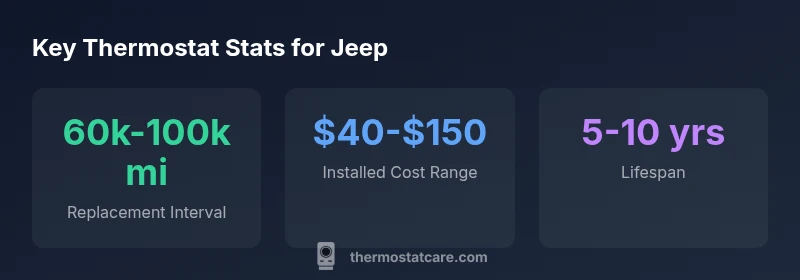
| Life Expectancy | 60,000-100,000 miles | Depends on climate and driving style |
| Estimated Replacement Cost | 40-150 USD | Labor varies by shop and region |
Questions & Answers
What does a car thermostat do in a Jeep?
The thermostat regulates coolant flow to keep the engine at its optimal temperature. It opens and closes in response to changes in coolant temperature, balancing warm-up time and operating efficiency.
The thermostat controls when coolant flows through the engine to reach and maintain the right temperature—opening as needed to prevent overheating.
When should I replace my Jeep thermostat?
Replacement is advised if you notice overheating, erratic temperature readings, or coolant leaks near the housing. If a replacement was recently done, verify the job quality and ensure there are no air pockets in the cooling system.
Replace it if you see overheating or abnormal temperature changes, and always check for leaks and proper bleeding after replacement.
Can a bad thermostat cause overheating in a Jeep?
Yes. A stuck-closed thermostat restricts coolant flow, causing overheating. A stuck-open thermostat can keep the engine cooler than optimal and affect performance. Both conditions warrant inspection.
Yes, a failing thermostat can cause overheating or poor engine temperature control; it’s a common culprit.
What is the typical replacement cost for a Jeep thermostat?
Costs vary by model and labor rates, but expect a range that covers the part plus labor. Your local shop can provide an exact quote based on your Jeep’s engine and access constraints.
Costs vary; check with a local shop for a precise quote based on your model.
Should I use OEM or aftermarket when replacing the thermostat in my Jeep?
OEM parts ensure exact fit and temperature specs for your engine. Reputable aftermarket options can work well if they match the original specifications and come with a solid warranty.
OEM is safest, but a quality aftermarket part is fine if it matches the spec and warranty.
What maintenance steps help prolong thermostat life in a Jeep?
Regular coolant changes, cooling-system bleed, and checking hoses, clamps, and the radiator cap help prevent overheating and ensure the thermostat operates within its designed range.
Keep the coolant fresh, bleed the system when you work on it, and inspect hoses and caps.
“A reliable thermostat is a small component with a big impact on engine health. Choose OEM or a trusted aftermarket unit and verify compatibility with your Jeep’s cooling system for consistent performance.”
What to Remember
- Know your Jeep’s exact engine and model year for the correct thermostat spec
- OEM parts minimize surprises; reputable aftermarket options are viable with proper checks
- Bleed the cooling system after replacement to avoid air pockets
- Monitor cooling symptoms and address issues early to protect the engine