Furnace Fan Keeps Running With Thermostat Off: Troubleshooting Guide
Urgent guide for homeowners: diagnose why the furnace fan won't stop when the thermostat is off and safe steps to fix it.


Furnace blower running with the thermostat off is typically caused by a stuck relay or faulty control board. Wiring faults or a stuck high-limit switch can energize the blower without a heat call. Power down at the furnace, verify thermostat wiring, and test the blower relay before moving to more advanced checks.
Why the furnace fan keeps running with thermostat off
When a furnace fan continues to run even after you switch the thermostat to OFF, it signals that the blower circuit is energizing without a heat call. In most systems, the G terminal controls the blower, and power should be cut when OFF. If the blower remains energized, the likely culprits are a stuck relay on the control board, a faulty fan-relay module, or a safety switch that has failed.
According to Thermostat Care, this symptom is not just an annoyance; it can wear components quickly and may indicate an underlying control fault. Start by cutting power to the furnace at both the service panel and the thermostat, then inspect basic connections. If you’re not trained in electrical work, treat this as a potential safety risk and proceed cautiously.
Next, verify that the thermostat is truly calling OFF: remove any batteries, set to OFF, and wait 60 seconds while you observe wire connections from the furnace. Any residual energization suggests a relay or wiring fault rather than a dead thermostat.
Common causes and how to test them
The most frequent causes are a stuck blower relay or a faulty control board. A failing fan relay can keep the G circuit energized even when the thermostat is OFF. Another common issue is a miswired or shorted thermostat wire that energizes the blower. A stuck high-limit switch can also keep fan running as a safety precaution fails to reset.
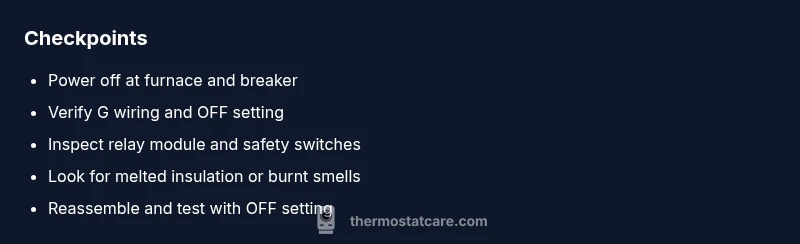
To test, start by turning off power at the furnace and the service disconnect. Remove the furnace access panel and locate the relay module on the control board; listen for a relay click when you cycle the thermostat between ON and OFF. If there is no clear reason for energization, you may need to measure voltage across the relay coil with a multimeter or consult the wiring diagram. Note that some boards require a trained tech to safely test or replace components.
If you’re comfortable, reseat plug-in relays, inspect for burnt smells, and disconnect the blower lead from the board for a quick sanity check; if the blower stops, the relay or wiring is the issue.
Safety-first steps you can take now
Power down the furnace at the breaker and at the furnace switch. Do not operate if you smell gas or suspect a gas leak. With power off, inspect the blower access area for signs of damage or scorching. If you must touch wires, wear insulated gloves and keep one hand in your pocket to minimize shock risk. Use a flashlight and avoid touching moving parts. If you are not confident, do not proceed beyond the inspection stage.
These steps reduce risk while you determine whether a simple wiring fix or a component replacement is needed.
How thermostat wiring affects blower behavior
Understanding G/W/R/C terminals helps; if G is energized when the thermostat is OFF, the blower may run. A miswired C wire or a thermostat with a failing internal switch can feed power into the blower circuit. Ensure the thermostat is set to OFF, then remove the thermostat from the wall and check that wires are securely connected to the correct terminals on both ends. If W and G are bridged by a jumper in older thermostats, fix it. Also consider that some smart thermostats can incorrectly energize the fan due to software settings; check fan control options to ensure Auto mode when not calling for heat.
A miswired or aging thermostat can masquerade as a relay problem. Double-check both ends of the wiring and correct any inconsistencies before replacing hardware.
When to call a professional
Call a licensed HVAC technician if the blower continues after basic checks, if you notice burning smells, buzzing noises, or if you’re not comfortable working with electrical components. A pro can test the control board, relay, and safety switches with the right tools and safely disconnect gas supply if needed. If the unit is still under warranty, contacting the manufacturer or installer is advised to protect coverage.
Prevention tips to avoid future runs
Schedule annual furnace service and replace air filters monthly to keep airflow steady, reducing strain on the blower relay and control board. Ensure thermostat wiring is tucked away and not subject to wear, and consider upgrading to a modern thermostat with robust fault detection. Regularly inspect the blower area for signs of overheating, and address unusual smells or noises promptly to prevent long-term damage.
Steps
Estimated time: 30-60 minutes
- 1
Power down and protect yourself
Turn off power at the furnace breaker and the main service disconnect. If you smell gas, evacuate immediately. Wait 60 seconds to ensure capacitors discharge, then proceed with caution.
Tip: Always work with one hand in your pocket to reduce shock risk. - 2
Confirm OFF on the thermostat
Set the thermostat to OFF and switch it to a higher temperature briefly to see if the blower responds. If the blower stays on, the issue is not solely the thermostat. Capture photos of wire connections for reference.
Tip: Label wires before disconnecting to avoid miswiring later. - 3
Open the furnace panel and locate the relay
Remove the access panel, locate the blower relay on the control board, and listen for a click when you toggle power or the thermostat. A relay that never clicks is a strong sign of a faulty component.
Tip: Do not touch live terminals; use insulated tools. - 4
Test the relay circuit
With power still off, visually inspect for burnt components and check wiring integrity. If you have a multimeter, test the coil resistance and continuity; compare with the manufacturer's diagram.
Tip: If you’re unsure, replace the relay rather than attempting risky measurements. - 5
Inspect thermostat wiring end-to-end
Check G, R, W, and C connections at both ends. Look for frayed insulation, loose screws, or crossed wires that could energize the blower.
Tip: Ensure no jumpers are bridging G to other terminals unless specified. - 6
Test system reassembly and observe
Reassemble the access panel, restore power, and set the thermostat to OFF. Observe whether the blower stops. If it continues, escalate to a professional for control-board diagnostics.
Tip: Document observations and any odors or sounds for the technician.
Diagnosis: Furnace blower runs continuously after thermostat OFF
Possible Causes
- highStuck blower relay on the furnace control board
- highFaulty fan control relay/module
- mediumThermostat wiring short or miswired (G energized when OFF)
- lowStuck high‑limit safety switch energizing the blower
Fixes
- mediumPower down at the furnace and service panel, then inspect/replace the stuck relay or control board as needed
- hardTest and replace the faulty relay module if the blower stops when the relay is disconnected
- mediumCorrect thermostat wiring; reseat or replace damaged wires, and ensure G is not energized when OFF
- hardInspect and replace a faulty high‑limit switch if it's stuck in the closed position
Questions & Answers
Why does my furnace fan keep running after I turn the thermostat to OFF?
This behavior is usually caused by a stuck blower relay or faulty control board. Wiring faults or a stuck high‑limit switch can maintain power to the blower even when heat isn't being called. Safety checks and replacements are often needed.
Most likely a stuck relay or faulty control board, plus possible wiring issues. A quick safety check can identify the culprit.
Can a thermostat cause the blower to run continuously?
Yes. Miswired or failing thermostat wiring can energize the G terminal even when OFF. Some smart thermostats also have software settings that keep the fan on. Verify OFF setting and wiring on both ends.
Yes, thermostat wiring or settings can keep the fan on. Check wiring and OFF mode on both ends.
Is it dangerous if the furnace blower runs when it shouldn't?
It can lead to unnecessary wear and potential overheating if left unresolved. Turn off power and assess basic causes; seek professional help for electrical or gas-related risks.
It's not safe to ignore. Turn off power and get it checked if you can't fix it safely.
How do I safely test the blower relay myself?
With power off, locate the relay and inspect for burn marks. A multimeter can test coil resistance if you’re comfortable. If you’re unsure, replacing the relay or board is safer than attempting a risky test.
Carefully check the relay; if unsure, call a pro rather than testing live components.
Could a dirty filter or airflow problem cause this?
A dirty filter mainly affects airflow and heating efficiency, not normally a continuous blower issue. It can, however, contribute to overheating and safety trips, so keep filters clean as part of prevention.
A dirty filter isn’t the main cause, but it can worsen problems and trigger safety trips.
When should I replace the thermostat?
If testing points to the thermostat as the fault or miswiring remains after checks, replacement may be warranted. Otherwise, focus on the relay, board, and wiring first.
Replace the thermostat if it’s clearly faulty after checks; otherwise prioritize the furnace components.
Watch Video
What to Remember
- Power off before inspections.
- Stuck relay or board is the likely culprit.
- Check thermostat wiring for miswirings or shorts.
- Call a professional for electrical or gas-related concerns.