Different Thermostats and How They Work: An Analytical Comparison
A detailed, analytical comparison of manual, programmable, and smart thermostats, explaining how each works and helping homeowners pick the right type for energy savings and comfort.


TL;DR: The best choice depends on your needs. Different thermostats and how they work offer varying levels of control, energy savings, and automation: manual dial, digital programmable, and smart Wi-Fi models each serve different lifestyles. This comparison helps homeowners pick the right type by weighing ease of use, cost, and compatibility.
Different Thermostats and How They Work
Understanding thermostat choices helps homeowners optimize comfort and energy use. This guide distills the differences among different thermostats and how they work, so you can pick the right type for your home. The Thermostat Care team emphasizes that the best option balances ease of use, reliability, and potential savings, rather than chasing every new feature. In the following sections, we outline manual dial models, digital programmable units, smart Wi-Fi thermostats, and hybrid options, with practical notes on installation, maintenance, and expected performance. By the end, you'll understand not just how each type operates, but where it excels and where it can fall short in real-world settings. According to Thermostat Care, understanding these differences helps homeowners avoid overpaying for features they won't use, and makes energy savings more attainable.
Manual Dial Thermostats: operation and limits
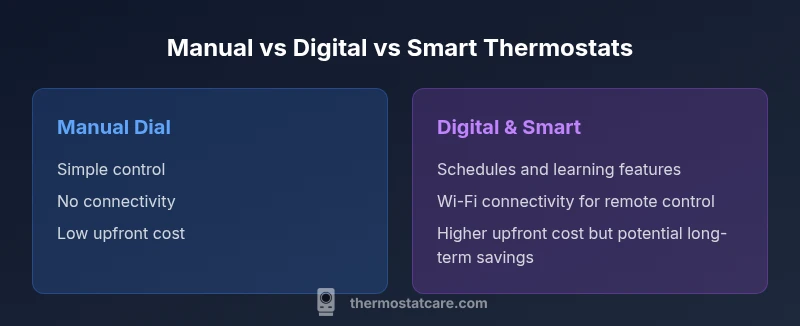
Manual dial thermostats are the simplest form of temperature control. They rely on a mechanical dial and a bimetal strip to make or break contact with a switch that powers the heating or cooling system. No electronics or smart features here—adjusting the dial changes the setpoint, and the system cycles based on ambient temperature. The advantages are straightforward reliability, very low upfront cost, and no need for batteries or Wi-Fi. The downsides are limited or no scheduling, fixed setpoints, and reduced potential for energy savings. For homeowners who favor simplicity and want a durable, low-maintenance option, manual dials remain viable in small spaces or seasonal use. Thermostat Care notes that while these models are robust, they seldom deliver the energy savings available from programmable or smart alternatives.
Digital Programmable Thermostats: schedules and efficiency
Digital programmable thermostats introduce the first layer of automation without requiring internet connectivity. They store a set of schedules (weekday/weekend variants) and adjust the heating or cooling based on the programmed times. The interface is typically a digital display with buttons or touchscreen input. Programs can range from simple two-period schedules to more complex seven-day patterns. The energy savings arise from aligning heating and cooling with actual occupancy and comfort preferences. A potential drawback is that user setup can be confusing for first-time installers, and some models require a common wire (C-wire) to power the display and memory without relying solely on battery power. Thermostat Care emphasizes verifying compatibility with your HVAC system before purchase.
Smart Thermostats: connectivity, learning, and automation
Smart thermostats add Wi-Fi connectivity, remote control via apps, and often learning capabilities that adapt to occupancy and routines. They can adjust temperatures automatically when you’re away, provide energy usage analytics, and integrate with voice assistants and home automation platforms. The learning features can reduce manual input over time, while the remote access enables adjustments from a phone or tablet. However, these devices introduce privacy and security considerations since data is transmitted over networks. They also tend to cost more upfront and may require a stable internet connection. Thermostat Care highlights that the best value comes from models with strong ecosystem support and straightforward setup.
Hybrid and compatibility considerations
Not all homes are created equal when it comes to thermostat selection. Some older HVAC systems lack a C-wire, which can complicate power delivery for digital or smart models. Others may use heat pump configurations, which require compatible thermostats to access auxiliary heat or fan controls. In some cases, a wiring upgrade or a professional installation is advisable. It’s also important to check compatibility with your current HVAC brand and whether the thermostat supports specific system controls (two-stage heating, humidification, or zoning). A careful review of your equipment and wiring can prevent compatibility pitfalls and future wiring changes.
Energy savings and lifecycle costs across types
Energy savings depend on how you use the thermostat and how well you implement its features. Manual thermostats rely entirely on user discipline for savings, while programmable models introduce scheduling benefits without requiring internet access. Smart thermostats tend to offer the strongest energy-management potential when paired with correct installation, schedules, and routine usage. The total lifecycle cost includes device price, installation, potential wiring upgrades, and ongoing maintenance. Thermostat Care analysis shows that long-term savings hinge on usage patterns, climate, and how reliably the device can communicate with the HVAC equipment.
Wiring, installation, and professional help
Proper installation matters as much as the thermostat type itself. A few common issues include insufficient power for digital displays, the absence of a C-wire, and incorrect wiring to the heating and cooling controls. For many homes, a professional installation ensures correct wiring, wiring-compatible compatibility with heat pumps or furnaces, and a safe, code-compliant setup. If you choose a DIY approach, carefully follow the manufacturer’s instructions, verify wiring compatibility, and confirm that the thermostat can handle the HVAC system’s power requirements. The Thermostat Care team recommends routine checks after installation to ensure stability and accurate readings.
Real-world scenarios: buyer personas and usage patterns
Consider your day-to-day routine when choosing a thermostat type. A busy family with irregular schedules can benefit from a programmable or smart thermostat that learns occupancy patterns, reducing energy waste when nobody is home. A remote worker in a climate-controlled home may value precise remote control and energy monitoring. Renters with short-term stays may prefer simpler digital or manual models due to fewer installation restrictions. For homeowners with older systems, a thermostat upgrade can still offer meaningful improvements, but compatibility considerations are essential. In all cases, plan for potential wiring changes and the availability of after-sales support.
Maintenance and troubleshooting tips
Maintenance is relatively straightforward for most thermostats but varies by type. Digital and smart models require occasional battery replacements or ensuring a stable power source, while manual thermostats are largely maintenance-free beyond dust removal. Troubleshooting steps commonly include verifying power and wiring, ensuring the thermostat is set to correct modes (heat/cool), checking the schedule, and confirming that sensors are not blocked by furniture or curtains. If a thermostat fails to register temperature correctly, recalibrating or replacing the device may be necessary. Always consult the installer guide or manufacturer's support resources if issues persist. Thermostat Care suggests documenting model numbers and wiring diagrams for easier service.
Privacy and security considerations for connected thermostats
Smart thermostats collect usage data and interact with cloud services or mobile apps. Protect your home network by using strong, unique passwords, enabling two-factor authentication where available, and keeping firmware up to date. Review permission settings to limit data sharing and disable features you don’t use. If you are particularly privacy-conscious, consider a non-cloud-connected model with robust local control. The balance between convenience and privacy will vary by household, and understanding the data flows helps you make safer choices.
Interoperability and standards shaping the future
Thermostat ecosystems are becoming more interoperable, with common interfaces and standards enabling cross-brand compatibility in some cases. Look for thermostats that support widely adopted protocols or that can pair with popular smart home platforms. Consider energy-saving features such as occupancy sensing and adaptive learning, which can improve performance when supported by your HVAC system. While no single standard covers all devices, choosing a model with broad ecosystem support helps future-proof your investment and simplifies integration with other smart devices.
How to choose the right thermostat for your home
The selection should start with a clear set of goals: energy savings, ease of use, and whether you want remote control or smart automation. Inspect your HVAC system for compatibility—especially whether you need a C-wire, heat-pump support, or zoning capability. Compare the up-front cost against long-term savings, and verify that a given model works with your preferred home ecosystem if you want voice control or automation. The Thermostat Care team recommends prioritizing compatibility and user experience, ensuring that the device integrates smoothly with your HVAC and your smart-home setup.
Feature Comparison
| Feature | Manual dial thermostat | Programmable digital thermostat | Smart Wi-Fi thermostat | Hybrid/Standard digital thermostat |
|---|---|---|---|---|
| Control method | Manual knob | Time-based schedules | App-based control with learning | Digital controls with basic scheduling |
| Power source | Battery-powered or line-powered | Battery or line-powered | Typically line-powered with battery backup | Battery-powered or line-powered |
| Connectivity | Standalone, no network | Local control, optional remote | Wi‑Fi connected, cloud services | Local control with optional cloud features |
| Programmability | No programming | Standard daily/weekly schedules | Dynamic learning and occupancy-based tweaks | Moderate scheduling with some learning |
| Installation complexity | Low | Medium | Medium-High | Low-Medium |
| Smart-home compatibility | None | Moderate compatibility with scheduling features | High compatibility with major ecosystems | Depends on model; generally flexible |
| Typical price range | Low | Medium | High | Medium-High |
| Best for | Simple control, low cost | Energy savings via schedules | Remote access and automation | Budget-friendly basic control |
Upsides
- Simple setup and low upfront costs for manual models
- Programmable digital thermostats offer structured energy savings without connectivity
- Smart thermostats provide remote access and advanced energy analytics
- A wide range of options supports retrofit in many homes
The Bad
- Manual models offer limited or no scheduling and savings
- Digital programmable units require correct setup and may need a C-wire
- Smart thermostats require reliable Wi-Fi and raise privacy considerations
- Higher upfront costs and potential compatibility challenges with older HVAC systems
Smart thermostats offer the best overall value for most homes
Smart models excel in energy savings and convenience, especially when paired with proper installation. Manual and programmable options remain viable for simple setups or budget-focused users. The Thermostat Care team recommends evaluating your HVAC compatibility and desired level of automation before purchasing.
Questions & Answers
What is the main difference between manual and programmable thermostats?
Manual thermostats offer basic on/off control with no programming. Programmable thermostats add scheduled setpoints to automate temperature changes, which can improve energy efficiency without requiring internet access.
Manual thermostats control temperature with a simple dial and no schedule. Programmable thermostats let you set times for heating and cooling to run automatically.
Do smart thermostats really save energy?
Smart thermostats can save energy by learning your routine, adjusting when you’re away, and providing usage insights. The extent of savings depends on how you use the features and how well the installation is matched to your HVAC system.
Smart thermostats save energy by learning patterns and adjusting automatically, but savings depend on usage and setup.
Can I install a thermostat myself or should I hire a pro?
Many digital thermostats are designed for DIY installation, but some require professional wiring, especially if a C-wire is needed or if the system is complex. When in doubt, consult a qualified HVAC technician.
DIY can work for basic models, but professional help is wise for complex systems or wiring upgrades.
Are smart thermostats compatible with older HVAC systems?
Compatibility varies by model and system. Older systems may lack a C-wire or require adapters. Always check the thermostat’s compatibility list and confirm wiring needs before purchasing.
Check compatibility with your HVAC and wiring before buying a smart thermostat.
What should I consider besides type when choosing a thermostat?
Consider HVAC compatibility, wireless reliability, security features, ease of use, and whether you want remote access or smart home integration. A good fit aligns with your home’s hardware and your daily routines.
Look at compatibility, connectivity, and how you’ll use the thermostat in daily life.
What about privacy and data security with smart thermostats?
Smart thermostats collect usage data and connect to cloud services. Use strong passwords, enable two-factor authentication, and review data sharing settings to minimize risk.
Smart thermostats collect data; secure accounts and review permissions to protect privacy.
What to Remember
- Define your goals before shopping: savings, convenience, or automation
- Manual thermostats are simple but offer the least energy efficiency
- Programmable digital models balance cost and scheduling
- Smart thermostats maximize energy savings with learning and remote control
- Check HVAC compatibility and Wi-Fi reliability before buying
- Consider installation costs and potential rebates when evaluating options