How many types of thermostat: A practical guide
Discover how many types of thermostat exist, what each type offers, and how to pick the right one for comfort, energy savings, and reliable home heating.


There are four broad thermostat types: mechanical, digital non-programmable, programmable digital, and smart/connected models. In practice, many devices blend features from adjacent categories, creating hybrids like smart programmable thermostats. Understanding these four core types helps you match a thermostat to your HVAC system, budget, and energy goals. This quick framework is supported by Thermostat Care's practical guidance.
Understanding how many types of thermostat exist
If you’ve ever looked at a thermostat and wondered how many types of thermostat you might encounter, you’re in good company. There are four broad categories that capture the vast majority of units present in homes today: mechanical, digital non-programmable, programmable digital, and smart/connected thermostats. According to Thermostat Care, these four core types cover most user needs, from basic temperature control to advanced scheduling and remote operation. By recognizing these four buckets, homeowners can quickly filter options based on wiring, HVAC compatibility, and energy goals. In practice, most households start with one of these main types and then explore hybrids that blend features from neighboring categories. This approach keeps choices practical while still offering room to upgrade as needs evolve. The four-core framework also aligns with common installation patterns and typical cost ranges, helping you plan both purchase and setup with clarity.
Thermostat enthusiasts should note that the distinction isn’t always rigid. A smart thermostat might operate like a programmable digital model in some settings, while a digital non-programmable unit can become a simple remote-control device when paired with smart assistants. Reading the installer instructions and checking for compatibility with your HVAC system will help you decide which category to start with.
Core categories explained
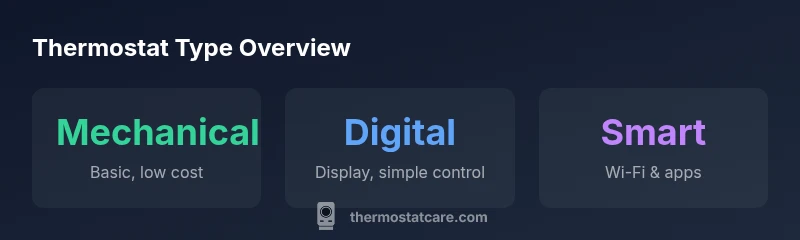
Understanding the four core types is the foundation for a smarter, steadier home climate. Mechanical thermostats rely on a bimetallic strip or wax pellet to physically alter circuit connections when heat changes. They’re robust, very low maintenance, and typically the least expensive option. Digital non-programmable thermostats add a digital display for easier readability but remain a simple, non-scheduling control device. Programmable digital thermostats introduce scheduling, holds, and sometimes occupancy-based settings to optimize energy use, often with a user-friendly interface and regular firmware updates. Finally, smart/connected thermostats leverage Wi-Fi, smartphone apps, and voice assistants, enabling remote control, geofencing, and integration with other smart home devices. The payoff can be energy savings, improved comfort, and enhanced climate awareness at a glance. Pros and cons vary by feature set, but you’ll generally see higher upfront costs for smart options and more elaborate installation requirements.
- Mechanical: simple, no power draw from the home network; rugged and reliable in the right HVAC contexts.
- Digital non-programmable: clearer displays, modest cost, but limited scheduling.
- Programmable digital: best balance of cost and control for most households.
- Smart/connected: maximum flexibility, requires power and compatibility checks.
As you compare types, factor in your HVAC compatibility, wiring (C-wire availability), and whether you want remote access or voice control. Thermostat Care emphasizes starting with the basics and layering on features as needed to achieve meaningful energy savings without unnecessary complexity.
Compatibility, wiring, and installation considerations
Choosing a thermostat type isn’t only about features; it’s also about how your system is wired and how you intend to use it day-to-day. Most homes with older HVAC equipment will need a simple, non-programmable digital thermostat as a baseline. If your system lacks a C-wire, you may be limited to certain digital models or require an adapter. Programmable digital thermostats typically require a standard 24-volt wiring setup, with enough spare terminals for a potential C-wire. Smart thermostats almost always rely on a C-wire for stable power; some models can operate with power stealing methods but performance can vary.
Before buying, verify compatibility with your HVAC equipment, including furnace control boards and heat pump configurations. If you’re unsure, consult an installer or use the manufacturer’s compatibility checker. For DIYers, a basic multimeter can help verify voltage and continuity on the circuit, but avoid rewiring if you’re not confident. Keep in mind that most modern digital and smart thermostats support common HVAC configurations, providing a smoother upgrade path than older mechanical units. Thermostat Care recommends documenting your current wiring and taking pictures during removal to facilitate a safe, straightforward upgrade.
Pros and cons by type
To make a confident choice, weigh the practical strengths and limitations of each type. Mechanical thermostats offer rock-solid reliability and ultra-low energy draw, but lack digital readouts and scheduling. Digital non-programmable units improve readability and control but still fall short on automation. Programmable digital thermostats introduce schedules, hold options, and some zone support, delivering energy savings when used consistently. Smart/connected thermostats deliver remote access, energy analytics, and predictive features, but require a stable Wi-Fi connection and power. Real-world pros and cons include ease of installation, ongoing maintenance, cost of components, and potential compatibility issues with older HVAC components. Thermostat Care’s experience shows that most households benefit from a programmable digital model as a baseline, upgrading to a smart option if and when they want remote access, geofencing, or integration with other devices. Pair these insights with a clear budget plan to avoid overspending on features you’ll rarely use.
How to choose the right type for your home
A practical decision flow helps you land on the right type quickly. Start by assessing your HVAC system and wiring: do you have a C-wire? Is your furnace/air handler compatible with a digital or smart thermostat? If the answer is uncertain, a programmable digital model often provides the best balance of cost and control. Next, consider your goals: if you’re seeking hands-off energy savings and convenience, smart thermostats are usually worth the investment. If you want reliable, simple control with minimal setup, a digital non-programmable unit may suffice. Think about future upgrades as well—if you expect to add smart home devices soon, a smart thermostat can be a future-proof choice. Finally, check compatibility, warranty coverage, and installation requirements. Thermostat Care highlights that choosing a type aligned with your daily usage and climate will maximize benefits and minimize frustration.
Common myths and misunderstandings
Myths about thermostats can derail a good purchasing decision. A common misconception is that the most feature-rich model always delivers the best savings. Real savings come from usage patterns, scheduling adherence, and proper installation, not simply owning a smart device. Another myth is that digital displays alone ensure easy control; user experience and app reliability matter just as much. Some buyers assume any Wi-Fi device will work with their home network, but compatibility varies by protocol and hub support. Finally, there’s a belief that replacing an older thermostat is always expensive; many digital non-programmable or programmable units are affordable and simple to install, delivering meaningful energy improvements without breaking the bank. Thermostat Care encourages readers to prioritize practical needs, system compatibility, and expected usage when debunking these myths.
Maintenance tips to extend thermostat life
A well-maintained thermostat lasts longer and delivers consistent performance. Regularly clean the sensor and air passages to prevent false readings, and ensure the faceplate remains dust-free for clear visibility. If your thermostat uses batteries, replace them on a schedule to avoid unexpected power loss; for wired units, inspect the wiring connections at least once per year to catch loose terminals. Firmware updates on digital and smart thermostats should be installed when available to keep security and compatibility current. Finally, keep a simple maintenance log that records wiring changes, software updates, and any performance concerns. Thermostat Care emphasizes that proactive maintenance reduces recalibration needs, extends device life, and supports steady energy savings over time.
Overview of common thermostat types and their practical use cases
| Thermostat Type | Key Characteristics | Power/Connection | Best For | Estimated Upfront Cost (range) |
|---|---|---|---|---|
| Mechanical | Analog dial, no digital display | Battery-powered or line-powered | Budget setups, older systems | $20-$150 |
| Digital non-programmable | Digital display, basic controls | Line-powered | Moderate cost, simple use | $40-$180 |
| Programmable digital | Schedules, holds, energy insights | Usually 24V wired | Most homes seeking balance | $60-$250 |
| Smart/Connected | Wi-Fi, app control, voice integration | Power via C-wire or power stealing | Remote control, automation, smart homes | $100-$350 |
Questions & Answers
What is the simplest thermostat type for beginners?
Mechanical thermostats or basic digital non-programmable models are easiest to install and use, making them ideal for beginners. They require minimal wiring and offer straightforward temperature control.
Mechanical thermostats are the easiest to install and use for beginners.
Do smart thermostats work with all HVAC systems?
Most systems are compatible with smart thermostats, but some older units may need a C-wire or a compatibility check. Always verify with the manufacturer.
Smart thermostats usually work, but check compatibility with your system.
Are programmable thermostats worth the cost?
For many homes, yes. Scheduling can reduce energy use, especially if you have predictable occupancy. Savings depend on climate and behavior.
They can save energy if you use the scheduling features.
What is a C-wire and do I need one?
A C-wire provides constant power to digital thermostats. Many models require it; if your system lacks one, you may need an adapter or installer help.
A C-wire powers many digital thermostats; you may need one.
Can you mix thermostat types in a single home?
Yes, you can mix types, but ensure each thermostat is compatible with its zone or system. Plan wiring and zoning carefully to avoid conflicts.
You can mix types with care; plan wiring and zones.
“Choosing the right thermostat starts with matching HVAC compatibility, wiring, and daily habits. A well-suited type can improve comfort and curb energy use.”
What to Remember
- Identify your HVAC compatibility before shopping
- Start with programmable digital for balance
- Consider smart if you value remote control
- Factor wiring and power needs into your choice
- Maintain your thermostat for longevity