Difference in Thermostats: Manual, Programmable, and Smart
An objective, in-depth comparison of thermostat types—manual, programmable, smart, and learning—covering control, features, energy impact, installation, privacy, and overall value.


TL;DR: The difference in thermostats comes down to control style, energy management, and connectivity. Manual models rely on you to set temperatures; programmable ones automate schedules; smart thermostats add remote control and data insights; learning models adapt to behavior over time. For most homes, a smart thermostat offers the best balance of comfort, savings, and ease of use, while manual units stay cheapest upfront.
What is a Thermostat?
A thermostat is a control device that manages your heating and cooling by signaling the HVAC system when to start and stop. In the world of thermostat differences, the core idea remains the same: it translates a desired indoor temperature into actionable commands for your furnace, boiler, or heat pump. The reader should understand that the term covers a spectrum of technologies, from basic, non-networked units to highly connected systems that learn from your habits. According to Thermostat Care, the difference in thermostats often hinges on three axes: user interaction, automation potential, and connectivity. This framing helps homeowners avoid paying for features they will not use while recognizing opportunities for energy savings and comfort improvements. The focus today is on four common categories: manual, programmable, smart, and learning thermostats.
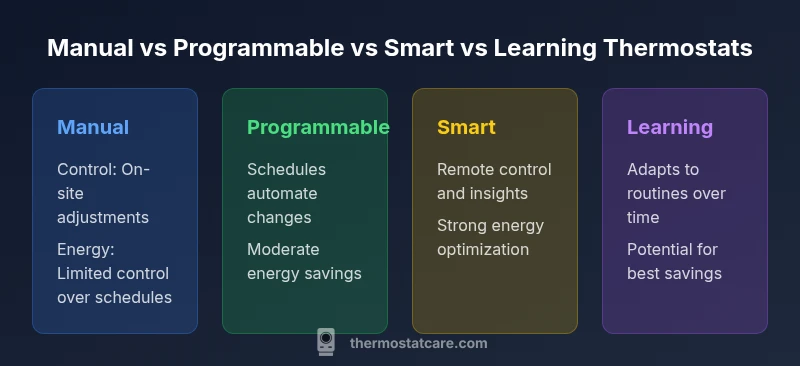
Manual thermostats require direct input each time you want to adjust the temperature. Programmable models offer scheduled changes that run even when you are away. Smart thermostats connect to Wi‑Fi for remote control and data-driven insights. Learning thermostats observe household patterns to optimize routines with minimal user effort. Each category has practical implications for how you live and how much you spend on heating and cooling.
The Core Difference: Manual, Programmable, Smart, and Learning
The difference in thermostats is not just a matter of nudging a dial. It reflects how much you want automation, how much you value remote access, and how closely you want to tailor comfort to your day. A manual thermostat excels on upfront cost and simplicity, making it a straightforward choice for a small apartment or a household with predictable routines. Programmable models lift a notch by presetting daily or weekly schedules, reducing the chances you forget to adjust the thermostat before leaving the house. Smart thermostats take another leap, enabling control from a phone or voice assistant, offering energy reports, and often integrating with other smart devices for a broader home automation strategy. Finally, learning thermostats push the envelope by adapting automatically to your patterns, adjusting temperatures while you sleep, work, or travel, and refining their behavior over weeks and months. The practical takeaway is to map your needs against these capabilities without overinvesting in features that don’t align with your habits.
Energy Use and Savings: What Changes with Each Type
Energy savings are a common reason homeowners consider upgrading thermostats. The difference in thermostats directly influences how your home uses energy. Manual thermostats provide no automatic adjustments, so energy use depends entirely on your discipline. Programmable models help by aligning heating and cooling with your presence; if you have a steady schedule, you can see meaningful reductions in energy waste. Smart thermostats add adaptive optimization, learning your routines and sometimes providing real-time feedback through mobile apps, which can translate into noticeable savings for many households. Learning thermostats take this a step further, attempting to anticipate changes in your routine and adjust in near real time. The degree of savings depends on multiple factors, including HVAC efficiency, insulation, local climate, and how consistently you follow schedules or rely on automation. The Thermostat Care team emphasizes that the potential for savings is real, but it improves with thoughtful setup and regular review of energy reports.
Control Interfaces and Automation Capabilities
The control interface is how you interact with the thermostat, and this facet of the difference in thermostats matters as much as any other feature. Manual thermostats are typically dial-based or simple digital displays with limited programming. Programmable models introduce a schedule editor—often with weekday and weekend settings—to automate temperature changes. Smart thermostats bring a mobile app, voice assistant compatibility, and cloud-based analytics; you can adjust the temperature from anywhere, and the device can sometimes respond to occupancy sensors or integration with other smart home devices. Learning thermostats attempt to anticipate your needs by observing patterns; they adjust automatically and may offer energy insights that explain why temperatures changed when they did. The user experience, reliability, and ease of use trade off against setup complexity and initial cost, so you should weigh how much you value automation versus manual control.
Installation, Wiring, and Compatibility Considerations
Installation is a practical and often overlooked dimension of the difference in thermostats. Manual models generally require little more than plugging in a new device; many are battery-powered and do not need a C-wire. Programmable models often mandate basic wiring and a compatible mounting plate; some may function with a straightforward wire replacement, while others require a professional if your HVAC setup is complex. Smart and learning thermostats most commonly require a C-wire for reliable power, plus a stable Wi‑Fi connection. If you have an older system, you may need a common wire adapter or a professional evaluation to ensure compatibility with your furnace, boiler, or heat pump. The installation complexity should guide your decision, especially if you are renting, living in a multi-unit building, or lack DIY confidence. Thermostat Care recommends confirming HVAC compatibility and power wiring before purchasing.
Privacy, Security, and Reliability in Connected Thermostats
Connected devices bring convenience along with privacy and security considerations. Smart and learning thermostats collect usage data to optimize schedules and to offer energy insights. This data can improve performance and comfort but raises questions about who can access it and how it is stored. Reputable manufacturers implement encryption and secure cloud services, yet the best practice is to review privacy settings, disable features you do not need, and keep firmware up to date. Reliability depends on both device quality and network stability. A device that frequently loses Wi‑Fi or experiences power interruptions can disrupt comfort and energy savings. In environments with poor connectivity, a non-connected model or a hybrid approach may be more reliable, underscoring the importance of balancing convenience with resilience when evaluating the difference in thermostats.
Cost, Value, and Total Ownership Costs Over Time
Upfront cost is a major factor when weighing thermostat choices, but total ownership cost matters more in the long run. Manual thermostats are the least expensive option upfront but offer minimal convenience and no energy analytics. Programmable models incur a moderate price premium for scheduling features and potential energy savings. Smart and learning thermostats command higher upfront costs, primarily due to connectivity hardware, cloud services, and learning algorithms. The value proposition hinges on how much you value remote access, energy reporting, and automatic optimization. Ownership costs also depend on maintenance, potential replacement cycles, and whether additional sensors or hubs are needed for full functionality. Thermostat Care recommends evaluating both upfront price and potential long-term savings tied to your specific usage.
How to Choose: A Practical Decision Framework
Choosing the right thermostat involves aligning your home, schedule, and budget with the device’s capabilities. Start by assessing your HVAC system compatibility and whether you require basic on/off control or full automation with remote access. If you have a consistent daily routine and want to reduce energy waste with minimal effort, programming or smart features can provide meaningful benefits. For tech enthusiasts or homes with multiple occupants and varying schedules, a smart or learning thermostat may offer the most value thanks to occupancy sensing, adaptive learning, and integration with other smart devices. Finally, consider privacy, reliability, and installation complexity. The decision in the difference in thermostats is not just about price; it is about how you live, how you value comfort, and how much you trust connected devices in your home.
Common Myths and Misconceptions About Thermostat Differences
A frequent misconception is that more expensive equals better energy savings in every scenario. The truth is nuanced: savings depend on how you use the device and how well it integrates with your home’s insulation and heating system. Another myth is that smart thermostats always require a perfect Wi‑Fi connection; while connectivity improves features, many models perform adequately with a basic home network, and there are reliable offline options. Finally, some people believe you must replace your entire HVAC system to benefit from a new thermostat; most homes can upgrade without changing major equipment, though compatibility checks are essential.
Conclusion: Putting It All Together for Your Home
The difference in thermostats translates into concrete choices about control, comfort, and energy management. Manual thermostats deliver simplicity and low upfront costs; programmable models provide scheduling without connectivity; smart thermostats offer remote access and data-driven insights; learning thermostats push automation further by adapting to your routines. The best path is a pragmatic one: map your daily life, analyze your budget, and verify compatibility with your HVAC system before upgrading. The Thermostat Care team emphasizes that the right choice balances ease of use, potential savings, and reliability for your home.
Feature Comparison
| Feature | Manual Thermostat | Programmable Thermostat | Smart Thermostat | Learning Thermostat |
|---|---|---|---|---|
| Ease of Use | Very simple | Moderate | High | High |
| Energy Savings | Partial | Moderate | Strong | Strong |
| Upfront Cost | Low | Medium | Medium to high | High |
| Installation & Wiring | DIY-friendly | Basic wiring | May require professional | Depends on HVAC compatibility |
| Connectivity | None | Local control/receiver | Wi-Fi | Wi-Fi + cloud |
| Best For | Budget-conscious upgrades | Fixed schedules and mid-range needs | Tech enthusiasts and smart homes | Energy-focused households with variable routines |
Upsides
- Potential energy savings with smart and learning models
- Enhanced comfort through precise scheduling
- Remote access and monitoring from mobile devices
- Greater compatibility with modern smart home ecosystems
The Bad
- Higher upfront cost than manual models
- Installation can require basic wiring or pro help
- Privacy concerns with data collection and cloud features
- Reliance on Wi-Fi or power supply for full functionality
Smart thermostats win for most homes; they balance control, savings, and convenience
If you value ease of use and ongoing energy optimization, a smart thermostat is usually the best choice. Programmable models suit fixed schedules, while manual thermostats remain the low-cost option. The Thermostat Care team recommends evaluating HVAC compatibility and home connectivity before upgrading.
Questions & Answers
What is the main difference in thermostats?
The main difference in thermostats is how they control heating and adapt to your routine. Manual units require direct input, programmable models automate schedules, smart thermostats offer remote access and data insights, and learning thermostats adjust autonomously based on behavior. This difference shapes comfort, energy use, and maintenance needs.
The main difference is how you control and automate heating—manual, programmable, smart, or learning thermostats each offer different levels of automation and connectivity.
Are programmable thermostats worth it for energy savings?
Programmable thermostats can reduce energy use when you maintain consistent schedules. Savings vary by how well you follow the programmed times and by your home’s insulation and HVAC efficiency. Setup that aligns with your daily routine is key.
Programmable thermostats save energy when you stick to a schedule and have a reasonably well-insulated home.
Do smart thermostats require a C-wire?
Many smart thermostats need a common wire (C-wire) for reliable power, but some models can operate with alternative power methods. Check your HVAC compatibility and the installation guide for your chosen model.
Most smart thermostats need a C-wire, but some work without one with adapters or power stealing.
Can I install a thermostat myself or should I hire a pro?
Many thermostats can be installed by homeowners with basic wiring, especially when the system is simple. For complex HVAC setups, unusual wiring, or uncertain compatibility, a professional installation is advisable to ensure safety and proper function.
If you’re comfortable with basic wiring, DIY is often fine; otherwise, hire a professional.
What features matter most for a two-story home?
Look for zoning compatibility, reliable Wi‑Fi, compatibility with your heating system, responsive sensors, and a straightforward app interface. A learning or smart model may help manage different schedules between floors.
Zoning, solid connectivity, and sensors are key for two-story homes.
What to Remember
- Assess your HVAC compatibility before upgrading
- Balance upfront cost against long-term energy savings
- Prioritize features you will actually use
- Consider privacy and reliability in connected models
- Choose a solution that fits your daily routine and lifestyle