Smart thermostat vs programmable: Which is best for your home in 2026
In-depth analysis of smart thermostat vs programmable thermostat, covering features, energy savings, setup, privacy, and best-use scenarios for homeowners.


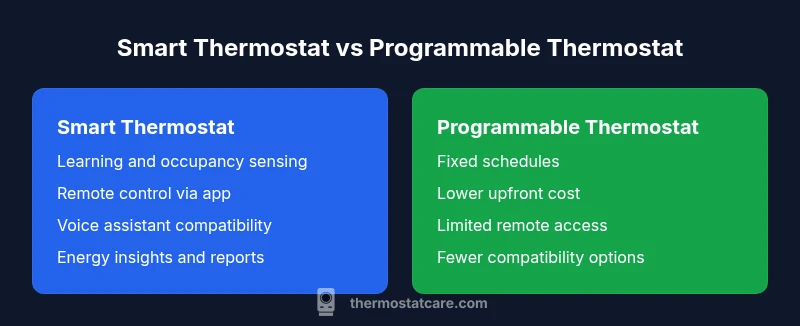
When choosing between a smart thermostat vs programmable thermostat, the smart option offers learning, remote control, and ecosystem integration, while programmable basics focus on fixed schedules with lower upfront costs. For most homes seeking energy savings and convenience, a smart thermostat is the better long-term value, provided you have reliable Wi-Fi and compatible HVAC equipment.
What are smart thermostats and programmable thermostats?
In practical terms, a smart thermostat vs programmable thermostat describes two approaches to automating home heating and cooling. A smart thermostat is a Wi-Fi connected device that learns your routines, senses occupancy, and can be controlled from a smartphone or voice assistant. A programmable thermostat allows you to schedule temperature changes in advance, but it does not adapt to your behavior unless you manually adjust the schedule. According to Thermostat Care, homeowners often start with a programmable model to test basic automation, then upgrade to a smart model when they want more convenience and energy insight. The difference isn't just about convenience; it shapes how you interact with HVAC equipment, how often you adjust settings, and how much you can save on energy bills over time. The market now offers many models in accessible price ranges, making the decision less about cost alone and more about how you use your home and access to Wi-Fi.
Core features and user experience
Smart thermostats bring learning algorithms, occupancy sensing, and remote control into a single device. They adapt to your routines, adjust temperatures when you’re away, and offer insightful energy reports. Programmable thermostats provide a predictable schedule but lack adaptive behavior unless you manually tweak it. The Thermostat Care team notes that the biggest practical difference is how you interact with the system: smart models reward proactive, automated control, while programmable models reward upfront planning. In real homes, this translates to how often you change settings, how quickly you respond to weather shifts, and how reliably you maintain comfort without constant adjustments. Both types support basic temperature control, but the smart option adds automation, compatibility with voice assistants, and remote access that can be leveraged for energy efficiency across seasons.
Energy savings, ROI, and long-term value
Energy savings depend on usage patterns, climate, and how often you adjust settings. Smart thermostats can reduce waste through occupancy sensing, adaptive schedules, and geofencing, often delivering meaningful energy savings over time. Programmable thermostats tend to deliver savings primarily through a well-crafted manual schedule, which can be effective in consistent routines but lacks the ongoing optimization helpers of a smart model. From Thermostat Care analysis, the long-term value of a smart thermostat increases when you regularly use remote features, receive energy insights, and integrate with other smart home devices. Yet the upfront investment matters: if you rarely adjust the schedule or you have a simple two-stage system, a programmable model might be adequate.
Setup, wiring, and installation considerations
Installing a thermostat is usually straightforward for standard systems, but the details matter. A smart thermostat often requires a dedicated C-wire to power the device, reliable Wi-Fi, and compatible HVAC equipment (including heat pumps). Programmable thermostats typically need only basic wiring with straightforward installation. Regardless of type, ensuring compatibility with your furnace, air conditioner, heat pump, and accessories is essential. Thermostat Care suggests checking your current wiring, confirming that the HVAC system supports the thermostat’s wiring standards, and planning for a potential professional install if your setup is unusual or if you’re uncomfortable with wiring. A clean install reduces troubleshooting later and improves reliability.
Control, apps, and ecosystem integration
Remote access via mobile apps is a core feature of smart thermostats, enabling you to adjust comfort from anywhere. Some programmable thermostats also support app control if they’re connected to a smart hub or Wi-Fi. The integration with voice assistants—Alexa, Google Assistant, or Apple HomeKit—varies by model and ecosystem. If you value hands-free control and automation, ensure the thermostat you choose supports your preferred ecosystem. Thermostat Care emphasizes evaluating not just the device, but how it communicates with other smart home products, because a well-integrated system reduces the complexity of managing comfort across rooms and devices.
Privacy, security, and firmware updates
Smart thermostats collect data to optimize performance, occupancy, and energy use. This raises privacy considerations, including data sharing with manufacturers and potential exposure to cyber threats if devices are not kept up to date. Choosing a model with clear privacy settings, robust firmware updates, and secure cloud communication reduces risk. Programmable thermostats typically have fewer connected features, which can limit exposure but also reduces the potential for ongoing security improvements. Thermostat Care recommends reviewing the manufacturer’s data practices, enabling strong passwords, and keeping firmware current to minimize risk.
Comparison
| Feature | Smart thermostat | Programmable thermostat |
|---|---|---|
| Learning capability | yes (adaptive learning) | no |
| Remote control / app | yes (mobile app, cloud access) | limited or no remote control |
| Voice assistant compatibility | yes (Alexa/Google/HomeKit integration) | often none |
| Energy-saving features | high potential with occupancy sensing and adaptive schedules | moderate with fixed schedules |
| Pricing strategy | mid-range to premium | budget to mid-range |
| Installation complexity | moderate (may require C-wire) | easy (standard wiring) |
| Updates and future-proofing | firmware updates and ongoing support | limited or no updates after purchase |
| Privacy implications | data collection and cloud processing | local control focused (model dependent) |
Upsides
- Enhanced energy savings from adaptive learning and occupancy sensing
- Convenience and remote monitoring across devices
- Strong ecosystem integration with major voice assistants
- More detailed energy insights and usage reports
- Future-proofing via regular firmware updates
The Bad
- Higher upfront cost compared with basic programmable models
- Reliance on stable Wi-Fi and cloud services
- Privacy considerations due to data collection
- Potential learning curve for users new to smart home tech
Smart thermostats generally deliver greater long-term value, but programmable models remain a solid choice for simple setups and tight budgets.
Choose smart thermostats if you want ongoing energy optimization and home automation. If cost, simplicity, and offline operation are priorities, a programmable model may be sufficient and more economical upfront.
Questions & Answers
What is the main difference between a smart thermostat and a programmable thermostat?
The main difference is that smart thermostats learn your patterns and offer remote control, while programmable thermostats rely on a fixed schedule without adaptive learning. Smart models can optimize energy use automatically, whereas programmable ones require manual updates to schedules.
Smart thermostats learn your habits and let you adjust settings from your phone, while programmable thermostats run on set schedules. Both manage temperature, but smart ones add automation and remote control.
Do smart thermostats save more energy than programmable ones?
In many homes, smart thermostats save more energy due to occupancy sensing, adaptive scheduling, and remote control features. Savings depend on how you use them and your climate, but the automation tends to reduce waste more effectively than fixed schedules.
Often yes, because smart thermostats learn when you're away and adjust automatically, reducing energy use.
Is installation of a smart thermostat difficult?
Installation is typically straightforward for standard systems, but many smart models require a C-wire and reliable Wi-Fi. If your system is older or uses specialized equipment, a professional installation may be best to ensure compatibility and safe operation.
Most homes can install a smart thermostat themselves, but a professional install helps with tricky setups.
Are smart thermostats secure and private?
Smart thermostats are generally secure when you keep firmware updated and use strong passwords. They collect data to optimize performance, so review privacy settings and data practices before purchase.
Security depends on updates and settings; keep firmware current and use strong passwords.
Can programmable thermostats connect to voice assistants?
Some programmable models offer Wi-Fi and limited remote control, but true voice control is more common in smart thermostats. Always check the model specifications for compatibility with your preferred voice assistant.
Voice control is usually a smart-thermostat feature, not guaranteed on basic programmable models.
Which is better for someone renting a home?
Programmable thermostats are often easier and cheaper to implement, but if the landlord allows, a smart thermostat can provide better energy management and remote access. Clarify lease terms and HVAC compatibility first.
If allowed, a smart thermostat offers better control and energy savings; otherwise, a programmable model is a simpler option.
What should I consider before buying?
Consider HVAC compatibility, Wi-Fi reliability, privacy preferences, and your routine. If you value automation and energy insights, prioritize a smart thermostat; if cost and simplicity are paramount, a programmable model may suffice.
Check compatibility, privacy, and how you’ll use it before buying.
What to Remember
- Start with your budget and wifi reliability before choosing
- Prioritize learning and remote features for long-term energy savings
- Check HVAC compatibility and C-wire requirements early
- Assess privacy preferences and security updates
- Consider ecosystem compatibility with existing devices