Why Are Smart Thermostats Better? A Thorough Comparison
Explore why smart thermostats are better, with a rigorous comparison of energy savings, comfort, integration, and practical tips to choose the right model for your home.


Smart thermostats are better because they combine energy efficiency, personalized comfort, and remote control through learning schedules and adaptive sensing. This comparison highlights how automation, geofencing, and ecosystem integration outperform traditional thermostats for most homes, delivering ongoing convenience and potential energy savings. By prioritizing intelligent control and platform compatibility, smart thermostats offer measurable value for homeowners and DIY enthusiasts.
Why Are Smart Thermostats Better for Modern Homes
The central question many homeowners ask is why are smart thermostats better for everyday living. The answer hinges on three core capabilities: learning your routines, adjusting to occupancy, and synchronizing with your home’s broader digital ecosystem. As you explore this topic, consider how you spend time in the home, when you are away, and how you like to tune comfort settings. According to Thermostat Care, the strongest argument for upgrading rests on the combination of energy awareness and user-centric design. The phrase why are smart thermostats better captures both the practical gains and the long-term value these devices deliver. In real-world terms, you’ll experience fewer temperature swings, fewer manual adjustments, and fewer wasted degrees, all while maintaining a comfortable living environment. The Thermostat Care team emphasizes that the best models reduce energy use through adaptive scheduling and occupancy sensing, without sacrificing comfort.
Energy Efficiency Fundamentals
Energy efficiency is often cited as the primary selling point for smart thermostats, but the underlying mechanics deserve closer inspection. These devices use learning algorithms to predict when spaces are occupied and to adjust heating and cooling accordingly. They can correlate outdoor temperatures, humidity, and user behavior to optimize runtime periods, reducing waste heat and unnecessary conditioning. The key distinction between a smart thermostat and a traditional model is not just automatic adjustments; it is the continuous feedback loop created by data collection and learning. When implemented well, this loop yields meaningful reductions in energy usage across different seasons and occupancy patterns, especially during workweeks or extended absences. Thermostat Care highlights that the energy-saving potential hinges on accurate sensing and a robust scheduling framework that matches real-life routines.
Comfort and Personalization
Beyond energy savings, comfort is a critical factor in evaluating why are smart thermostats better. These devices enable granular control by zone or room, set flexible schedules, and support multi-user preferences, so family members don’t have to compromise. Features like adaptive setback, wake-timetables, and smart alerts help maintain ideal environments with minimal manual effort. Personalization extends to app-based controls, voice assistant compatibility, and even occupancy-aware temperature drift correction. A major advantage is the ability to maintain consistent temperatures when you are at home or away, aligning comfort with energy goals. In short, the enhanced personalization offered by modern smart thermostats translates into a more pleasant, less fiddly home climate experience.
Intelligent Scheduling and Learning
One of the strongest arguments in favor of smart thermostats is their capacity to learn from your behavior and refine schedules over time. They analyze occupancy patterns, seasonal changes, and routine shifts, then propose adjustments that keep you comfortable while improving efficiency. This learning capability makes the question why are smart thermostats better more about adaptive automation than static programming. The best models update schedules automatically, with options to override or fine-tune through quick-access controls. The result is less time spent managing the thermostat and more consistent comfort, particularly for households with irregular schedules or variable occupancy. Thermostat Care notes that intelligent scheduling is most effective when there is accurate occupancy data and a stable Wi-Fi connection.
Connectivity and Ecosystem Integration
Smart thermostats shine when they integrate with broader home ecosystems. They connect to Wi-Fi, sync with voice assistants like Alexa or Google Assistant, and often participate in routines with other smart devices (lights, blinds, sensors). This integration makes the question why are smart thermostats better compelling in the context of a connected home: they provide centralized control and interoperability across platforms. Look for compatibility with your preferred apps, ecosystems, and cloud services, as well as open APIs that allow third-party automation. A well-integrated thermostat can become a hub for energy management, automation, and even insurance or warranty considerations that reward proactive maintenance.
Security, Privacy, and Reliability Considerations
Security and privacy are critical when evaluating why are smart thermostats better in the long run. These devices rely on cloud services and mobile apps, which introduces potential attack surfaces. Reputable models implement strong encryption, regular firmware updates, and strict access controls to mitigate risk. Reliability depends on a stable internet connection and robust cloud performance; however, most models offer local control options as a fallback. When evaluating options, review data policies, how long data is stored, and whether the manufacturer allows firmware rollbacks or on-device processing. Even with high security standards, you should set up two-factor authentication and routinely review connected devices to maintain a secure home environment.
Cost and ROI Considerations
From a cost perspective, why are smart thermostats better when considered over time includes upfront price and ongoing energy savings. The most important factor is return on investment, which tends to improve as you unlock automation, seasonal optimization, and integration with other energy-saving devices. While premium models command higher upfront costs, the long-term energy savings and conveniences can justify the investment for many homes. Consider incentives, rebates, or bundled offers in your region to offset initial costs. The decision often hinges on your willingness to pay a premium for learning features, ecosystem reliability, and future-proofing through software updates.
Installation Realities and Maintenance
Installation ease matters in the broader question of why are smart thermostats better for homeowners and DIY enthusiasts. Most modern units are designed for straightforward installation, with common HVAC wiring and simple mounting hardware. However, there are exceptions depending on your system (two-stage furnaces, heat pumps with aux heat, or incompatible control wiring). If you’re comfortable with basic wiring, a DIY install is feasible and often cost-effective. Some systems benefit from professional installation to ensure correct wiring, sensor placement, and optimization of advanced features. After installation, maintenance is typically minimal: firmware updates, occasional battery checks (if applicable), and periodic evaluation of sensor coverage and device compatibility.
Common Myths Debunked
A frequent hurdle in the decision process is to separate myths from reality. A common myth is that all smart thermostats require a constant internet connection; in truth, many offer meaningful offline capabilities and local control. Another misconception is that all models save significant energy; the actual savings depend on usage patterns, climate, and how well you configure schedules. Some buyers worry that smart thermostats are purely a data-collection risk; while data handling is a concern, reputable manufacturers implement privacy controls and transparent policies. Understanding these nuances helps you assess why are smart thermostats better in a practical, risk-aware way.
How to Choose the Right Model
Choosing the right model depends on your home, budget, and comfort priorities. Start with compatibility with your HVAC system, integration with your preferred smart-home ecosystem, and the learning capabilities that match your routines. Evaluate sensor coverage (temperature, humidity, occupancy), ease of use, and update frequency from the manufacturer. If you rely heavily on voice control, prioritize compatibility with your preferred assistant. Finally, review warranty terms, customer support quality, and the ability to manage privacy settings to protect your data.
Practical Tips to Maximize Benefits
To maximize the benefits of any smart thermostat, set up a clear initial schedule aligned with typical occupancy. Enable geofencing if you travel or work irregular hours, but test it with a few days of monitoring to reduce unexpected temperature changes. Use adaptive cooling/heating modes during shoulder seasons to optimize energy use without sacrificing comfort. Regularly review the energy usage reports provided by the device or app, and adjust schedules based on observed patterns. Keep firmware up to date and monitor for new features that improve efficiency or compatibility. With careful setup, a smart thermostat delivers more consistent comfort and tangible energy savings over time.
Thermostat Care Perspective: Best Practices
From a maintenance standpoint, embracing best practices ensures you get maximum value from a smart thermostat. Keep the device firmware current, verify Wi-Fi reliability, and maintain sensor accuracy by ensuring unobstructed air flow around the thermostat location. Periodically assess whether the thermostat is still aligned with your occupancy patterns and climate goals. If you notice erratic behavior, consult the manufacturer’s support resources or a licensed technician. The Thermostat Care perspective emphasizes a proactive, informed approach to ensure your smart thermostat continues to deliver energy efficiency and comfort for years to come.
Comparison
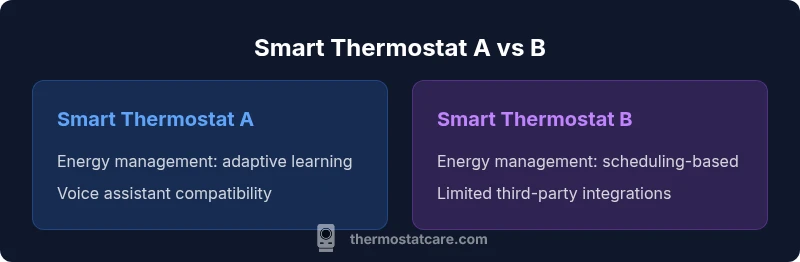
| Feature | Smart Thermostat A | Smart Thermostat B |
|---|---|---|
| Energy Efficiency | Significant energy savings through adaptive scheduling and occupancy sensing | Consistent energy management with proven scheduling and presence detection |
| Convenience & Remote Access | Full mobile app control and alerts | Basic scheduling with remote access limited |
| Learning & Automation | Advanced AI-driven learning of routines and occupancy | Good manual control with basic automation |
| Ecosystem Compatibility | Broad compatibility with major voice assistants and hubs | Narrower ecosystem integration with fewer third-party options |
| Installation & Setup | DIY-friendly setup in many homes | Often requires professional installation or more wiring work |
| Privacy & Security | End-to-end encryption and local control on some models | Cloud-dependent data collection with standard protections |
| Price & Value | Higher upfront cost but long-term savings | Lower upfront cost with potentially slower ROI |
Upsides
- Energy savings potential through adaptive scheduling
- Enhanced comfort and convenience
- Remote access and control from anywhere
- Compatibility with smart-home ecosystems
- Future-proof features via updates
The Bad
- Higher upfront cost and potential device dependency
- Privacy concerns due to data collection
- Requires reliable Wi-Fi for full functionality
- Some models may have compatibility issues with older HVAC systems
Smart thermostats are the better choice for most homes due to energy savings, enhanced comfort, and smarter scheduling.
If you value automation and control from anywhere, a smart thermostat pays back over time. Ensure compatibility with your HVAC and strong privacy settings to maximize benefits.
Questions & Answers
Are smart thermostats worth the investment?
For many homes, the combination of energy savings, convenience, and improved comfort justifies the upfront cost. ROI depends on usage, climate, and the model chosen. If you value automation and remote control, a smart thermostat is worth considering.
For many homes, smart thermostats are worth it due to energy savings and convenience. Consider your climate and usage to estimate ROI.
Do smart thermostats actually save energy?
Smart thermostats save energy by optimizing heating and cooling around occupancy and learned schedules. Savings depend on how well you configure them and how consistently you use automation. They perform best when there is good Wi‑Fi coverage and thoughtful routine setup.
Yes, they save energy by optimizing usage based on occupancy and learned habits. Setup and Wi-Fi quality influence the magnitude of savings.
Will my existing HVAC system work with a smart thermostat?
Most conventional HVAC systems are compatible with at least one smart thermostat, but some proprietary or very old setups may require adapters or professional installation. Before buying, verify compatibility with your furnace, heat pump, and wiring (C-wire availability is common).
Most systems work, but check compatibility with your furnace or heat pump and ensure you have a C-wire if needed.
How secure are smart thermostats against hackers?
Security varies by model, but reputable thermostats use encryption, regular updates, and strong authentication options. Use strong passwords, enable two-factor authentication where available, and keep firmware current to minimize risk.
Security depends on the model; enable encryption, update firmware, and use strong passwords to stay safe.
Do I need stable internet to use a smart thermostat?
Most features rely on cloud services and mobile apps, so internet is important for full functionality. Many devices retain local control if the internet is temporarily unavailable, but updates and remote access require connectivity.
Internet is important for full features, but many thermostats still work with local controls if the connection is down.
What features should I look for when choosing a model?
Prioritize compatibility with your HVAC, robust learning capabilities, reliable mobile app, privacy controls, and how well it integrates with your smart-home setup. Sensor coverage and ease of installation are also important factors to compare.
Look for HVAC compatibility, solid learning, good app support, privacy controls, and ecosystem compatibility.
What to Remember
- Assess HVAC compatibility before purchase
- Prioritize learning and geofencing features
- Ensure reliable Wi-Fi for cloud features
- Consider long-term energy savings vs upfront cost