Are Digital Room Thermostats Better? A Practical Comparison
Explore whether digital room thermostats outperform traditional models. This analytic comparison covers features, energy efficiency, cost, installation, and long-term value for homeowners evaluating digital vs analog thermostats.


Are digital room thermostats better? The quick answer is that digital room thermostats often outperform traditional analog models in precision, scheduling, and energy insight. They enable remote control and data-driven adjustments, though the best choice depends on your HVAC system and budget. This quick comparison previews the key differences and what matters most for homeowners, with guidance from the Thermostat Care team.
Are Digital Room Thermostats Truly Better for Home Comfort?
Are digital room thermostats better? The short answer is that they often are, especially when you value precise temperature control, flexible scheduling, and the ability to monitor energy usage. According to Thermostat Care, the decision hinges on how you plan to interact with your system and whether your HVAC setup supports digital control. In many homes, upgrading from a purely mechanical thermostat to a digital model brings noticeable improvements in comfort and responsiveness. The Thermostat Care team has found that digital interfaces typically reduce temperature swings, making rooms feel consistently comfortable. That said, the degree of benefit varies with installation quality, existing wiring, and whether you opt for a connected smart thermostat or a more basic digital model.
Defining Digital Room Thermostats: What They Are and What They Aren’t
Digital room thermostats replace the old dial with a digital interface, typically offering temperature readouts, programmable schedules, and sometimes connectivity to a home network. They aren’t a single product category; the term covers devices that range from basic programmable thermostats to fully connected smart thermostats. In short, digital thermostats translate user inputs into precise control signals for your HVAC system, often with software that learns routines over time. Thermostat Care emphasizes distinguishing digital from purely mechanical thermostats: you gain clarity, logging, and remote access, but you may trade some simplicity for features.
Energy Efficiency and Temperature Accuracy: Do Digital Models Save Energy?
Digital thermostats are designed to improve energy efficiency by reducing overshoot, maintaining tighter setpoints, and adapting to occupancy patterns. The Thermostat Care analysis shows that digital models typically provide more consistent temperatures and better integration with heating and cooling schedules. With learning capabilities and occupancy sensing, these devices can shift from broad on/off cycles to targeted adjustments, potentially lowering energy use over time. However, the actual savings depend on how often the thermostat is programmed, how often it is adjusted, and how well it is integrated with weather data and your HVAC system.
User Experience: Interfaces, Scheduling, and Connectivity
A central advantage of digital thermostats is user experience. Modern units offer clean interfaces, mobile apps, and sometimes voice control. Scheduling can be granular, and some models learn routines to automate temperature changes. Connectivity can unlock features like remote access, weather-based adjustments, and alerts if temperatures drift beyond a set range. The trade-off is added complexity and potential reliance on a stable wifi connection. For many homeowners, the convenience and control outweigh the extra setup time, especially when integrated with a broader smart home ecosystem.
Smart vs Digital: Where Digital Meets Smart Home
All smart thermostats are digital, but not all digital thermostats are truly smart. Smart models connect to the internet, support mobile apps, and offer advanced automation, geofencing, and voice assistant integration. Digital thermostats without connectivity still provide clear displays, programmable schedules, and better precision than analog. If you value remote control and automation, opt for a model with robust app support and strong interoperability with your preferred ecosystem (Alexa, Google Assistant, or Apple HomeKit). Thermostat Care notes that compatibility should be tested before purchase to ensure reliable operation with existing devices.
Compatibility, Wiring, and Installation: What to Expect
Before upgrading, assess wiring: most digital thermostats require a C-wire to power the device consistently. If your current setup lacks a C-wire, you may need a converter or a 24V transformer, which can add cost and complexity. In many homes, a straightforward replacement is possible, but older systems may require a pro to verify compatibility and ensure safe wiring. Thermostat Care advises confirming heat type (gas or electric), stage configuration (single-stage or two-stage), and the presence of a common wire. A proper fit ensures stable operation and long-term reliability.
Cost, Installation, and Long-Term Value
Digital thermostats generally come with a higher upfront cost than basic analog units, but the long-term value often justifies the expense through improved energy efficiency and convenience. In many cases, energy savings accumulate over time, and the ability to adjust remotely reduces the likelihood of overheating or underheating. The exact payback period varies with climate, usage patterns, and installation quality. Thermostat Care recommends evaluating total cost of ownership, including potential compatibility upgrades, installation fees, and any required Wi-Fi service.
Privacy, Security, and Reliability Considerations
Digital thermostats can introduce privacy and security considerations due to their connectivity. Ensure devices receive regular software updates, use strong passwords, and enable network protections such as firewalls and guest networks for IoT devices. Reliability depends on the stability of your home network and the vendor’s software support. For many households, regular updates and a robust router configuration mitigate most risks. Thermostat Care emphasizes choosing reputable brands with transparent privacy policies and clear guidance on data collection and usage.
Real-World Scenarios: When Digital Is the Clear Winner
In new-home builds with modern HVAC systems and robust Wi-Fi, digital thermostats with smart features clearly shine. They deliver precise control, automation, and energy feedback that helps homeowners optimize usage. In retrofit projects where wiring is constrained or HVAC systems are older, a digital thermostat with a simple interface can still offer significant value, especially if it supports a C-wire retrofit. In rental properties, remote management and alert features can be particularly advantageous for maintenance teams and tenants alike.
Pitfalls to Avoid When Moving to a Digital Thermostat
Avoid assuming all digital thermostats are created equal. Look for models with clear app interfaces, credible privacy policies, and a track record of secure software updates. Check wiring compatibility and whether the device needs a C-wire or a separate power adapter. Beware overly aggressive energy-saving modes that may cause uncomfortable temperature swings. Thermostat Care advises testing the device across a full week to ensure it maintains comfort and does not exhibit unexpected behavior.
Quick Decision Checklist: Are Digital Room Thermostats Right for You?
Use this quick checklist to decide: Do you have reliable wifi and a compatible HVAC system? Is remote control and energy feedback valuable to you? Are you comfortable with a potential setup more complex than a basic analog install? If you answered yes to these, a digital thermostat project is likely worthwhile. If you value extreme simplicity and minimal electronics, a basic digital model without connectivity could be a better fit. Thermostat Care recommends weighing both comfort and long-term savings.
Maintenance and Upkeep: Keeping Digital Thermostats in Peak Form
Maintenance for digital thermostats is generally light but important. Keep firmware up to date, monitor for connectivity issues, and periodically verify sensor calibration. Clean dust from the thermostat faceplate and ensure the device remains securely mounted. If you notice unusual temperature swings, check for power issues or a failing C-wire. A well-maintained digital thermostat will deliver consistent performance and ongoing energy insights.
Comparison
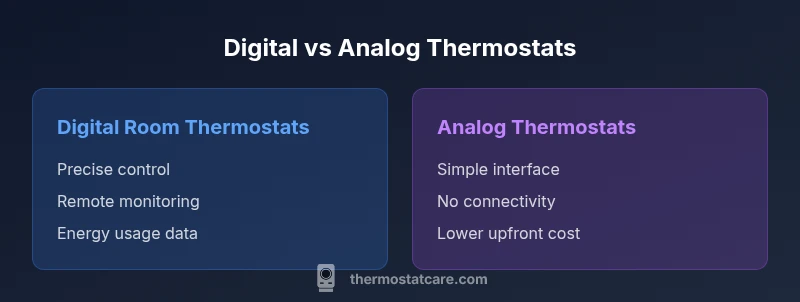
| Feature | Digital Room Thermostats | Analog Thermostats |
|---|---|---|
| Interface/Input method | Touchscreen and app control | Rotary dial or basic push-button |
| Control options | Remote/app access; some models with voice control | Local control only; no remote access |
| Scheduling & learning | Advanced scheduling; learning capabilities on many models | Simple, manual scheduling or none |
| Energy reporting | Detailed energy usage data and trends | Minimal or no usage data |
| Power source | C-wire or battery powered | Typically battery-powered or line-powered via HVAC |
| Wiring/install complexity | Moderate to high (may require C-wire or transformer) | Usually straightforward replacement |
| Upfront cost | Higher upfront cost | Lower upfront cost |
| Reliability/maintenance | Software/firmware updates; potential connectivity issues | Fewer moving parts; simpler maintenance |
| Best for | Tech-enabled homes; energy-conscious users | Budget-conscious or simple setups |
Upsides
- Improved temperature precision and comfort
- Remote control and scheduling enhance convenience
- Energy usage insights support smarter decisions
- Easier integration with other smart devices
- Faster troubleshooting through alerts and data
The Bad
- Higher upfront cost and ongoing software updates
- Requires stable Wi-Fi and cybersecurity precautions
- More complex installation in older homes
- Reliance on power and connectivity can introduce risk
Digital room thermostats generally offer better energy management and convenience; compatibility and budget determine the best fit
Choose digital if you want precise control and remote access. Choose analog if you prioritize simplicity and upfront cost. For many homes, a smart digital model provides the best balance of comfort and savings.
Questions & Answers
Are digital thermostats compatible with most HVAC systems?
Most digital thermostats work with standard HVAC setups, but some older systems may require wiring changes or adapters. Always confirm C-wire availability and compatibility with your furnace or air handler before purchasing.
Most digital thermostats fit typical systems, but check C-wire compatibility before buying.
Do digital thermostats help save energy?
Yes, digital thermostats often reduce energy use by delivering precise temperatures and enabling smarter schedules. The actual savings depend on usage patterns and climate, so set realistic schedules and utilize learning features where available.
They can save energy with precise control and smart schedules.
Are digital thermostats more expensive than analog ones?
Digital thermostats typically cost more upfront, especially smart models. However, potential energy savings and enhanced comfort can offset the initial price over time.
Upfront cost is higher, but long-term savings can offset it.
Can digital thermostats be controlled by voice assistants?
Many digital thermostats support voice control via Alexa, Google Assistant, or Apple HomeKit. Verify compatibility and setup steps with your preferred ecosystem.
Many support voice control—just confirm compatibility.
Do these thermostats require an internet connection?
Smart digital thermostats often rely on Wi-Fi for remote access and features, but non-connected digital models can operate without internet for basic functions.
Wi-Fi is common for smart models, but some digital ones work offline.
What maintenance do digital thermostats require?
Keep firmware up to date, monitor for connectivity issues, and periodically verify sensors. Regular checks help prevent misreadings and ensure stable performance.
Update firmware, check connectivity, and calibrate sensors as needed.
What to Remember
- Evaluate HVAC compatibility before upgrading
- Digital thermostats offer energy insights and automation
- Consider connectivity, privacy, and security implications
- Plan for potential wiring upgrades to enable power (C-wire)