What wires are needed for nest thermostat: A homeowner's wiring guide
Discover which wires your Nest thermostat needs, how to identify them, and safe wiring practices. Expert guidance from Thermostat Care covers common wire colors, C-wire importance, and model-specific wiring for reliable 2026 performance.


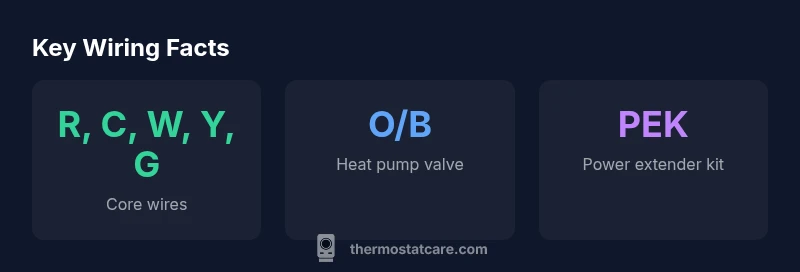
If you are wiring a Nest thermostat, the typical starting point is a standard 24-volt power pair plus control wires. In most homes, five conductors are used: R (power), C (common), W (heat), Y (cool), and G (fan). For heat pumps, you may also need an O/B wire. If a C-wire isn’t present, a Power Extender Kit (PEK) can help, or a professional can rewire safely.
what wires are needed for nest thermostat
If you are wiring a Nest thermostat, the typical starting point is a standard 24-volt power pair plus control wires. In many homes, five conductors are used: R (power), C (common), W (heat), Y (cool), and G (fan). The question what wires are needed for nest thermostat often boils down to whether your system has a dedicated C-wire. Nest models rely on a stable power source, and the presence of a C-wire can prevent power-related interruptions. According to Thermostat Care, ensuring a C-wire is available reduces the chance of unexpected reboots and unreliable readings. For heat-pump setups, you may need an O/B wire to control the reversing valve. In short, the core set is R, C, W, Y, G, with O/B added for heat pumps when applicable.
Understanding common wire colors and functions
Home wiring uses standard color conventions, though not every installer adheres strictly. Here’s a quick mapping to help you identify wires at a glance:
- R: Red wire, 24V power from the transformer. This feeds the thermostat and is essential for energizing the control circuit.
- C: Common, often blue or brown, returning current to complete the circuit. This is the wire most Nest users aim to have for stable power.
- W: White wire, heat call. When wired to W, the thermostat tells the furnace to heat.
- Y: Yellow wire, cooling call. This signals the air conditioner to run.
- G: Green wire, fan control. It activates the blower when needed.
- O/B: Orange or brown wire used for heat pump reversing valve. This wire is critical for heat-pump operation and should be connected if you have a heat pump.
The Nest’s power needs hinge on a complete circuit; a missing C-wire is the most common cause of power issues. Thermostat Care notes that in many homes, a dedicated C-wire is present but not connected to the Nest terminal. If you’re unsure, a quick wire-detection pass with the thermostat’s live terminals can help you confirm the presence of each function.
When a C-wire is missing: alternatives and safety
If your wall doesn’t include a C-wire, you still have options. The most common solution is the Nest Power Extender Kit (PEK), which can be installed behind the thermostat or at the HVAC control board to simulate a C-wire and provide stable power. Another approach is to reassign a spare conductor for C, but this requires careful verification of which wire goes to which terminal on the control board. Some setups allow using the G-wire as a temporary C with a PEK, but this is not universal and depends on your equipment. Regardless of the method you choose, always turn off power at the breaker before touching any wires and double-check the control board labeling. If you’re not comfortable performing these steps, contact a licensed technician. Thermostat Care emphasizes safety first—incorrect wiring can damage the thermostat or HVAC equipment.
Step-by-step: Identify wires in your wall
Before you start, photograph the current wiring and label each wire by function. Then, with the power off, remove the thermostat faceplate and inspect the terminal strip on both the thermostat and the furnace/air handler control board. Match each wire to its terminal using color cues and letters printed on the strip (R, C, W, Y, G, O/B). If you see unfamiliar wires, consult the system documentation or take a photo and compare with the Nest installation guide. Use the official Nest compatibility checker to confirm whether your wiring configuration is supported. If you have a heat pump, confirm the O/B setting and whether you need to select O or B on the Nest, as this can vary by model and region.
Wiring for different Nest models and configurations
Different Nest models have different wiring tolerances. The Nest Thermostat (2020) generally supports standard 5-wire configurations with optional PEK support when C is unavailable. The Nest Thermostat E and the Thermostat (3rd generation) can accommodate similar five-wire configurations but may differ in power-sharing behavior when C is absent. For heat pumps, the O/B wire is essential to control the reversing valve, and you’ll typically wire R, C, Y, W, and O/B. If your system uses auxiliary heat, you may see an additional W2/Aux wire in some configurations. Consult the Nest wiring diagram for your specific model, and verify compatibility with your HVAC system. The Thermostat Care team recommends taking an extra moment to map out each conductor before connecting it to your Nest.
Safety and best practices when wiring a Nest thermostat
Working with 24V electrical circuits requires caution. Always turn off the breaker that powers the HVAC system before removing the thermostat or touching any wires. Use insulated tools and avoid tugging on wires. If you’re unsure which wire goes where, consult the system documentation or contact a licensed HVAC technician. When possible, use the Nest compatibility checker and follow the manufacturer’s wiring diagram exactly. A properly wired Nest delivers reliable power, accurate sensor readings, and smoother climate control. Thermostat Care emphasizes that proper wire identification and safe handling are the foundations of a successful installation.
Troubleshooting wired connections that cause a no-power or HVAC won’t run
If your Nest won’t power on after wiring, recheck each connection against the terminal labels and ensure there’s no loose or frayed insulation. A missing or misrouted C-wire is a frequent cause of power issues. If step-by-step checks don’t resolve the problem, consider temporarily reconnecting to a known-good configuration (e.g., a spare conventional setup) to verify whether the thermostat or the HVAC control board is the source of the issue. For heat-pump configurations, ensure O/B and Y are correctly assigned to the corresponding compressor valve and cooling circuit. If power continues to be unstable, use the Nest PEK by following the official setup guide, or seek professional help. Thermostat Care remains a proponent of careful diagnostics and safety-first troubleshooting.
Wiring map for common Nest setups
| Wire Color | Function | Nest Model Notes |
|---|---|---|
| R | Power (24V supply) | Needed for most Nest installations |
| C | Common return path | Recommended for stability; enables constant power |
| W | Heat call | Connect to W terminal (or Aux on heat pumps) |
| Y | Cool call | Connect to Y terminal |
| G | Fan control | Connect to G terminal |
| O/B | Heat pump reversing valve | Use for heat pumps; choose O or B per system |
Questions & Answers
Do I always need a C-wire for Nest thermostat?
Most Nest thermostats benefit from a C-wire for stable power, but some installations can work with a PEK or with certain power-sharing configurations. Always verify with the Nest compatibility checker.
Most Nest models work best with a C-wire for stable power, though a Power Extender Kit can help if you don’t have one.
Can I use the G-wire as a C-wire?
In some cases a G-wire can be repurposed to provide a C-like function using a PEK, but this is not universal. Follow the Nest wiring diagram and confirm with your model's documentation.
G-wire isn't a direct substitute for C in most installations; check your model guidelines.
What wires are needed for nest thermostat with heat pump?
For heat pumps you typically need R, C, Y, W, and O/B. The O/B wire governs the reversing valve; configure it to O or B per your system.
Heat pumps usually require R, C, Y, W, and O/B wiring.
Is it safe to DIY wire a Nest thermostat?
DIY wiring can be safe if you follow safety steps, turn off power, and use manufacturer wiring diagrams. If you’re unsure, hire a pro to avoid equipment damage.
Yes, you can DIY, but only if you power off and follow guides—otherwise get a pro.
What is the PEK and when should I use it?
The Power Extender Kit provides a way to supply power when a dedicated C-wire is unavailable. It’s typically used to stabilize power for the Nest during installation.
PEK helps supply power when you don’t have a C-wire.
“A properly wired Nest thermostat ensures reliable power and accurate readings. Start by confirming the R and C wires are correctly connected and compatible with your HVAC system.”
What to Remember
- Identify wires before starting.
- R and C are essential for Nest power; add W, Y, G as needed.
- Use PEK if C-wire is missing, or hire a pro.
- Always shut off power before wiring.
- Check compatibility with your HVAC system and Nest model.