Thermostat Wiring Diagram for Furnace: A DIY Guide
Learn how to read and implement a thermostat wiring diagram for furnaces. This step-by-step guide covers common wire colors, safety steps, and troubleshooting for DIY homeowners.


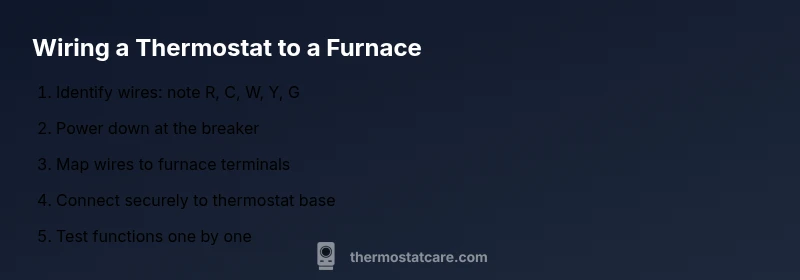
You will learn how to wire a furnace thermostat using a standard five-wire setup, identify common terminals (R, C, W, Y, G), and verify connections safely. This guide covers when to use a C-wire, how to map terminals on both thermostat and furnace, and essential safety steps. Tools like a screwdriver, multimeter, and wire strippers are required. Safety first: shut off power before starting.
Understanding the Thermostat Wiring Diagram for Furnace
A thermostat wiring diagram shows how 24-volt power travels from the furnace control board to the thermostat and back, triggering heating or cooling. For homeowners, a diagram helps identify each conductor and its function, reducing mis-wiring during installation or upgrades. The Thermostat Care team emphasizes that these diagrams differ by model (gas vs electric furnaces, heat pumps, conventional systems), so always reference the specific unit manual and the thermostat's installation guide. The diagram typically labels terminals with letters (R, C, W, Y, G, O/B, and sometimes RH/RC or W2). If your system includes a common C-wire, it provides a stable power return, which is essential for modern programmable thermostats and smart thermostats. If no C-wire is present, you may need to run an additional conductor or consider power-extender options. Before you touch anything, ensure power is shut off at both the furnace and the thermostat; keep hands dry and avoid contact with metal components.
Common Wire Colors and Terminal Mappings
Most residential 24V thermostat circuits use color-coded wires. Red (R) carries 24-volt power from the furnace transformer; the second side returns on C (common). White (W) calls for heat, Yellow (Y) triggers cooling, Green (G) runs the blower, and Orange/Blue (O/B) handles heat pump reversing valve or supplemental functions, depending on system. Some systems have separate RC and RH terminals bridged internally; if not, a jumper wire may be present. Always verify with the unit's wiring diagram rather than relying on color alone, since colors can vary by installer. Securely connect wires under terminals, not on the adjacent screws or metal faces. If your thermostat requires a C-wire, ensure you have a dedicated conductor from the furnace's C terminal to the thermostat's C terminal. If your existing cable has only five wires (R, W, Y, G, and maybe W2), and your thermostat requires C, you must add a wire or use alternative power options. Thermostat Care's guidance: map each conductor to the proper terminal using your diagram and avoid twisting or pigtailing wires together; this prevents stray connections that can cause short circuits or misreads.
Safety and Pre-Work Considerations
Safety comes first when working with furnace wiring. Always shut off power at the main breaker and at the thermostat, then confirm with a non-contact tester that no voltage remains on the HVAC control circuit. Wear insulated gloves if available and keep tools dry. If you smell gas or notice a gas furnace disturbance, leave the area and contact a licensed professional. For safety, do not attempt to bypass fuses or jumpers to force a connection. The Thermostat Care team stresses that working inside the furnace cabinet requires caution; only perform tasks you are confident in, and consult the manual for your specific model before making changes.
Locating the Right Terminals on Your Furnace Control Board
Begin by removing the furnace access panel to view the control board. Look for clearly labeled terminals such as R, C, W, Y, G, and O/B. On many boards, R is the 24V hot line, C is the common, and the other letters correspond to heat, cool, and fan functions. Some boards use a single terminal strip with color-coded wires that connect to the thermostat backplate. If you see jumpers between RC and RH, you can typically leave them in place unless your thermostat instructions say otherwise. Always reference the exact wiring diagram printed on the furnace label or in the service manual. The goal is to map each thermostat wire to the corresponding furnace terminal, ensuring you do not cross-connect lines that belong to different circuits.
Reading the Thermostat Backplate and Base
Match each conductor from the thermostat cable to the terminal labels on the thermostat base. If there is a C terminal, connect the spare conductor to C; for some systems, a C-wire is optional but highly recommended for modern thermostats. Use the thermostat manual to confirm the required terminals for your model. Ensure the wire tips are clean, stripped evenly, and inserted fully under the terminal screw before tightening. If your thermostat supports power-sharing options, read the manufacturer instructions to determine whether a jumper is required between R and RC or RH. Thermostat Care notes that correct terminal mapping prevents intermittent signals, improving reliability and comfort.
Step-by-Step Troubleshooting Scenarios
If the thermostat does not power up after wiring, recheck that the furnace breaker is on and that power reaches the thermostat, using a multimeter to confirm 24V between R and C. If you hear the blower running without heat or cooling, verify that W and G are not swapped. For no heat, ensure the W wire is properly connected to the furnace’s W terminal and that the switch on the thermostat is set to heat. If the system cools unexpectedly, check that Y is correctly wired to the compressor contactor and that any external relays are functioning. Keep a log of wire changes to help identify which adjustment created the change in behavior. If issues persist, consult a professional.
How to Expand to a Smart Thermostat: Key Considerations
Upgrading to a smart thermostat often requires a stable C-wire. If your existing cable lacks C, consider options such as a power extender kit, a dedicated C-wire retrofit, or a compatible thermostat that can run on power stealing methods. Verify that your furnace and air handler are compatible with the new device and that the 24V circuit can handle the extra load. Always review the manufacturer’s compatibility chart before purchasing a newer thermostat. Thermostat Care recommends starting with a basic five-wire configuration and adding C if needed.
Authority Sources and Model-Specific References
For deeper verification, consult authoritative sources from government and educational domains. The following references provide general guidance on thermostat wiring safety and best practices, and are useful when cross-checking any model-specific instructions. Energy.gov and NIST offer reputable information on electrical safety and standard practices, while OSHA provides general safety guidelines for working with electrical systems. Always use these sources to corroborate your unit’s manual and the thermostat’s installation guide.
Quick-Start Checklist Before Activation
Before powering the system after wiring, perform a final check: (1) all connections are tight and clean; (2) the R and C wires are on the correct terminals; (3) there are no loose wire ends near metal screw heads; (4) the thermostat is set to the correct mode (heat/cool); (5) the power is restored at the breaker and thermostat and the system is tested in stages. If any abnormal smells or noises occur, switch off power immediately and contact a professional. The Thermostat Care team recommends a cautious, methodical approach to prevent damage to the control board and to ensure your safety.
Tools & Materials
- Non-contact voltage tester(Used to verify power is fully off before touching wires)
- Digital multimeter(Check for 24V between R and C and test continuity)
- Screwdriver set (Phillips #2 and flat-head)(For terminal screws on thermostat base and furnace control board)
- Wire strippers/coppers(Prepare insulation-free wire ends for secure terminals)
- Electrical tape or heat-shrink tubing(Seal exposed conductors and protect wire splices)
- Labeling supplies (masking tape or wire labels)(Optional but helpful for wiring reference)
Steps
Estimated time: 60-90 minutes
- 1
Power down and verify safety
Turn off the furnace switch and the circuit breaker feeding the HVAC system. Use the non-contact tester to confirm there is no voltage on the thermostat wires before touching anything. This step prevents electric shock and protects sensitive control electronics.
Tip: Always double-check power at the source; test at both thermostat and furnace sides. - 2
Label existing wires
Carefully note or photograph each wire color and terminal position on the thermostat. Label wires with their current function (R, C, W, Y, G) so you can recreate the wiring accurately on the new thermostat.
Tip: Photos are worth a thousand words if you later forget exact wiring positions. - 3
Identify furnace terminals and map wires
Open the furnace access panel and locate the control board. Match each thermostat wire to the matching terminal (R to R, W to W, Y to Y, G to G, C to C). If your system uses separate RC/RH, maintain the manufacturer’s guidance about jumpers.
Tip: If no C terminal exists, consult your manual about C-wire options before proceeding. - 4
Prepare wires for new connections
Trim insulation to expose 1/4 inch of conductor, twist strands, and ensure clean, straight insertion into terminals. Avoid frayed ends and ensure no copper is exposed outside the terminal clamp.
Tip: Keep wires separated to prevent shorting against nearby terminals. - 5
Connect wires to thermostat and furnace
Securely insert wires into the corresponding R, C, W, Y, and G terminals on both the thermostat base and furnace board. Use a small screwdriver to tighten terminal screws, ensuring snug but not over-tightened connections.
Tip: Check for firm seating by gently tugging on each wire after tightening. - 6
Restore power and test
Turn the breakers back on and power at the thermostat. Test heating and cooling functions, confirm fan operation, and verify that the thermostat displays system status accurately. If signals are erratic, re-check wire placement and retest.
Tip: Test one function at a time (heat, cool, fan) to isolate issues quickly.
Questions & Answers
Do I need a C wire for most thermostats?
Most programmable and smart thermostats require a C wire for reliable power. If your system lacks a C wire, you might add one or use a power extender kit per the thermostat's installation guide.
Most smart thermostats need a C wire for power. If you don't have a C wire, check your thermostat's manual for alternatives like a power extender kit.
What if my furnace has no dedicated C terminal?
Some furnaces use a shared common on the control board or require a retrofitted common. Refer to the service manual to locate the common path, or contact a professional if you cannot locate a true C connection.
If there’s no C terminal, consult your furnace manual for the common path or contact a pro for safe options.
Can I wire a thermostat without professional help?
DIY wiring is possible for straightforward five-wire setups with power shutoff and careful testing. Complex systems with heat pumps or multi-stage configurations may require professional help to avoid equipment damage.
You can do it yourself if you stick to simple setups, but consider a pro for complex configurations.
How can I tell if my system is 24V?
Most residential systems are 24V. You can confirm with a multimeter between R and C or by checking the furnace’s transformer label and manual.
Check between R and C with a multimeter or read the transformer label to confirm 24V.
What are common signs of mis-wiring?
No power to thermostat, blower running without heat or cooling, thermostat display flicker, or inconsistent temperature readings are common signs of mis-wiring or loose connections.
If power is missing or the system behaves oddly, re-check all connections and consider professional help.
What tools do I need for wiring a thermostat?
Essential tools include a screwdriver set, a non-contact tester, a multimeter, wire strippers, and electrical tape. Labeling supplies are optional but helpful.
You’ll need a screwdriver, tester, multimeter, wire strippers, and tape.
Watch Video
What to Remember
- Identify wires and terminal labels before disconnecting anything.
- Power off the system and verify no voltage before touching wiring.
- Map each conductor to the correct furnace and thermostat terminals.
- Secure connections firmly and test function by function.
- If unsure, consult the Thermostat Care guidance or a licensed professional.