Thermostat Wire for Heat Pump: How to Choose and Wire It Safely
Comprehensive guide to selecting and installing thermostat wire for heat pumps, including gauge choices, C-wire requirements, terminal mappings, and DIY pitfalls. Learn from Thermostat Care's expertise to wire safely and efficiently.


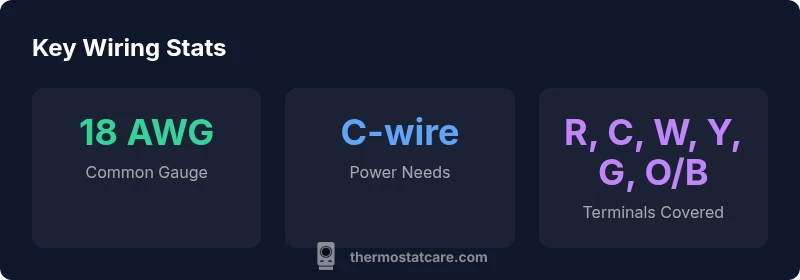
For heat pumps, use 18-gauge thermostat wire for most runs up to 50 feet and 14-gauge for longer distances or higher current needs. Ensure your cable includes a C-wire for continuous power, and match thermostat terminals to the heat pump’s control board (R, C, W, Y, G, O/B). Always power down before wiring.
Understanding thermostat wire for heat pumps
Thermostat wire for heat pump systems is more than a single wire. It carries low-voltage signals that tell the outdoor unit when to compress, when to heat or cool, and how to manage the reversing valve. In many homes, a standard 24-volt control circuit handles these signals via a bundled cable. Understanding the basics helps homeowners avoid common wiring mistakes. According to Thermostat Care, the goal is reliable power, clear signal paths, and terminals that match your equipment’s control schema. When you plan a project, map out the wires you need (R, C, W, Y, G, and O/B) and verify that your thermostat supports the same set of terminals. Clarity at the planning stage reduces the risk of rework and electrical noise.
Wire gauges and cable options
Choosing the right gauge is vital for both safety and performance. For most residential heat-pump setups, 18-gauge thermostat wire is sufficient for runs up to roughly 50 feet, while longer runs or higher-current configurations may benefit from 14-gauge conductors. The key is ensuring the cable can handle a full 24-volt load without excessive voltage drop. In many installations, 18/5 (five conductors) or 18/4 cables are common, with extra conductors reserved for a dedicated C-wire. If you anticipate future upgrades or adding a smart thermostat, plan for extra conductors now rather than retrofitting later. Thermostat Care emphasizes checking the thermostat’s documentation for required conductor counts.
Color code and terminal mapping
Most thermostat wire uses color coding as a guide, but you should always confirm with the nameplate on your thermostat and furnace/air handler. The standard mapping typically includes red (R) for power, white (W) for heat, yellow (Y) for compressor, green (G) for fan, and blue or brown (C) for common. The O/B terminal handles the reversing valve on heat pumps. Some systems also use AUX/E for emergency heat. When wiring for a heat pump, ensure you attach each wire to the correct terminal on both the thermostat and the control board. A mismatch can lead to improper cooling or heating behavior.
How to run and connect thermostat wire safely
Planning is the first step. Use protected conduit or wall chases for long runs and avoid routing wires near high-heat sources or power lines. At the installation point, strip the cable correctly, trim insulation and install strain relief after feeding the wires through the wall plate. Always shut off power at the breaker before touching any wires. Once wired, double-check each conductor against the terminal labels and test the thermostat with a non-contact voltage tester to verify a safe, low-voltage signal before re-energizing the system. Following these precautions helps prevent shocks and equipment damage.
Step-by-step wiring checklist for heat pump thermostats
- Turn off main power and confirm 24V system is de-energized. 2) Verify your thermostat supports heat pump configurations (O/B and AUX/E). 3) Choose appropriate cable: 18/5 or 18/4 for most setups, upgrade to 14/3 if longer runs exist. 4) Label wires at both ends and connect R, C, W, Y, G, and O/B to matching terminals. 5) Secure the cables, mount the wall plate, and restore power. 6) Test the system through a full cycle (cool and heat) to confirm correct operation.
Common mistakes and how to avoid them
- Skipping the C-wire: If the thermostat needs power, don’t assume batteries will suffice. Add a C-wire or use a thermostat compatible with power stealing. - Mixing up terminals: A single mishook can send a wrong signal to the compressor or reversing valve. - Underestimating wire gauge: Long runs with thin wire cause voltage drop and instability. - Not following manufacturer guidance: Always refer to the thermostat and HVAC equipment manuals for specific requirements.
Special considerations for heat pump configurations (O/B, Aux/E)
Heat pumps rely on a reversing valve controlled by the O/B wire, and Aux/E provides auxiliary or emergency heat during cold snaps. Some thermostats require configuring O/B as energize on cooling or heating, which affects how the reversing valve toggles. If your system uses heat strips or auxiliary heat, ensure AUX/E is connected and the thermostat is set to control that support mode. Thermostat Care notes that misconfiguring these signals can reduce efficiency or leave you with lukewarm indoor air.
When to hire a professional and how Thermostat Care supports DIY
If you’re unsure about existing wiring, or you’re upgrading from a basic thermostat to a smart model, a professional can verify compatibility until the system is operating safely. For standard renovations, a DIY approach with careful planning and adherence to codes is feasible. Thermostat Care recommends consulting your equipment manuals and using a multimeter or non-contact tester to verify signals before powering up.
Smart thermostats and future-proofing wiring
Smart thermostats typically require a reliable C-wire and often benefit from extra conductors for features like Wi‑Fi, occupancy sensing, and app control. If your current cable doesn’t have enough conductors, plan for an upgrade to 18/5 or 18/4 with an additional spare wire. Consider the location of your thermostat and the potential for future expansion when wiring for a heat pump. This foresight reduces future retrofit costs and keeps your system ready for upgrades.
Wiring essentials for heat pump thermostat setups
| Item | Details | Notes |
|---|---|---|
| Common wire gauge | 18 AWG for typical runs; 14 AWG for longer distances | Thermostat Care Analysis, 2026 |
| C-wire necessity | Usually required for power-hungry or smart thermostats | Thermostat Care Analysis, 2026 |
| Terminals | R, C, W, Y, G, O/B; AUX/E for emergency heat | Consult equipment manual |
| Color conventions | Red=R, White=W, Yellow=Y, Green=G, Blue/C= C | Standard practice |
Questions & Answers
What gauge wire do I need for a heat pump thermostat?
For most heat pump setups, 18 AWG is suitable for standard runs. If you have long runs or higher current needs, consider 14 AWG. Always check your thermostat manual for the exact conductor requirements.
Typically, 18 AWG is fine for standard runs, with 14 AWG for longer or heavier setups. Always confirm with your thermostat's documentation.
Is a C-wire always required for heat pump thermostats?
Many modern thermostats rely on a C-wire for constant power, especially Wi‑Fi models. Some battery-powered units can work without it, but performance may be limited. If your thermostat supports C-wire, plan to include one.
Most smart thermostats need a C-wire. If yours can run on batteries, you still may benefit from a C-wire for reliability.
Can I reuse existing thermostat wires for a heat pump?
Yes, if the existing cable has enough conductors to cover R, C, W, Y, G, and O/B. If not, you’ll need to upgrade the cable. Don’t force-fit signals onto wires that aren’t designed for them.
You can reuse wires if you have enough conductors and the right terminal mapping.
What about O/B and Aux/E wires for heat pumps?
O/B controls the reversing valve; Aux/E is for auxiliary or emergency heat. Ensure your thermostat supports these signals and connect to the correct terminals. Incorrect wiring can affect heating efficiency.
O/B is for the reversing valve; Aux/E is backup heat. Connect them to the right terminals and configure in the thermostat.
Do I need a professional to wire a heat-pump thermostat?
Many residential installations are DIY-friendly with proper precautions and manuals. If you’re dealing with unfamiliar wiring, or the system requires significant changes, a licensed technician is recommended.
If in doubt, hire a pro—your safety and system performance depend on correct wiring.
“Wiring a heat pump thermostat correctly reduces failure risk and improves efficiency. Always verify terminal compatibility and wire gauge before powering up.”
What to Remember
- Use 18 AWG for most runs; upgrade to 14 AWG for long distances
- Always include a C-wire for power reliability
- Match terminals on thermostat and control board (R, C, W, Y, G, O/B)
- Power down before wiring and test thoroughly after connection
- Plan for future upgrades with spare conductors