Nest Thermostat vs Honeywell: A Comprehensive 2026 Comparison
A detailed, objective comparison of Nest and Honeywell thermostats, highlighting ecosystem, features, installation, energy savings, and value to help homeowners decide which smart thermostat fits their home in 2026.


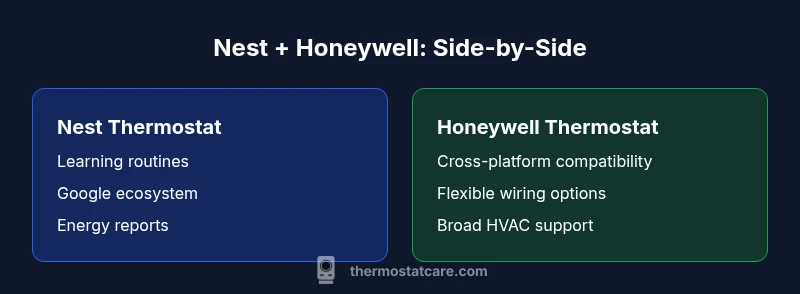
Nest thermostat vs Honeywell: both are leading smart thermostats, but they serve different user needs. Nest emphasizes learning behavior, occupancy sensing, and an ecosystem built around Google Assistant and Google Home. Honeywell prioritizes broad compatibility, robust manual control, and straightforward setup. If you want hands-off optimization within a Google-centric home, Nest is compelling; if you need flexible integration across brands and easy setup, Honeywell may suit you better.
nest thermostat vs honeywell: market positioning and core differences
In the world of smart thermostats, nest thermostat vs honeywell represent two distinct philosophies. According to Thermostat Care, Nest is designed for hands-off automation, learning routines, and deep integration with the Google ecosystem. Honeywell, by contrast, emphasizes compatibility with a wide range of HVAC systems, flexible wiring, and reliable performance across platforms. The core difference informs everything from feature sets to installation choices. Nest tends to reward users who want a low-effort, intelligent schedule, while Honeywell appeals to homeowners who value cross-brand compatibility and direct control. For homeowners and DIY enthusiasts weighing installation effort, ecosystem commitment, and long-term value, this fundamental split helps frame the rest of the comparison. The Thermostat Care analysis highlights that user preference for an ecosystem and level of automation often dominates the decision. In short, Nest leans into automation; Honeywell leans into versatility.
core feature differences
Both brands deliver core thermostat functionality—cooling and heating control, scheduling, and remote access—but they diverge on how those features are delivered. Nest places a premium on learning algorithms, occupancy sensing, and energy reporting, with a streamlined app that minimizes manual setup once the device is installed. Honeywell emphasizes traditional controls, expanded compatibility with a diverse lineup of HVAC systems, and the ability to fine-tune schedules through a robust app. In practical terms, Nest shines when you want a “set it and forget it” experience, while Honeywell shines when you need flexibility to match unusual HVAC configurations or integrate with non-Google platforms. The upshot is a trade-off between automation depth and configuration breadth. For most homes, the choice comes down to whether you want a seamless, smart-home experience or a flexible, platform-agnostic controller.
ecosystem, compatibility, and smart-home integration
Ecosystem compatibility is a central differentiator. Nest is deeply integrated with Google Home and Google Assistant, which makes voice control and routines feel natural within a Google-centric home. If you already rely on Google services, Nest can feel like a natural extension of your smart space. Honeywell offers broader cross-platform compatibility, including support for Alexa, Google Assistant, and, depending on the model, HomeKit and other platforms. This makes Honeywell a strong choice for homes that use multiple assistants or that have devices outside the Google ecosystem. In practice, if you want a single-brand experience within Google’s ecosystem, choose Nest; if you need flexibility across several platforms, Honeywell is the safer bet. The decision often hinges on your current smart-home investments and future device plans.
installation, wiring, and setup considerations
Wiring requirements can influence long-term satisfaction. Nest is often recommended for homes with standard wiring and a C-wire, but it has models that perform reasonably well with limited wiring and battery power. Honeywell generally offers broader compatibility with a variety of HVAC systems and wiring configurations, which can reduce installation headaches for older homes or unusual setups. If you’re upgrading from a basic thermostat, you may encounter more straightforward wiring with Honeywell in some scenarios, while Nest can be very straightforward in typical modern homes. Always verify compatibility with your furnace control board and air handler. Thermostat Care emphasizes planning the wiring map before purchase to avoid surprises during installation, particularly if your system uses unconventional heat pumps or multi-stage setups.
energy management, privacy, and data handling
Energy-saving features are a key driver for most buyers. Nest provides energy reports, occupancy-based adjustments, and learning behaviors that can yield meaningful savings over time. Honeywell offers energy-saving modes and efficient scheduling, with a focus on predictable performance across a wide variety of systems. Privacy considerations differ between brands. Nest, being part of Google’s ecosystem, may involve data handling practices aligned with Google’s policies, while Honeywell emphasizes local-control options on many models and transparent privacy settings. For privacy-conscious users, reviewing each device’s data policies and opting into only necessary features is a wise step before enabling cloud-connected controls.
hardware design, user interface, and experience
From a hardware and UX perspective, Nest finishes with a modern, minimalist look and a touch-sensitive user interface. The Nest app tends to emphasize ease of use, with automated suggestions and simple remote control. Honeywell devices often prioritize tactile controls and a comprehensive app that provides extensive customization options. If you prefer a sleek, modern device with an emphasis on automation, Nest is appealing. If you want granular control over schedules, fan settings, and multi-stage systems, Honeywell’s approach can feel more satisfying. In a real-world home, the choice often comes down to whether you value aesthetics and automation (Nest) or customization and cross-brand compatibility (Honeywell).
reliability, updates, and long-term support
No thermostat lasts forever, but both brands push regular firmware updates to add features and fix issues. Nest tends to push updates that align with Google’s broader platform strategy, which can deliver streamlined features but may require more frequent app interaction. Honeywell’s updates are typically more module-driven, focusing on compatibility improvements across a broader hardware lineup. For homeowners who want a long-term, predictable upgrade path with a clear support channel, Honeywell can be appealing due to its broad installation base. Thermostat Care notes that ongoing compatibility and timely security updates should factor into your decision, especially if you plan to keep your system for many years.
choosing between Nest and Honeywell: use-case driven guidance
Consider your home’s existing ecosystem and your preferences for automation versus control. If you already live in a Google ecosystem and prefer a hands-off experience that learns your patterns, Nest is a compelling choice. If you have a mixed device environment, value broad compatibility, and want maximum control over settings, Honeywell is typically the better fit. Budget considerations, the age and type of your HVAC system, and the likelihood of future device additions should guide your final decision. Thermostat Care’s recommendation is to map your priorities to the brand’s strengths and to verify compatibility with your current wiring and HVAC configuration before purchasing.
practical buying tips and next steps
Before you buy, confirm the exact model’s features and compatibility for your home. Create a wiring plan and check for a compatible C-wire if available. Compare the apps’ interfaces and how each brand handles notifications, schedules, and voice control in your home setup. If possible, consult a local installer or HVAC professional to confirm wiring and compatibility, especially for homes with older systems or multi-stage heating. Finally, review each brand’s privacy and data practices to align with your comfort level about data sharing and cloud-based features. A thoughtful comparison will help you select the thermostat that best fits your home and lifestyle.
Comparison
| Feature | Nest Thermostat | Honeywell Thermostat |
|---|---|---|
| Ecosystem compatibility | Strong with Google ecosystem; limited non-Google hub support | Broad cross-platform compatibility (Alexa, Google Assistant; some HomeKit) |
| Learning vs manual control | Learning routines with occupancy sensing | Traditional scheduling with strong manual controls |
| Energy features | Energy reports and occupancy-based optimization | Energy-saving modes and flexible scheduling |
| installation/wiring requirements | Typically requires C-wire; optimized for standard wiring | Broad wiring compatibility; adaptable to non-standard configurations |
| Voice assistant support | Best with Google Assistant; compatible with others via routines | Supports Alexa and Google Assistant; broader third-party integrations |
| Price/value | Mid-to-premium pricing; strong feature set | Mid-range to value-oriented pricing with broad compatibility |
| Best for | Google ecosystem lovers seeking automation | Cross-platform homes needing flexible integration |
Upsides
- Strong energy-saving features and learning in Nest
- Excellent Google ecosystem integration for Nest
- Broad compatibility and flexible installation options with Honeywell
- Reliable performance and broad platform support with Honeywell
- Remote access and intuitive mobile apps for both brands
The Bad
- Nest learning can be slow to adapt in some homes
- Google ecosystem dependence may limit features for users outside that ecosystem
- Some Honeywell models require more setup time due to compatibility options
- Privacy considerations require reviewing data policies before enabling cloud features
Nest is best for Google-centric, automated setups; Honeywell excels in cross-platform compatibility and flexible installation.
Choose Nest if you want hands-off automation and Google ecosystem depth. Choose Honeywell if you need broad compatibility and more wiring flexibility. Your choice should align with your home’s devices and how you plan to use voice assistants.
Questions & Answers
Which thermostat is easier to install, Nest or Honeywell?
In many homes, Nest can be straightforward if you have standard wiring and a C-wire. Honeywell often offers broader compatibility with a wider range of HVAC systems, which can simplify installation in older or more complex setups. Always verify your system’s compatibility before purchasing and consider professional help if you’re uncertain.
Nest can be easy with standard wiring, while Honeywell’s broader compatibility helps in unusual systems. Verify compatibility before buying.
Do Nest and Honeywell work with Google Home and Alexa?
Both brands support major voice assistants. Nest integrates deeply with Google Assistant and Google Home, while Honeywell supports Alexa and Google Assistant, with varying levels of integration depending on model. If you rely on HomeKit or other ecosystems, check model-specific compatibility.
Nest works great with Google; Honeywell supports Alexa and Google Assistant. Check model-specific compatibility for HomeKit.
Can I upgrade from a basic thermostat to Nest or Honeywell without a professional?
Many homeowners can upgrade without a professional if their wiring is standard and compatible. However, certain HVAC configurations or unfamiliar wiring can require an HVAC tech. Use the manufacturer guidance and, when in doubt, consult a local pro to avoid damaging the system.
DIY is possible for standard wiring, but consult a pro for complex HVAC setups.
Which is better for energy savings?
Both brands offer energy-saving features, but Nest emphasizes learning-based optimization and occupancy sensing, while Honeywell focuses on configurable schedules and efficient modes. Your actual savings depend on your home, occupancy, and how you tailor settings.
Nest leans on learning-based savings; Honeywell on configurable efficiency. Actual results depend on usage and setup.
Are there privacy concerns with Nest or Honeywell?
Yes, both collect data through cloud-based services to enable features. Nest’s data practices are tied to Google’s policies; Honeywell offers more control over data sharing on some models. Review the privacy settings and disable cloud features if you prefer local control.
Both involve data sharing; review privacy settings and adjust accordingly.
Do these thermostats require ongoing maintenance?
Both devices typically require occasional firmware updates and app maintenance to access new features. Regularly check for updates and verify that the thermostat remains connected to a reliable Wi-Fi network for best performance.
Expect occasional updates and app checks; keep Wi‑Fi stable for best results.
What to Remember
- Assess your ecosystem: Nest for Google-first setups; Honeywell for cross-platform homes
- Check wiring and compatibility before purchase
- Review privacy policies and cloud-based features
- Think about automation vs. control: learning vs manual tuning
- Plan for long-term support and future device additions