Nest vs Ecobee Thermostat: An Objective Comparison for 2026
Objectively compare Nest vs Ecobee thermostats, covering ecosystem fit, sensors, energy features, installation, and value to help homeowners decide which smart thermostat suits their home in 2026.


nest vs ecobee thermostat boils down to ecosystem fit, sensors, and value. The nest vs ecobee thermostat debate highlights Nest’s learning and Google integration, versus Ecobee’s sensor‑driven comfort and flexible voice support. For most homes, Ecobee offers better overall value, while Nest shines if you’re deeply invested in Google Home.
Nest vs Ecobee Thermostat: An Objective Overview
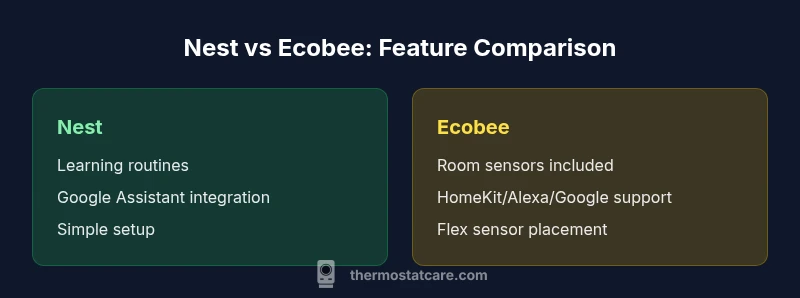
Understanding nest vs ecobee thermostat comes down to ecosystem fit, sensor strategy, and value over time. According to Thermostat Care, the real differences aren’t just about temperature control—they're about how each thermostat integrates with your smart home, how it senses occupancy, and how you prefer to interact with settings. Nest emphasizes learning routines and heavy Google integration, while Ecobee highlights bundled sensors, flexible voice support, and broader compatibility with major platforms. In this block we’ll map out the core capabilities, highlight where the two diverge, and explain which scenarios favor one choice over the other. Whether you’re upgrading an aging thermostat or choosing for a new build, the nest vs ecobee thermostat decision should align with your daily routines, privacy preferences, and preferred ecosystem.
Ecosystem Compatibility and Voice Assistants
The two thermostats differ markedly in how they fit into your smart-home ecosystem. Nest is designed to shine within the Google ecosystem, offering deep integration with Google Assistant, Google Home, and Chrome OS. Ecobee, by contrast, brings broad compatibility across Alexa, Apple HomeKit, Google Assistant, and various third-party hubs. If you rely on multiple platforms or want a chip‑agnostic setup, Ecobee tends to be the more flexible choice. Matter support, where available, can further influence long‑term compatibility. In practical terms, choose Nest if your daily routines revolve around Google services; choose Ecobee if you want cross‑platform comfort and future‑proofing for diverse devices.
Sensors, Occupancy, and Comfort Control
Sensor strategy is a major differentiator. Ecobee ships with multiple room sensors (for temperature and occupancy) that help balance temperatures across larger or multi-room homes. This sensor network often translates into more consistent comfort in busy living spaces and hallways. Nest relies on its built‑in sensors and optional remote sensors, placing emphasis on learning patterns and occupancy for efficiency. If you have a large home or rooms with uneven heating, Ecobee’s sensor array can deliver more predictable comfort, while Nest can deliver strong performance with simpler setups. Thermostat Care notes that sensor placement matters for both products, and planning sensor locations ahead of installation pays dividends later.
Learning Capabilities vs Manual Control
Nest’s hallmark is its learning capability: over time it studies your routines and makes automated adjustments. For some homeowners, this “it just works” approach reduces manual tweaking. Ecobee emphasizes more user-driven control, with SmartSensor data actively guiding comfort and energy usage, yet it also offers smart learning features through schedules and routines. The result is two distinct philosophies: gradual automation versus explicit user control. If you like hands-off operation, Nest can be attractive; if you want perceived control with smart adaptation, Ecobee often wins on predictability.
Energy Management and Reports
Both platforms provide energy usage insights, which helps you optimize heating and cooling. Nest tends to integrate energy history into the app with trend visuals and simple recommendations tied to usage patterns. Ecobee expands on this with more granular reporting and sensor-driven adjustments that can influence energy spend month to month. In practice, Ecobee’s architecture tends to favor savings in homes where sensors are deployed strategically, while Nest shines when the learning engine quickly aligns with typical schedules and occupancy. Thermostat Care analysis shows that energy savings are highly contingent on how you configure schedules and sensors, not just on the thermostat model alone.
Installation, Wiring, and Power Options
Installation ease varies depending on your existing wiring. Nest has historically leaned on power management that sometimes relies on “power stealing” techniques in homes with limited C-wire runs. Ecobee generally benefits from a dedicated C-wire and a more flexible setup process, thanks to its standard wiring expectations and included external power options. If you’re upgrading an older system, verify C-wire availability and confirm whether your furnace’s wiring harness supports the new thermostat. Both brands provide step-by-step setup guides, online support communities, and diagnostic tools to identify common installation hurdles.
Display, Interface, and User Experience
Both thermostats offer modern, high-contrast displays and intuitive apps, but the interaction style differs. Nest emphasizes a clean, learning-oriented interface that adapts to your habits, with voice commands supported through Google Assistant. Ecobee presents a more menu-driven experience with explicit settings for occupancy, schedules, and sensor balancing. In busy households, Ecobee’s deeper sensor-driven controls can feel more actionable, whereas Nest’s streamlined interface can feel snappy and simple for quick adjustments.
Data Privacy, Security, and Updates
Data privacy and security are important considerations. Nest typically emphasizes data collection tied to learning and personalization, with options to adjust privacy settings in the Google ecosystem. Ecobee emphasizes security with regular firmware updates and platform-agnostic controls that reduce reliance on a single ecosystem. Both brands offer firmware updates to improve performance and add features, but your comfort with data collection will influence which system you trust. Thermostat Care notes that keeping firmware up to date is essential for security and reliability.
Price, Warranty, and Long-Term Value
Pricing for Nest and Ecobee varies with promos, models, and bundles. In general, expect similar price bands, with Ecobee often including bundled sensors that can reduce extra accessory costs. Warranty terms for smart thermostats typically cover basic hardware and electronics for a set period, with extensions available through retailers or service plans. When evaluating long-term value, consider sensor coverage, platform compatibility, and the likelihood of software feature updates over several years. Thermostat Care suggests calculating total cost of ownership, including potential energy savings, to determine true value over time.
Real-World Scenarios: Nest Best For
Nest tends to be preferred for households deeply invested in Google Home, leveraging Google Assistant features, voice control, and a learning approach that minimizes manual tweaks. If you’re moving from an older thermostat in a Google-centric smart home and want a streamlined experience, Nest can be compelling. It also works well for users who value a simple, fast interface and don’t need extensive sensor networks across multiple rooms.
Real-World Scenarios: Ecobee Best For
Ecobee shines in homes where multi-room comfort matters and where cross‑platform control is desired. The included room sensors and flexible setup are advantageous for larger floor plans or homes with distinct “hot” and “cold” zones. If you use Apple HomeKit, Alexa, or Google Assistant and want a single thermostat that plays nicely with all three, Ecobee is often the more versatile choice. For households prioritizing energy management, Ecobee’s sensor-driven approach can yield tangible savings over time.
Quick Start Evaluation Checklist
- Assess your primary ecosystem (Google, Apple, Amazon) and pick the thermostat with the strongest native support
- Verify C-wire availability or plan for Ecobee’s power options if a C-wire is missing
- Plan sensor placement for Ecobee or rely on Nest learning if you prefer a simpler setup
- Review warranty coverage and support options from retailers and manufacturers
- Consider whether energy reporting and occupancy sensing align with your goals
- Prepare for a short setup window with a guided installation and a few appliance-level tests to confirm proper operation
Comparison
| Feature | Nest Thermostat | Ecobee Thermostat |
|---|---|---|
| Smart home ecosystem compatibility | Strong Google Assistant integration (native) | Broad: Alexa, HomeKit, Google Assistant, and more |
| Sensors included/required | Fewer built-in sensors; relies on learning | Multiple room sensors included for occupancy and temperature |
| Voice assistant support | Voice control via Google Assistant | Voice control via Alexa and Google Assistant; HomeKit via Apple ecosystem |
| Learning vs manual control | Learning routines and automation | Explicit schedules with sensor-driven adjustments |
| Energy reports and insights | Energy history integrated with Google services | Detailed energy reports with sensor-based guidance |
| Installation and wiring | Often works with minimal wiring; can use power stealing | Typically requires C-wire; straightforward wiring kit included |
| Price positioning | Mid-range with frequent promos | Mid-to-high range with bundled sensors |
| Warranty and support | Standard warranty via retailer | Standard warranty plus ecosystem support options |
Upsides
- Broad ecosystem compatibility (Ecobee)
- Sensor-rich comfort (Ecobee)
- Energy management features across both platforms
- User-friendly app experiences across platforms
- Learning and automation options that fit different lifestyles
The Bad
- Nest’s learning can feel opaque to some users
- Nest is heavily Google-ecosystem oriented
- Ecobee may require a C-wire in older homes
- Sensor placement matters more for best results
Ecobee generally offers stronger overall value for most homes.
Ecobee’s bundled room sensors and broad compatibility typically yield better comfort and flexibility across multi-room layouts. Nest remains compelling for Google‑centric homes and users who prefer a minimalist interface with learning features.
Questions & Answers
Which thermostat is easier to install, Nest or Ecobee?
Both are straightforward, but Nest often appeals to simple setups with minimal wiring. Ecobee can require a C-wire for the best performance, though it includes adapters and guides.
Both are installation-friendly; check for a C-wire and follow the manufacturer guides for quickest setup.
Do both thermostats support HomeKit, Alexa, and Google Assistant?
Ecobee supports Alexa, Google Assistant, and HomeKit. Nest primarily supports Google Assistant and Google Home, with limited HomeKit options via bridges or updates.
Ecobee offers broad support across major assistants; Nest works best with Google’s ecosystem.
Will sensors improve comfort in a single-story home?
If you have a large or multi-zone single-story home, Ecobee’s sensors can help balance temperature more evenly. Nest can still perform well with smart scheduling and occupancy, but may not equal Ecobee’s sensor coverage in broad layouts.
Yes, sensors help balance temps, especially in multi-room spaces.
Which provides better energy savings?
Both offer energy insights and optimization features. Ecobee’s sensors often lead to more consistent savings in homes with multiple rooms; Nest’s learning can also reduce usage over time for light occupants.
Energy savings depend on setup; Ecobee often edges out in sensor-rich homes.
Do Nest and Ecobee require ongoing subscriptions?
Neither requires a subscription for core functionality. Some advanced features or cloud services may have optional costs depending on the platform.
No ongoing subscription is required for basic operation.
Can I upgrade from Nest to Ecobee without rewiring everything?
Upgrading can often be done with existing wiring, but Ecobee benefits from a C-wire. Check compatibility with your furnace and controls before switching.
You may need to adjust wiring when switching to Ecobee; consult the installation guide.
What to Remember
- Evaluate ecosystem alignment before buying
- Prefer Ecobee if you have multi-room needs and diverse platforms
- Plan sensor placement for optimal comfort
- Account for wiring needs and warranty when budgeting