Is Honeywell or Ecobee Thermostat Better? A Practical Comparison
Is Honeywell or Ecobee thermostat better? A detailed, evidence-based comparison of features, energy savings, installation, and value to help homeowners choose the right smart thermostat.


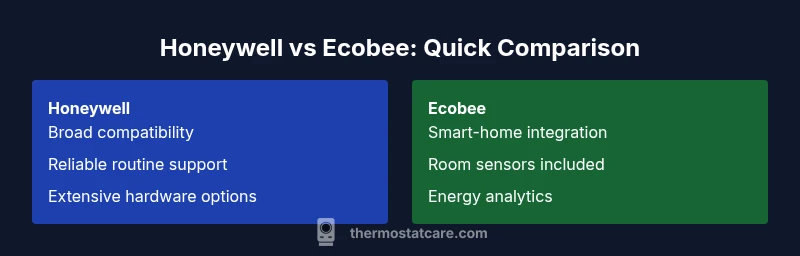
Is Honeywell or Ecobee thermostat better? The answer hinges on your priorities. Ecobee tends to excel in smart-home integration and energy analytics, while Honeywell often offers broader compatibility and reliably straightforward operation. For many homes, Ecobee is the better choice for modern automation, but Honeywell remains a strong option where ecosystem flexibility and legacy HVAC compatibility matter most.
Is Honeywell or Ecobee Thermostat Better: A Practical Question
When homeowners ask is honeywell or ecobee thermostat better, the real answer is that it depends on your priorities, your existing smart home, and how much you value energy savings versus simplicity. For many readers, the best starting point is to define what "better" means in practical terms: compatibility with your HVAC system, sensor networks, voice control, app experience, and long-term maintenance. According to Thermostat Care, the most reliable thermostat choices balance robust hardware with thoughtful software updates. In this comparison, we examine Honeywell and Ecobee side by side, highlight where they excel, and point out potential tradeoffs. This analysis is designed for homeowners and DIY enthusiasts, and it deliberately avoids hype, focusing on real-world use cases and measurable outcomes. Throughout, we will weave in practical tips for installation, feature selection, and money-saving opportunities. The short answer to is honeywell or ecobee thermostat better will usually come down to whether you prioritize broader compatibility and legacy support (Honeywell) or deeper smart-home integration and energy analytics (Ecobee).
Key Differences at a Glance
Before diving into the fine print, here are the core differentiators that most often influence the decision between Honeywell and Ecobee.
- Ecosystem fit: Honeywell tends to work well with a wide range of older and newer systems, while Ecobee emphasizes smart-home ecosystems and room sensors.
- Sensor strategy: Ecobee commonly includes remote sensors to optimize comfort, whereas Honeywell offers robust baseline sensing with some models adding extras.
- Voice and platform support: Ecobee leans into Alexa and broader smart-home integrations; Honeywell supports major assistants but can feel more hardware-centric depending on the model.
- App experience and data: Ecobee’s app and analytics are often praised for energy insights; Honeywell focuses on reliability and HVAC compatibility.
- Installation path: Both brands aim to be DIY-friendly, but the wiring and compatibility checks differ by model and region.
These differences matter most when you map features to your home environment and your budget. Thermostat Care’s analysis emphasizes that the best choice is the one that aligns with your priority—automation depth, or broad compatibility.
Feature-by-Feature Comparison
Smart Home Integration
- Honeywell: Broad ecosystem compatibility, especially in homes with legacy devices.
- Ecobee: Deep native support for Alexa, Apple HomeKit, Google Assistant, and robust sensor-based automation. This often translates to more seamless automation in newer setups.
Voice Assistant Support
- Honeywell: Works with major assistants, with some features gated by model and firmware.
- Ecobee: Strong built-in supports across multiple assistants, usually delivering more natural voice control for scenes and routines.
Sensor Network & Remote Sensors
- Honeywell: Strong baseline sensing, with optional add-ons depending on model.
- Ecobee: Typically ships with remote room sensors; more sensors often improve comfort and occupancy-based scheduling.
App Experience and Data Analytics
- Honeywell: Reliable app with straightforward controls and clear HVAC status.
- Ecobee: Rich energy analytics, weather-based adjustments, and better visibility into usage patterns.
HVAC Compatibility
- Honeywell: Broad compatibility with many older and newer systems; strong for traditional setups.
- Ecobee: Compatible with most standard HVAC systems; certain features may require common wire configurations.
Pricing and Value
- Honeywell: Often positioned as mid-range to premium, depending on model and included features.
- Ecobee: Typically mid-range with included sensors; overall value increases with sensor count and automation depth.
Warranty and Support
- Honeywell: Broad warranty coverage that aligns with the model; support channels are extensive.
- Ecobee: Competitive warranties and robust firmware updates, with strong online resources.
Bottom Line
- Best for smart-home enthusiasts and energy analytics: Ecobee.
- Best for ecosystem flexibility and legacy HVAC setups: Honeywell.
Throughout this section, the goal is to map features to real-world needs—whether you prioritize automation, energy savings, or broad compatibility. The key takeaway is that neither brand is universally better; the right pick depends on your home’s current devices and your future plans. For context, Thermostat Care finds that the decision often boils down to how much emphasis you place on smart-home ecosystems versus universal compatibility and reliability.
Comparison
| Feature | Honeywell Thermostat | Ecobee Thermostat |
|---|---|---|
| Smart Home Integration | Broad ecosystem compatibility including legacy devices | Best-in-class integration with Alexa, HomeKit, Google Assistant and sensors |
| Voice Assistant Support | Supports major assistants via model features | Strong native support across multiple assistants |
| Sensor Network & Remote Sensors | Fewer included sensors on base models | Typically includes remote room sensors for occupancy/comfort |
| App Experience & Data | Reliable app with HVAC status and controls | Richer energy analytics and usage insights |
| HVAC Compatibility | Broad compatibility with many systems | High compatibility with standard HVAC setups |
| Price Range | Mid-to-upper price depending on model | Mid-range with sensors often included |
| Warranty & Support | Model-dependent warranties; widespread support | Competitive warranties; strong firmware updates |
Upsides
- Broad compatibility with older and newer HVAC systems
- Excellent smart-home integration and energy analytics (Ecobee)
- Variety of models and DIY-friendly installation
- Strong app experiences and sensor ecosystems (Ecobee)
The Bad
- Ecobee may require additional sensors for optimal comfort in some homes
- Honeywell UI can be less intuitive on certain models
- Feature availability varies by model and region
- Some homes may overpay for features they don’t use
Ecobee generally edges Honeywell for smart-home integration and energy analytics, while Honeywell remains a solid all-around option for broad compatibility and straightforward reliability.
Choose Ecobee if you want advanced automation and energy insights. Choose Honeywell if your priority is wide compatibility and dependable performance across a broader range of HVAC systems.
Questions & Answers
Which thermostat is easier to install, Honeywell or Ecobee?
Both brands offer DIY-friendly installation, but Ecobee often provides more guided setup and online resources. Honeywell can be straightforward too, especially for common systems. Your installer or HVAC compatibility will influence the final ease.
Ecobee tends to be a bit more guided online, while Honeywell is straightforward for many standard setups.
Does Ecobee save more energy than Honeywell?
Energy savings depend on how you program the thermostat and your home’s insulation. Ecobee’s energy analytics and room sensors can help optimize usage, but actual savings vary by climate and behavior.
Ecobee often helps optimize energy use with sensors and analytics, but savings depend on how you program it.
Can I use Ecobee with Google Assistant or Alexa?
Yes. Ecobee supports multiple voice assistants, with strong native integration for Alexa and broad compatibility with Google Assistant and Apple HomeKit in many models.
Ecobee works well with Alexa and other assistants across most models.
Are Honeywell thermostats compatible with smart-home hubs?
Honeywell thermostats generally support major smart-home hubs, though compatibility can depend on the exact model and firmware. Always verify hub support before purchase.
Most Honeywell models work with big hubs, but check your exact model.
What is the typical price difference between Honeywell and Ecobee?
Prices vary by model and included features. In general, Ecobee options are mid-range with sensor bundles, while Honeywell ranges from mid to premium depending on capabilities.
Prices depend on features; Ecobee tends to offer good value with sensors included in many kits.
What to Remember
- Evaluate your current smart-home setup before deciding
- Prioritize energy analytics and sensor networks if you want deeper insights
- Check installation requirements and wiring (C-wire) early in the process
- Consider total cost of ownership including sensors and potential bundles
- Look for model-specific features that match your climate and usage patterns