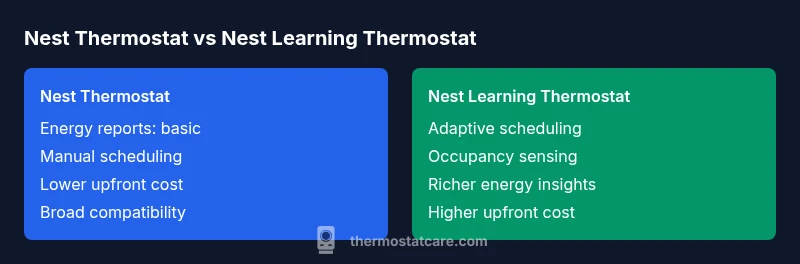
Nest Thermostat vs Nest Learning Thermostat: A Practical Comparison
A thorough head-to-head comparison of the Nest Thermostat vs Nest Learning Thermostat, covering features, compatibility, energy savings, and best-use scenarios for homeowners.


In most homes, the Nest Learning Thermostat tends to save more energy through adaptive scheduling, especially with variable schedules, while the basic Nest Thermostat offers solid automation at a lower price. If you value maximum energy savings and occupancy-aware features, choose the Learning model; otherwise, the standard Nest Thermostat is a strong, budget-friendly option.
Overview: nest thermostat versus nest learning thermostat
When homeowners compare the Nest Thermostat versus the Nest Learning Thermostat, the core question is not just feature count but how you live in your home. The Nest Learning Thermostat uses adaptive scheduling and occupancy sensing to tweak temperatures automatically, whereas the Nest Thermostat emphasizes straightforward automation and essential energy features at a lower price point. According to Thermostat Care, understanding these differences upfront helps you match the device to your daily routine, HVAC setup, and long-term energy goals. Both devices are designed to work with most cooling and heating systems, but the level of automation and data insights varies. This guide uses plain-language comparisons, real-world scenarios, and clear criteria so homeowners can decide with confidence.
How the learning algorithm works
The Nest Learning Thermostat learns from your daily patterns, adjusting schedules over several days or weeks. It analyzes when you wake, leave, return, and sleep, gradually creating a personalized temperature plan. This adaptive approach can reduce energy use by aligning heating and cooling with actual occupancy, rather than fixed presets. However, the learning period can be influenced by irregular schedules, guest rooms in use, or seasonal shifts. Thermostat Care emphasizes that the learning feature shines when your routine has regularity; it may be less impactful in highly variable homes. Regardless, the device collects data to improve comfort and efficiency over time.
Energy savings potential and how to measure it
Energy savings are not guaranteed by hardware alone; they depend on usage patterns and home insulation. The Learning Thermostat often delivers higher savings for households with variable schedules and frequent occupancy changes, thanks to its dynamic scheduling and occupancy sensing. The standard Nest Thermostat still offers meaningful energy savings through smart temperature setpoints, but it relies more on user inputs and routines. Thermostat Care analyses indicate that the difference in energy savings can be noticeable in real-world use, especially in climates with distinct heating and cooling seasons. For many homeowners, the incremental savings justify the higher upfront cost of the Learning model, while others prioritize simplicity and upfront affordability.
Scheduling, occupancy, and real-world habits
A key differentiator is how each device handles scheduling. The Nest Learning Thermostat can autonomously create schedules based on your behavior, reducing the time you spend configuring settings. It also uses occupancy signals to adjust temperature when no one is home or when someone leaves a room. In contrast, the Nest Thermostat excels for households that want reliable automation without the learning curve, offering clear, manual scheduling and fine-grained controls. If you travel frequently or have unusual energy patterns (e.g., shifts, vacation homes), the Learning Thermostat often delivers more consistent results over time, provided you supervise initial setup and testing.
Compatibility, wiring, and installation considerations
Both thermostats target broad HVAC compatibility, but wiring requirements can differ. The Nest Learning Thermostat sometimes benefits from a C-wire to supply stable power for continuous operation, especially on older systems. The standard Nest Thermostat is more forgiving when power draw is marginal, but still benefits from a common wire in many installations. Before upgrading, verify your furnace/air handler compatibility, the presence of a C-wire, and whether your system uses multiple stages of heating or cooling. Thermostat Care recommends noting your current wiring, checking compatibility with the official Nest setup guide, and planning for a potential professional inspection if you have an unusual system.
App experience, dashboards, and energy insights
The Nest app serves as the control hub for both devices, yet the depth of insights differs. The Learning Thermostat typically provides richer energy reports, longer-term trends, and more granular guidance on optimizing schedules. The standard Nest Thermostat focuses on essential controls and a straightforward energy-saving path. For homeowners who want ongoing data to inform decisions, the Learning Thermostat offers more value. For those who prefer a simpler interface with predictable automation, the standard model remains compelling.
Geofencing, automation, and smart-home integration
Geofencing lets your phone trigger temperature changes when you approach home. Both devices support geofencing, but the Learning Thermostat tends to translate occupancy data into smarter local actions due to its learning history. In addition, both thermostats integrate with major smart home ecosystems, including Google Home. If you have a broader automation strategy (sensors, hubs, or routines across multiple rooms), the Learning Thermostat’s data-driven approach can play more nicely into a larger smart-home picture. Thermostat Care suggests mapping your automation goals before you buy to ensure compatibility.
Price and value: upfront cost versus long-term return
Pricing is a major consideration. The Nest Thermostat generally costs less upfront, making it attractive for budget-conscious homeowners or renters. The Nest Learning Thermostat commands a higher price, reflecting its adaptive scheduling, better energy visibility, and more proactive energy-saving features. Over time, the Learning Thermostat can offer stronger energy savings, but the payback period varies by climate, insulation, and behavior. Consumers should compare total cost of ownership, including potential energy savings, to determine the best value for their home. Thermostat Care recommends evaluating your local energy prices and typical daily schedules as part of this calculation.
Real-world use cases: when each model shines
A small apartment with a predictable routine may get excellent results from the standard Nest Thermostat, delivering consistent comfort and solid energy savings without extra features. A family home with variable schedules, frequent guests, and multiple HVAC zones tends to benefit more from the Learning Thermostat’s adaptive scheduling and occupancy-aware adjustments. In homes with smart thermostats already integrated into broader ecosystems, the Learning Thermostat can better leverage data to optimize cross-device routines. In short, the choice should align with your daily life, energy goals, and how much you value long-term energy insights.
Maintenance, firmware updates, and ongoing support
Both devices receive periodic firmware updates that introduce new features, security improvements, and bug fixes. Keeping the thermostat connected to Wi-Fi ensures you receive critical updates that improve reliability and energy performance. Thermostat Care stresses the importance of enabling automatic updates and periodically reviewing energy reports to track improvements. If you encounter abnormal behavior, a quick reset or reconfiguration often resolves issues without needing professional service.
Decision framework: a practical, step-by-step approach
Start by outlining your priorities: energy savings, ease of use, or deep data insights. If energy savings plus smart learning are crucial and your schedule varies, lean toward the Nest Learning Thermostat. If you want straightforward automations at a lower cost, the standard Nest Thermostat remains a strong choice. Check compatibility with your HVAC, budget constraints, and how much you value ongoing data and adaptive scheduling. Finally, read user reviews from homeowners with similar climates to understand how each device performs in real-world conditions.
Comparison
| Feature | Nest Thermostat | Nest Learning Thermostat |
|---|---|---|
| Energy Savings Potential | Good energy savings through smart setpoints | Higher potential due to adaptive scheduling and occupancy sensing |
| Learning Capability | No learning; relies on user input | Advanced learning that adapts over time |
| Scheduling Flexibility | Manual scheduling with clear controls | Auto-scheduling via learned routines |
| Geofencing & Occupancy | Basic occupancy features | Advanced occupancy sensing with learning context |
| App Experience | Straightforward app controls and energy reports | Richer energy insights and long-term trends |
| HVAC Compatibility | Broad compatibility; good for most systems | Broad compatibility; may require C-wire on older setups |
| Price Range | Lower upfront cost | Higher upfront cost |
| Best For | Budget-conscious users needing reliable automation | Energy-conscious households with variable schedules and a desire for data |
Upsides
- Potential energy savings through automated setpoints
- User-friendly interface with reliable automations
- Solid compatibility with most HVAC systems
- Clear app dashboard and energy insights
- Good resale value and future-proofing with ongoing updates
The Bad
- Higher upfront cost for the Learning model
- Learning may take time to stabilize in irregular schedules
- Reliance on Wi-Fi for best performance and updates
- Some advanced features require a Nest account and cloud access
Nest Learning Thermostat generally offers more energy savings and smarter scheduling; Nest Thermostat is a strong, budget-friendly option for simpler needs.
Choose Learning for maximum energy optimization in variable routines. Choose Nest Thermostat for straightforward comfort and lower upfront cost.
Questions & Answers
What are the Nest Thermostat and Nest Learning Thermostat, and how do they differ?
The Nest Thermostat focuses on essential automation and straightforward energy savings, while the Nest Learning Thermostat adds adaptive scheduling and occupancy-aware features. The Learning model learns your patterns over time to optimize comfort and efficiency, which can lead to greater energy savings in homes with variable routines.
The Learning Thermostat learns your schedule and adjusts automatically, while the standard Nest Thermostat offers solid automation with fewer advanced features.
Will the Nest Learning Thermostat save more energy?
In many cases, yes. The Learning Thermostat can optimize heating and cooling based on occupancy and learned routines, which can reduce energy use, especially in homes with changing schedules. Savings vary by climate, insulation, and user behavior.
Expect higher energy savings if your schedule changes often and you prefer automated optimization.
Is Nest Learning Thermostat compatible with my HVAC system?
Both devices support a wide range of HVAC systems. Some legacy setups may benefit from a C-wire or a professional check. Always verify compatibility with the manufacturer’s setup guide before upgrading.
Most systems work, but check for C-wire needs and multi-stage heating/cooling.
What installation steps are required?
Typical steps include turning off power, removing the old thermostat, wiring according to the labeled terminals, and running the Nest setup in the app. If your wires or HVAC are unusual, consider professional installation to ensure safe operation and proper power.
Power off, wire to terminals, and finish setup in the app.
Do I need a C-wire for these thermostats?
A C-wire helps power the thermostat reliably, especially for models with advanced features. If you lack a C-wire, you may still install the thermostat but could experience power-related issues over time. Check your current wiring before purchasing.
A C-wire is often recommended for reliability, but many homes install without it with limited features.
Can I use both versions with the same Nest account?
Yes. If you own one thermostat, you can add another in the same Nest account and manage settings from a single interface. This makes comparing models easier and allows you to migrate settings gradually.
You can manage both thermostats from one Nest account.
What to Remember
- Assess your daily schedule to decide if learning features matter
- Check HVAC compatibility and wiring needs before upgrading
- Compare total cost of ownership, including energy savings
- Consider climate and occupancy patterns when predicting savings
- Test drive the app experience and automation depth before committing