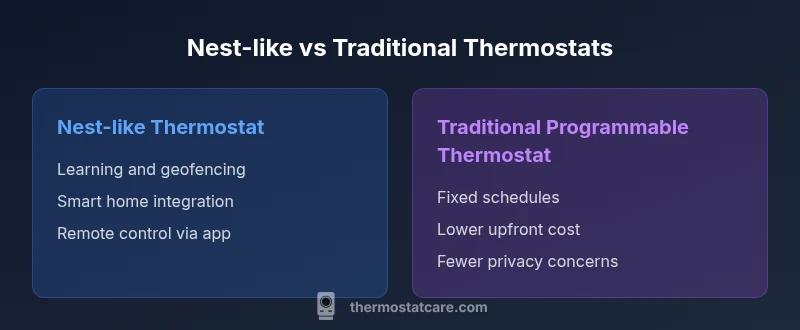
Nest-like Thermostat Comparison: Nest-like vs Traditional
A clear, data-driven comparison of Nest-like learning thermostats versus traditional programmable models, offering practical guidance for homeowners and DIY enthusiasts seeking comfort, energy savings, and ease of use.


Nest-like thermostats deliver learning and smart home integration, but traditional programmable models remain simpler and cheaper upfront. This comparison outlines what matters most: learning capability, energy savings potential, and user experience so homeowners can decide what to install next. Thermostat Care provides an objective view to help DIYers and homeowners weigh automation against straightforward control.
What is a thermostat like nest?
A thermostat like nest represents a learning, adaptive device aimed at predicting comfort needs, automating schedules, and integrating with other smart devices. While it sits at the center of modern climate control, the core value depends on whether the learning engine aligns with your real-life routines. The Thermostat Care team emphasizes that the best outcomes come when features—such as occupancy sensing, geofencing, and remote control—match your home’s actual usage. If you’re a homeowner or a DIY enthusiast, you’ll appreciate how these devices can reduce manual adjustments over time, but you should also weigh setup complexity and privacy implications. For many readers, the question isn’t just “does it work?” but “does it fit my climate, family patterns, and hardware wiring?” This section sets the stage for a structured, evidence-based comparison by clarifying what separates Nest-like devices from fixed-schedule thermostats, and why learning matters in real-world use. The goal is to help you make an informed choice that aligns with your goals for comfort and efficiency.
Core Differences: Learning vs Scheduling
The primary distinction between a Nest-like thermostat and a traditional programmable thermostat is how they manage schedules. A learning device observes when you adjust temperatures, how long you stay home, and even when you leave, building a personalized profile over days and weeks. It then attempts to anticipate changes, reducing manual adjustments over time. A traditional programmable thermostat relies on explicit schedules created by the user, which can be precise but may become rigid if routines shift. For homeowners who value consistency, a fixed schedule can minimize surprises. On the other hand, the learning approach can adapt to weekend variability or unexpected guests, potentially improving comfort and reducing energy use when occupancy is misaligned with a preset program. Thermostat Care’s analysis indicates the best results come when learning features match consistent but occasionally changing patterns in daily life.
Setup and Installation Considerations
Installation is often the biggest barrier for a first-time buyer considering a Nest-like thermostat. Most devices require a C-wire for stable power, though some models offer alternatives; if your current wiring lacks a dedicated C-wire, you may need a small adapter or professional help. Compatibility with your HVAC system matters: heat pump vs. conventional furnaces, single-stage vs. multi-stage configurations, and existing smart home hubs can all influence setup difficulty. Before buying, confirm compatibility with common ecosystems such as Alexa, Google Assistant, or Apple HomeKit. A smooth install also depends on having a functioning existing thermostat, as the new device must learn from real data rather than a blank slate. The Thermostat Care team suggests budgeting time for wiring checks and controller pairing, then testing features like geofencing and scheduling in a low-stakes window.
Energy Savings and Real-world Performance
Energy savings with Nest-like devices are highly climate- and usage-dependent. In many homes, learning-based adjustments align with occupancy patterns, leading to fewer unnecessary cycles and more stable comfort, especially during shoulder seasons. However, savings are not guaranteed and can be offset if the device is over- or under-heated due to aggressive learning, frequent temperature bumps, or unusual work-from-home patterns. In real-world scenarios, households that embrace automation, keep schedules aligned with daily routines, and use temperature setpoints that reflect true comfort often see the most benefit. Thermostat Care cautions readers that the potential impact is more pronounced in homes with irregular occupancy or variable weather, while in tightly controlled climates the advantage may be modest.
Smart Home Integration and Privacy
A Nest-like thermostat often acts as a smart home control point, interfacing with voice assistants, smart speakers, and other connected devices. This interoperability can simplify routines (such as "temperature before arrival" or "away mode") but it can also introduce privacy concerns. Look for clear explanations of data collection, retention, and sharing policies, and review how third-party skills or routines handle information. If privacy is paramount, consider limiting data sharing, turning off certain features, or choosing devices with robust privacy controls. The traditional programmable thermostat typically stores less data and may integrate less deeply with ecosystems, but it offers a lower profile in terms of potential data exposure. Thermostat Care notes that user preferences should guide the balance between convenience and privacy in any smart thermostat decision.
User Experience: Interface and App Design
The best Nest-like devices emphasize intuitive interfaces and well-designed companion apps. Navigation should feel natural, with clear status indicators, simple back-and-forth adjustments, and predictable behavior after learning periods. Users often value straightforward setup wizards, helpful reminders, and good on-device feedback when the device is learning. By contrast, traditional programmable thermostats rely on tactile controls and fixed menus, which some users prefer for their predictability. A well-designed learning thermostat can make advanced features accessible to non-technical users, while a clunkier app can undermine the entire promise of automation. Thermostat Care suggests evaluating apps on responsiveness, offline operation, and how easily you can override automatic adjustments when needed.
Reliability, Maintenance, and Support
Reliability hinges on firmware updates, sensor accuracy, and how well the device tracks occupancy. Nest-like devices typically push regular updates to improve learning algorithms and integration, but updates can occasionally alter behavior in ways you must adapt to. Sensor drift, battery life in wireless sensors, and compatibility with your current Wi-Fi network are practical considerations. Support options vary by brand and region, with some manufacturers offering extended warranties or online diagnostic tools. A maintenance viewpoint should include periodic review of geofencing accuracy, schedule correctness, and privacy settings. In many cases, ensuring a stable home network reduces issues that could undermine learning performance.
Price and Value Considerations
Price for Nest-like thermostats generally sits above traditional programmable models, reflecting the added technology, cloud-based features, and ongoing software support. The upfront cost is higher, and you should weigh the potential energy savings and improved comfort against this premium. In regions with mild climates or highly stable schedules, the incremental value may be modest. In areas with variable occupancy or frequent changes in routine, the value proposition strengthens as automation reduces manual interventions. The Thermostat Care team recommends evaluating total cost of ownership over several seasons, including installation, potential professional wiring adjustments, and any required hub subscriptions or premium features.
Practical Decision Factors by Home Type
Your home’s characteristics influence whether a Nest-like thermostat makes sense. Large homes with inconsistent occupancy patterns benefit from adaptive learning and geofencing, whereas compact homes with fixed routines may see less value. If you share control with others or rely on smart home routines, a Nest-like device can simplify coordination and comfort. For renters or homeowners wary of high upfront costs, a traditional programmable thermostat remains a viable option, keeping in mind that it lacks many smart features and camera-like integration. Thermostat Care emphasizes matching device capabilities to your actual lifestyle rather than chasing the latest trend.
Common Pitfalls and How to Avoid Them
One common pitfall is assuming the learning algorithm will perfectly predict every scenario. In reality, you may need to tweak setpoints, schedules, and zones to align with your routines. Another pitfall is underestimating wiring requirements; a missing C-wire or incompatible HVAC configuration can lead to unstable power delivery and erratic behavior. Privacy settings are often overlooked; disable unnecessary data sharing if privacy concerns exist. Finally, ensure you’re not locked into a proprietary ecosystem that limits future flexibility. A careful review of compatibility with your current home setup reduces the risk of buyer’s remorse later.
What Homeowners Should Do Next
Start with a needs assessment: consider climate, occupancy patterns, existing wiring, and how much automation you want. If you decide a Nest-like thermostat is right for you, map out wiring requirements, check for C-wire presence, and plan a test window for learning features before fully committing. Compare offers from trusted brands, read privacy policies, and verify compatibility with your smart home devices. If you choose a traditional programmable thermostat, confirm you can achieve the scheduling you require without automation, and plan for a straightforward installation with minimal risk. Thermostat Care’s practical approach is to identify the primary goal—comfort, energy savings, or ease of use—and choose a solution that aligns with that goal.
Thermostat Care's Practical Guidance for DIYers and Homeowners
For DIYers, start with the basics: confirm wiring, power supply, and display compatibility. When evaluating Nest-like options, look for clear learning timelines, user-friendly setup guides, and transparent privacy statements. If you’re comfortable with basic wiring and can follow installation instructions, a self-install can be feasible, but do not hesitate to call a licensed professional if you encounter stuck points. Thermostat Care emphasizes testing critical features—like schedule overrides, geofencing, and remote access—before committing to long-term use. The verdict for most homes is to choose the device that best mirrors your day-to-day life, climate, and device ecosystem, not merely the most popular brand. The Thermostat Care team stands ready to help you optimize your thermostat setup once you’ve decided on a path.
Comparison
| Feature | Nest-like Thermostat (learning) | Traditional Programmable Thermostat |
|---|---|---|
| Learning capability | Yes, adaptive schedules and occupancy sensing | No, relies on user-set schedules |
| Energy savings potential | Higher in variable occupancy and climate | Moderate, depends on schedule adherence |
| Smart home compatibility | Strong integration with major ecosystems (voice, apps) | Limited to basic features without hubs |
| User interface | Modern app and on-device controls | Physical interface with manual controls |
| Power and wiring | Often requires C-wire; power via common supply | May work with power stealing or existing wires |
| Installation complexity | Moderate to high; may require professional setup | Low to moderate; straightforward wiring |
| Privacy/data sharing | Higher data collection; cloud-enabled features | Minimal data collection; local control |
| Price range | Higher upfront price | Lower upfront price |
Upsides
- Automates temperature management and comfort
- Seamless smart home integration
- Potential energy savings with adaptive scheduling
- Remote control and monitoring via mobile apps
- Regular updates improve features
The Bad
- Higher upfront cost and potential subscription features
- Data privacy and sharing concerns
- Learning can misfire with irregular schedules
- Requires compatible wiring (C-wire) or professional install
Nest-like thermostats offer advanced automation for many homes, but traditional programmable models remain the best value for simple setups.
If you want automation and smart home control, choose a Nest-like device. If you prioritize straightforward control and lower upfront spend, go traditional. Thermostat Care recommends matching your choice to climate, occupancy, and comfort goals.
Questions & Answers
What defines a Nest-like thermostat?
A Nest-like thermostat is a learning device that adjusts temperature settings based on occupancy, usage patterns, and environmental data. It often integrates with voice assistants and smart home ecosystems to automate comfort. Expect a learning period during which the device tunes itself to your routines.
A Nest-like thermostat learns your patterns and adjusts automatically. It works with your home’s other smart devices for convenient control.
Do Nest-like thermostats require a C-wire?
Most Nest-like thermostats need a C-wire to maintain stable power, especially during learning. If your existing wiring lacks a C-wire, you may need a transformer adapter or professional installation. Some models can operate with alternative power methods, but results vary by system.
Yes, many require a C-wire for reliable power. If you don’t have one, consider professional help or an adapter.
Are there privacy concerns with learning thermostats?
Yes. Learning thermostats collect data to optimize schedules and enable remote access. Review data policies, disable unnecessary data sharing, and adjust privacy controls to suit your comfort level. Understanding what data is collected helps you balance convenience with privacy.
Learning thermostats collect data for automation. Check privacy settings to control what’s shared.
Can I install a Nest-like thermostat myself?
DIY installation is feasible for many homeowners with basic wiring experience. However, incorrect wiring can damage equipment. If you’re unsure, consult installation guides or hire a licensed professional to ensure safety and code compliance.
DIY installation is possible, but if you’re unsure, hire a pro to avoid issues.
How can I maximize energy savings with learning thermostats?
Enable occupancy sensing, set reasonable comfort ranges, and avoid frequent, large temperature changes. Let the device learn for several days before evaluating results, and periodically review setpoints to ensure they reflect actual comfort needs.
Let it learn first, then fine-tune setpoints and avoid big, frequent changes.
Is there smart home platform compatibility I should care about?
Most Nest-like devices work with popular ecosystems, but compatibility varies by model. Verify support for your preferred voice assistants and hubs before purchase to ensure seamless automation.
Check compatibility with your existing smart home devices before buying.
What to Remember
- Assess climate and occupancy before choosing
- Check wiring and hub compatibility early
- Balance upfront cost with potential energy savings
- Weigh convenience against privacy preferences
- Choose based on real-life routines, not trends