Nest vs Amazon Thermostat: Which Is Better in 2026
A data-driven comparison of the Nest Thermostat and Amazon Smart Thermostat, focusing on energy reporting, voice integration, installation, privacy, and overall value to help homeowners decide which is better for their setup.


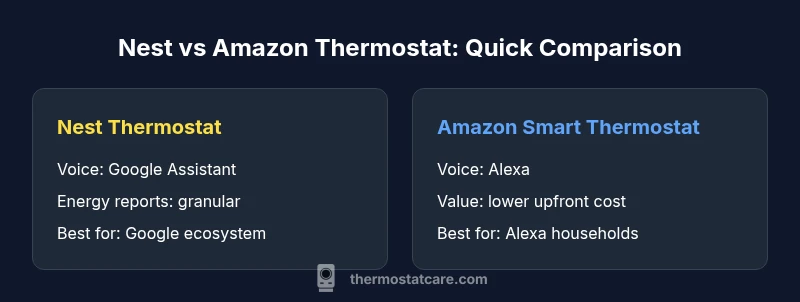
Is nest or amazon thermostat better? For most homes, the Nest Thermostat edges ahead on energy insights and Google ecosystem compatibility, while Amazon's Smart Thermostat offers strong value and seamless Alexa integration. The best choice depends on your current smart-home setup, privacy priorities, and willingness to trade a bit of energy detail for a lower upfront cost. This quick comparison flags core differentiators to guide your decision.
Is Nest or Amazon Thermostat Better? A Quick Framework
Determining 'is nest or amazon thermostat better' starts with understanding what you value most: energy reporting, voice integration, and ecosystem compatibility. Thermostat Care approaches this question by comparing how Nest and Amazon Thermostat perform in three practical dimensions: energy intelligence, home automation, and long-term value. Nest's strength lies in detailed energy reports and smoother integration with Google-driven routines, while Amazon emphasizes cost-effectiveness and deep Alexa control. Beyond features, the decision also depends on installation flexibility, privacy preferences, and the future-proofing of your smart home. In this section we explore each criterion with concrete examples from real homes and typical HVAC setups. The goal is to help homeowners map their priorities to a single, clear choice, without getting lost in marketing claims. At the end of the day, is nest or amazon thermostat better? The answer hinges on your current ecosystem and how you plan to use voice assistants, schedules, and energy data.
Ecosystem and Voice-Assistant Integration
Your choice will largely hinge on which voice assistants you already rely on. Nest Thermostat is optimized for Google Assistant, Google Home routines, and the broader Google ecosystem, making it a natural fit for homes that lean on Google services. Amazon Smart Thermostat, by contrast, is designed to harmonize with Alexa, Alexa routines, and Amazon's smart-home cloud. Both devices offer compatibility with common smart-home hubs, but the depth of integration (such as routine triggers and device interconnections) often favors the ecosystem you already use. In practical terms, if your daily life revolves around Google services and Chromecast, Nest tends to feel more seamless. If you live by Alexa voice commands and Fire TV, the Amazon device can feel more instinctive. The Thermostat Care team notes that most households benefit from choosing the platform that already powers their smart devices, because cross-vendor compatibility rarely delivers the same level of control across all apps.
Energy Reporting, Learning Features, and Scheduling
Energy reporting and learning behaviors are central to the value proposition of any smart thermostat. Nest tends to excel in energy analytics, offering granular data about when and how you heat or cool your home, which can drive meaningful long-term savings. Nest also has learning features that adapt schedules based on occupancy patterns, which can be convenient for busy households. Amazon's thermostat offers robust energy insights as well, with clear summaries and useful budgeting tools, but some users report that the depth of historical data and predictive insights may be slightly less granular than Nest in certain configurations. Scheduling through both devices is flexible, but Nest often shines when you want automatic adaptation to daily routines, while Amazon provides straightforward, voice-driven scheduling that many users find intuitive. Thermostat Care emphasizes testing your actual energy patterns over the first few weeks to assess true savings.
HVAC Compatibility and Installation Nuances
Both Nest and Amazon thermostats support common residential HVAC setups, including 24V systems, heat pumps, and multi-stage configurations. That said, installation realities can differ. Nest generally aims for a clean, single-plate installation with strong compatibility for most standard systems; however, certain older or uniquely configured units may require adapters or professional assessment. Amazon’s thermostat is often praised for its straightforward wiring options and cost-effective installation process, which can be appealing for handy homeowners who want a quick setup. If you’re integrating with a legacy system or a complex heat-pump arrangement, consult your HVAC tech to confirm compatibility before purchasing. The Thermostat Care team recommends documenting your current wiring (C-wire presence, O/B, Y, G, W connections) to minimize surprises during install.
Privacy, Data Handling, and Voice-Assistant Security
Privacy is a meaningful consideration with any smart device that collects usage data. Nest emphasizes data minimization within the Google ecosystem and offers strong controls over what data is shared with Google services. Amazon’s thermostat leverages Alexa integrations, which can raise questions about how voice data is used, stored, and shared with third-party skills. Both companies provide privacy dashboards, but the depth of control may vary by region and account settings. If privacy is a top priority, disable nonessential data-sharing options, review third-party skill permissions, and consider regional data-handling policies. Thermostat Care recommends a regular review of privacy settings after any major app or firmware update.
Pricing, Warranties, and Long-Term Value
Price sensitivity is real for many homeowners evaluating is nest or amazon thermostat better. Nest generally sits at a higher upfront price but can offer richer energy insights and longer-term energy savings for households that rely heavily on data-driven decisions. Amazon’s thermostat often undercuts Nest on upfront cost, especially during sales, and still delivers reliable core features with strong Alexa integration. Warranties for both are typically comparable and depend on retailer promotions and regional policies. When weighing total cost of ownership, consider not only the sticker price but potential energy savings, the value of ecosystem compatibility, and how often you plan to upgrade or expand your smart-home suite in the coming years.
Real-World Performance: Energy Savings and Comfort
In practical use, energy savings depend on your HVAC system, insulation, and how aggressively you use schedules. Nest’s analytics-driven approach can highlight inefficiencies in your home and suggest adjustments that routinely translate into noticeable energy reductions. Amazon’s thermostat excels in day-to-day comfort control and reliable performance within Alexa-enabled homes. Both devices can deliver comfort improvements via geofencing, occupancy sensing, and responsive scheduling. Thermostat Care recommends tracking your energy bills before and after installation to quantify the impact, while also considering comfort factors like humidity control and fan operation.
Real-World Scenarios: Choosing Based on Home Type
Owners of newer smart-home setups with Google devices may gain incremental value from Nest's data-centric features, especially if energy savings and detailed reporting matter. Households already invested in Alexa or Prime services may find Amazon’s thermostat a natural extension, offering strong value and practical voice control. Renters or homeowners seeking a straightforward, budget-friendly option might prefer the Amazon device for its lower upfront cost, provided their landlord allows device changes. For multi-family buildings or privacy-conscious users, these decisions may hinge more on ecosystem trust and data-sharing preferences than on feature lists alone. Thermostat Care suggests mapping your home type, preferred assistant, and long-term goals to a decision matrix before purchase.
Common Misconceptions About Nest vs Amazon Thermostats
A common myth is that the more expensive device automatically saves more energy. Reality varies by home, HVAC type, and usage pattern; energy savings come from usage behavior and scheduling more than hardware alone. Another misconception is that one ecosystem locks you in forever. In practice, both devices support multiple integrations and can be swapped, though the switch may require reconfiguring routines. Finally, some buyers assume privacy is guaranteed with any major brand; privacy controls exist but require active management and awareness of data-sharing settings. Thermostat Care encourages readers to audit their privacy preferences and test energy data accuracy in the first weeks after installation.
Authority Sources and Independent Context
To provide independent context, we reference credible sources that discuss thermostat features, energy efficiency, and smart-home trends. For consumer-focused guidance on thermostats and energy use, see Energy.gov’s consumer energy-efficiency resources. Additional perspectives from major publications discuss real-world performance and feature trade-offs in Nest and Amazon devices. This external context supports a balanced, evidence-based approach to determining which thermostat is better for your situation.
Getting Started: 5 Practical Steps to Decide and Install
- Step 1: List your must-have features (energy reporting, voice control, geofencing).
- Step 2: Inventory your current ecosystem (Google vs Alexa devices) and determine which assistant you’ll rely on most.
- Step 3: Check HVAC compatibility and wiring (C-wire presence matters for continued power and feature support).
- Step 4: Compare upfront costs and expected energy savings, using your last 12 months of utility data if possible.
- Step 5: Plan installation with privacy settings in mind and test routines after setup to validate performance.
Authority Sources (URL References)
- https://www.energy.gov/eere/buildings/energysaver/thermostats
- https://www.nytimes.com/section/technology
- https://www.bbc.com/news
Comparison
| Feature | Nest Thermostat | Amazon Smart Thermostat |
|---|---|---|
| Voice assistant compatibility | Google Assistant & Home app integration | Alexa-enabled with robust routines |
| Energy reporting and insights | Granular energy usage data and insights | Clear energy summaries with budgeting tools |
| HVAC compatibility | Broad support for 24V systems, heat pumps, multi-stage | |
| Price range | Higher upfront cost with long-term savings | Typically lower upfront cost with solid value |
| Best for | Energy Analytics enthusiasts and Google ecosystem | Alexa fans and budget-conscious buyers |
Upsides
- Strong energy insights and detailed reports for energy-conscious homeowners
- Excellent Google ecosystem integration and Voice Assistant depth
- Solid HVAC compatibility with common residential setups
- Good long-term value if you leverage energy data over time
- Clear privacy controls and settings when configured carefully
The Bad
- Higher upfront cost compared to some alternatives
- Privacy concerns due to data collection in cloud ecosystems
- Learning features may be less noticeable in highly variable schedules
- Some advanced features depend on ecosystem compatibility (Google/Amazon)
Nest is the better all-around choice for energy insights and Google-integrated homes; Amazon Thermostat offers strong value and excellent Alexa integration.
If your home already relies on Google services, Nest provides deeper energy data and smoother integration. If you prefer Alexa and cost-saving upfront, Amazon’s thermostat delivers solid performance with excellent voice control. The Thermostat Care team recommends choosing based on your ecosystem and budget, not just feature lists.
Questions & Answers
Which thermostat works best with Google Assistant or Alexa?
Nest works best with Google Assistant and Google Home routines, while Amazon Smart Thermostat excels with Alexa. Both can integrate with other smart-home platforms, but the deepest integration is with their respective ecosystems.
Nest pairs best with Google Assistant; Amazon pairs best with Alexa. If you’re already using one ecosystem, that’s the safer bet.
Is there a real difference in energy savings between Nest and Amazon?
Both devices offer energy reports and scheduling that can reduce consumption. Nest tends to provide more granular data, which can lead to more precise savings for data-driven users; Amazon offers solid savings with straightforward usage.
Nest often gives deeper energy insights, but both can save energy with smart scheduling.
How hard is it to install each thermostat?
Both are designed for DIY installation if you’re comfortable with wiring typical 24V HVAC systems. Nest may require adapters for older setups, while Amazon is often praised for simpler wiring. Always turn off power before starting.
Both are doable for DIYers; check your wiring first.
Do either thermostat support multi-stage heat pumps?
Yes, both Nest and Amazon thermostats generally support common multi-stage configurations, but you should verify compatibility with your exact model and HVAC setup before purchasing.
Check your system’s compatibility before buying if you have a multi-stage setup.
Are there privacy concerns I should consider?
Both brands collect data to improve services. Reviewing privacy settings and limiting data sharing can mitigate concerns. Disable nonessential options and review app permissions after setup.
Privacy comes down to settings—tune them to your comfort level.
What to Remember
- Prioritize ecosystem: choose Nest for Google-heavy homes and Amazon for Alexa homes
- Value vs energy data: Nest often costs more upfront but can save more over time with insights
- Expect similar installation steps; confirm C-wire and HVAC compatibility
- Leverage privacy controls to manage data sharing from day one
- Test energy data against your utility bill to quantify benefits