How to Set Up Your Honeywell WiFi Thermostat: A Step-by-Step Guide
Step-by-step instructions to set up your Honeywell WiFi thermostat, connect to Wi-Fi, configure schedules, and optimize for energy savings. Includes compatibility checks, app pairing, and troubleshooting tips for homeowners and DIY enthusiasts.


With this guide you’ll complete the Honeywell WiFi thermostat set up, connect it to your home network, and tailor it for comfort and energy savings. You’ll need a compatible Honeywell model, a stable Wi‑Fi connection, and the Honeywell Home app. The steps cover wiring checks, app pairing, and a quick test to verify heating and cooling respond correctly.
Understanding Honeywell WiFi Thermostat Set Up According to Thermostat Care, the honeywell wifi thermostat set up process blends hardware checks, network configuration, and app pairing. This type of setup improves comfort and energy savings when performed carefully, especially on models designed for WiFi control. You will be guided through model compatibility, wiring considerations, and how to verify that the thermostat communicates correctly with your furnace or air conditioner. Keep in mind that your success depends on a stable internet connection, the right Honeywell Home app version, and following the safety precautions for electrical work. This block explains what the setup enables, common terminology, and the benefits of smart scheduling, remote control, and real-time feedback from the thermostat interface.
Compatibility and prerequisites Most Honeywell WiFi thermostats support common heat and cooling systems, including single and multi-stage configurations. Before you start, confirm that your system is compatible with the model you choose and that you have access to a working WiFi network and a mobile device with the Honeywell Home app installed. You should also verify that the thermostat’s wiring terminals match your existing wiring, and that you have a C-wire or a suitable power solution if a continuous power supply is required by the model. This block covers typical compatibility checks, common exceptions, and what to do if you have a heat pump or a furnace-only setup.
What you’ll need before starting Gather the essentials before you begin honeywell wifi thermostat set up: a compatible thermostat, a stable home WiFi network, your network password, and a smartphone or tablet with the Honeywell Home app. Have mounting screws and a wall plate ready, plus a small screwdriver and a wire stripper. If your current system uses a C-wire, ensure it’s connected or prepared for the new thermostat’s power needs. This section also highlights safety precautions, such as turning off power at the breaker before touching wiring.
Connecting to the Honeywell Home app The Honeywell Home app is the hub for setup and ongoing control. Start by creating a new account or signing in, then choose add device and select your Honeywell thermostat model. Follow the prompts to place the thermostat in pairing mode, and use the app to scan for the device. When the app detects the thermostat, you’ll be guided to name the unit, assign it to a room, and verify your home network settings. This block also explains how to troubleshoot poor app responsiveness and ensure the device shows up in the app after installation.
Pairing the thermostat with WiFi After the initial pairing with the app, connect the thermostat to your home WiFi network. Choose a 2.4 GHz network if prompted, enter the WiFi password, and wait for the thermostat to confirm the connection. If the connection fails, consider moving the router closer, reducing interference, or temporarily turning off guest networks. The goal is a stable, reliable link between the thermostat and your home router so you can access features remotely.
Configuring schedules and energy features With the Honeywell WiFi thermostat connected you can set schedules that reflect your daily routines. Use hold and smart scheduling features to optimize temperatures during wake, work, and sleep hours. Explore energy saving modes, occupancy sensing if available, and potential ECO or adaptive learning options. This section helps you personalize comfort while preventing unnecessary heating or cooling.
Common issues and how to fix them Connectivity problems, app pairing failures, or incorrect time settings are common potholes. Start by checking the WiFi password, router compatibility, and whether the thermostat is on the same network as your phone. If needed, reboot the router, reset the thermostat, or re-run the pairing process. This block provides practical troubleshooting steps for typical setup hiccups.
Security, updates, and ongoing maintenance Keep firmware up to date, enable strong passwords, and consider two factor authentication if the app supports it. Regularly review device permissions, and avoid exposing the thermostat to insecure networks. This block also covers best practices for keeping software current and minimizing risk while enjoying remote access and scheduling features.
Final checks before you rely on it Before you trust the Honeywell thermostat for daily comfort, perform a quick test of both heating and cooling, check temperature readings against a separate thermometer, and verify that the app responds quickly to changes. Confirm that schedules run as expected, and review energy reports if available. Thermostat Care’s guidance emphasizes thorough testing to ensure reliable operation.
Tools & Materials
- Screwdriver set (Phillips #2)(for wall plate screws and thermostat base)
- Wire stripper/culler(for stripping insulation on control wires)
- Voltage tester or multimeter(helps confirm live circuits if you’re unsure)
- Level and pencil(to ensure the thermostat base is level)
- Wall anchors and mounting screws(provided with thermostat or hardware kit)
- Smartphone or tablet with Honeywell Home app(needed for pairing and setup)
- Stable WiFi network with 2.4 GHz band(required for most Honeywell wifi thermostats)
- Safety gear (optional gloves)(basic safety while working on electrical wiring)
Steps
Estimated time: 30-60 minutes
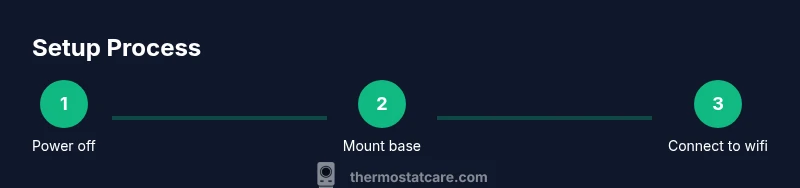
- 1
Power off and remove existing thermostat
Turn off power at the breaker and remove the old thermostat from the wall. Photograph wires for reference and label each conductor before disconnecting. This helps prevent wiring mistakes during replacement and supports accurate reassembly.
Tip: A labeled diagram or phone photo speeds up reassembly if you’re unsure about wire color codes. - 2
Confirm wiring and C-wire availability
Inspect the wall plate to locate the C terminal and all other wires. If a C-wire is present, ensure it’s connected to the thermostat’s C terminal. If there is no C-wire, plan an alternative power solution or a Honeywell model that doesn’t require one.
Tip: If you’re unsure, consult the wiring diagram on the old thermostat or use a multimeter to verify the common wire. - 3
Mount the new base and plan wire routing
Attach the thermostat mounting plate level on the wall and route wires cleanly through the back. Avoid bending wires sharply and keep connections accessible for later labeling.
Tip: Use a level to ensure the base sits squarely, which helps the touchscreen align properly. - 4
Connect wires to the correct terminals
Insert each wire into its matching terminal as labeled on the thermostat base. Do not skip terminals; double‑check color coding and ensure there is no loose strand that could short.
Tip: Double-check the wire letters (R, W, Y, G, C) against your old thermostat. - 5
Install the thermostat and power up
Attach the faceplate, restore power at the breaker, and allow the thermostat to boot. This initial power-up initiates pairing and prompts for setup in the Honeywell Home app.
Tip: If the screen stays blank, re-check connections and ensure the power circuit breaker is fully ON. - 6
Connect to WiFi and complete app setup
Open the Honeywell Home app, add a new device, and follow on-screen prompts to join your WiFi network. When prompted, enter your password and confirm the device appears in the app.
Tip: Choose a strong, unique password for your Honeywell account and enable two factor authentication if available.
Questions & Answers
Do I need a C-wire for Honeywell wifi thermostat?
Most Honeywell wifi thermostats require a C-wire for continuous power. If your system lacks a C-wire, you may need a power adapter or a model that supports power stealing. Always ensure the C-terminal is connected before finalizing setup.
Most wifi thermostats need a C-wire for continuous power. If you don’t have one, you may need a power adapter.
Which Honeywell models support wifi setup?
Many Honeywell models support wifi setup, but availability depends on the model line and region. Check the product page for compatibility with your heating and cooling system and required app version.
Most Honeywell wifi models support setup. Check the product page for compatibility.
Can I install the thermostat myself or should I hire a pro?
If you’re comfortable handling basic wiring and safety precautions, you can install the thermostat yourself. If you’re unsure about wiring or older equipment, hiring a licensed technician reduces risk.
If you’re comfortable with wiring, you can install it yourself; otherwise, hire a pro.
How long does setup take?
Most setups take about 30 to 60 minutes, depending on wiring complexity and whether you’re integrating features like scheduling and energy reports.
Typically a half-hour to an hour.
Why won’t my Honeywell wifi thermostat connect to WiFi?
Check that you entered the correct password, ensure the thermostat is on a 2.4 GHz network, and move the router closer if needed. Rebooting the router and re‑starting the pairing process often resolves the issue.
Make sure you’re using the right network and password, and try rebooting your router.
How do I reset a Honeywell wifi thermostat?
Reset can be done via the Honeywell Home app or by using a reset procedure on the device, then re-run the setup to reconnect to WiFi.
You can reset from the app or use a reset on the device and set it up again.
Watch Video
What to Remember
- Verify compatibility before starting
- Keep C-wire or power solution ready
- Test heating and cooling after setup
- Secure your account and WiFi for remote control