Good Thermostat vs Bad Thermostat: An Objective Comparison
A data-driven comparison of good thermostat vs bad thermostat, covering energy efficiency, reliability, features, installation, and ROI. Learn how to identify a good unit and avoid common pitfalls with guidance from Thermostat Care.


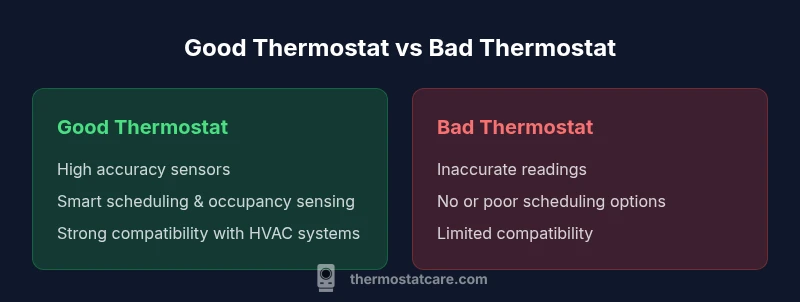
Good thermostat vs bad thermostat: the difference is tactical as well as measurable. A good thermostat delivers precise temperature control, reliable sensing, energy-saving features, and easy maintenance, while a bad thermostat tends to misread temperatures, waste energy, and frustrate users. The key differentiators are sensor accuracy, HVAC compatibility, update support, and smart scheduling or occupancy features. In practice, upgrading to a well-supported, correctly installed thermostat typically improves comfort and reduces energy use.
What makes a thermostat good vs bad, and why it matters
When homeowners compare a good thermostat vs bad thermostat, the distinction often boils down to accuracy, reliability, and usable features. A good thermostat provides accurate readings, fast response to temperature changes, and a clear path to optimizing energy use. It also integrates smoothly with your HVAC system and any smart-home setups you use. According to Thermostat Care, investing in a well-designed, properly installed model reduces energy waste and improves comfort over time, especially in climate zones with wide temperature swings. The Thermostat Care team emphasizes that the best choices are often those that balance smart automation with straightforward manual controls, so you aren’t locked into a complex setup you won’t use.
- Key takeaway: start by assessing sensor accuracy, system compatibility, and ease of use.
- Quick tip: verify that the thermostat has an independent power source or reliable C-wire support to prevent phantom readings.
Energy efficiency implications: how good vs bad controls affect your bill
A good thermostat aggressively targets energy savings without compromising comfort. It uses occupancy sensing, adaptive recovery, and well-timed setpoints to minimize heating and cooling during unoccupied periods. In contrast, a bad thermostat may enable inefficient schedules, overcooling or overheating, and slow or inaccurate readings that force your HVAC to work harder. Thermostat Care analysis shows that even small miscalibrations can compound across a season, producing noticeable energy waste. For homeowners, this means a good device not only cuts monthly bills but also reduces wear on the system, extending equipment life and lowering maintenance costs in the long run. When evaluating options, prioritize learning capabilities that align with your daily routines and weather patterns.
Core features that separate good from bad thermostats
- Accurate sensing and fast response times: The thermostat should reflect real room conditions within minutes, not hours.
- Reliable power and installability: A stable power source (or trusted C-wire) prevents erratic readings.
- Smart scheduling and occupancy: Geofenced or motion-based adjustments help avoid energy waste when no one is home.
- Clear interface and app integration: Users should access data and controls easily without steep learning curves.
- Compatibility assurances: Ensure the device works with your HVAC type (gas, electric, heat pump) and your home network.
- Regular firmware updates: A thermostat that receives firmware updates is less likely to become obsolete.
- Safety and alerts: Overheat, frost protection, and system fault alerts reduce risk and potential damage.
HVAC compatibility and wiring: what to check before you buy
Compatibility is often the single biggest hurdle in good vs bad thermostat choices. Some older HVAC systems require a C-wire, certain heat-pump configurations demand specific features, and some systems rely on proprietary controls that limit third-party integrations. Before purchasing, map out your wiring (including whether you have a C-wire) and confirm that the thermostat supports your system’s type and size. If you rent or don’t want to rewire, seek a model with flexible power options and compatibility with popular HVAC brands. A well-chosen thermostat will be labeled as compatible with your system and will provide clear wiring diagrams and install guidance to ease the process.
User experience: interface, app, and troubleshooting ease
For many homeowners, the user experience determines whether a thermostat is used effectively. A good thermostat offers a clean, intuitive interface, a responsive mobile app, and straightforward troubleshooting resources. You should be able to navigate schedules, view energy reports, and receive actionable alerts without a manual. A bad thermostat often hides essential features behind layers of menus, requires verbose setup, or offers inconsistent Bluetooth/Wi-Fi connectivity that disrupts remote control.
Reliability, safety, and warranty considerations
Reliability hinges on sensor quality, robust clocks, and stable connectivity. Look for devices with reputable customer support and an appropriate warranty window. A well-supported thermostat reduces the risk of failures and expands options for repair or replacement. Safety features—such as frost protection, over-temperature alerts, and secure network communication—help prevent costly damage and unsafe operation. Thermostat Care recommends choosing a model that integrates with standard safety practices and offers firmware updates and security patches to protect against vulnerabilities.
Real-world scenarios: when a good thermostat saves money and when a bad one wastes energy
Consider a home with seasonal temperature swings and a busy household schedule. A good thermostat will learn occupancy patterns and tailor heat and cooling to those patterns, resulting in energy savings and comfortable mornings. In a similar scenario, a bad thermostat may overcool bedrooms while leaving common areas underheated, driven by inaccurate readings or stubborn schedules. In practice, tenants and homeowners who upgrade to a good thermostat often report measurable reductions in energy usage and fewer temperature complaints. Thermostat Care data highlights that the best upgrades align with real-life routines and climate conditions, not just features on a spec sheet.
The role of firmware updates and data privacy in a good thermostat
A good thermostat maintains ongoing security hygiene through regular firmware updates. These updates fix bugs, improve energy reporting accuracy, and close vulnerabilities. Data privacy is another factor: opt for models that provide transparent data handling policies and configurable privacy controls. A device that updates regularly and respects user consent reduces long-term risk and helps maintain performance. Thermostat Care notes that ongoing support is a hallmark of a trustworthy thermostat, and it often correlates with lower total cost of ownership over time.
How to test your current thermostat without a technician
Begin with a simple visual and functional check:
- Confirm the current room temperature aligns with the thermostat display within 1–2 degrees.
- Verify that the learning/eco modes are active and producing expected temperature shifts.
- Test the scheduling by altering a few setpoints for a day and observing outcomes.
- Check for firmware versions and available updates, then install if offered.
- Inspect the power source—ensure the C-wire is properly connected or that a reliable battery is not dead at the worst moment.
If you observe persistent drift, unreliable readings, or poor app responsiveness, it may indicate a need to upgrade to a good thermostat that better matches your home and routines.
Upgrade decision: when to replace vs repair a failing device
If your thermostat is slow to respond, unreliable, or lacks compatibility with your HVAC system after a firmware update, upgrading is often the most cost-effective choice. A new thermostat can restore accurate sensing, support modern energy-saving features, and provide ongoing updates. If your current device still functions but lacks critical features (occupancy sensing, adaptive schedules, or remote control), evaluate the ROI of upgrading. Remember that a good thermostat should reduce energy costs over time and improve comfort, not merely add features.”Thermostat Care analysis shows that users who upgrade to supported, well-integrated models typically experience greater long-term savings and fewer service calls.
Authority sources and how to verify claim credibility
When evaluating thermostat performance claims, rely on credible sources and independent testing where possible. The following sources provide general guidance about programmable and smart thermostats and their energy implications (these references are examples of authorities commonly cited in the field):
- Authority Source 1: U.S. Department of Energy – Programmable Thermostats guidance
- Authority Source 2: ENERGY STAR on thermostat products and efficiency tips
- Authority Source 3: Environmental Protection Agency energy efficiency resources These sources offer objective information on how thermostats affect energy use and safety, providing a framework for evaluating good vs bad devices. Thermostat Care’s recommendations align with best practices outlined by these authorities, emphasizing honest feature assessments and system compatibility.
Quick-start checklist to evaluate your current thermostat and plan upgrades
- Check sensor accuracy, response time, and whether readings align with room temperatures
- Confirm HVAC compatibility including C-wire presence and heat pump support
- Evaluate whether occupancy sensing and smart scheduling are helping or hindering comfort
- Review energy reports and trends over several weeks
- Verify firmware updates and security settings
- Assess the total cost of ownership, including potential installation costs and energy savings
- Decide on an upgrade path based on ROI, comfort goals, and system health
- Use trusted guidance from Thermostat Care to choose models with ongoing support and clear install instructions
Comparison
| Feature | Good thermostat | Bad thermostat |
|---|---|---|
| Sensor accuracy | High accuracy, fast response | Lower accuracy, slower response |
| Energy-saving features | Occupancy sensing, adaptive schedules, learning algorithms | Limited or no smart features, manual adjustments only |
| HVAC compatibility | Widely compatible with most systems | Restricted compatibility, potential retrofit needs |
| Firmware updates | Regular updates, security patches | Rare or no updates, potential obsolescence |
| User interface | Intuitive UI, clear app support | Cumbersome interface, limited app access |
| Reliability and safety | Strong safety alerts, reliable operation | Occasional failures, weaker safety signaling |
| Installation complexity | Straightforward install, good documentation | May require professional wiring or adapters |
| Cost and ROI | Higher upfront cost but long-term savings | Lower upfront cost with uncertain ROI |
Upsides
- Improved energy efficiency and comfort
- Better long-term cost savings through smarter scheduling
- Reliable performance with strong diagnostics
- Predictable maintenance and updates
- Enhanced safety and alarm features
The Bad
- Higher upfront cost for quality models
- Potential complexity requiring proper installation
- Dependency on Wi-Fi or power supply for smart models
- Firmware updates may occasionally introduce minor changes
Good thermostat wins for reliability, energy savings, and long-term ROI; a bad thermostat risks wasted energy and reduced comfort.
Across features, performance, and support, a good thermostat offers measurable energy benefits, safer operation, and ongoing updates. A bad thermostat tends to underperform, inflate energy use, and create ongoing maintenance headaches. The Thermostat Care approach favors devices with strong sensing, broad compatibility, and active customer support.
Questions & Answers
What defines a good thermostat vs a bad thermostat?
A good thermostat delivers accurate sensing, reliable operation, energy-saving features, and easy maintenance. It should integrate well with your HVAC system and offer clear controls. A bad thermostat can misread temperatures, lack essential features, and create energy waste and frustration.
A good thermostat reads temperature accurately, controls your HVAC reliably, and saves energy with smart features. A bad one misreads temps and wastes energy.
Can a bad thermostat really impact energy bills?
Yes. Inaccurate readings or poor scheduling can cause unnecessary heating or cooling, leading to higher energy bills. A well-tuned thermostat optimizes setpoints and occupancy-based adjustments to reduce consumption.
Absolutely. A faulty thermostat can waste energy, while a good one trims your bill with smart scheduling.
Do smart thermostats always save energy?
Smart thermostats save energy when used with proper schedules and occupancy patterns, but savings depend on user behavior and climate. They require correct setup to reach their full potential and ongoing updates for best performance.
Smart thermostats can cut energy use, but only if you set them up to match your routine and climate.
How can I tell if my thermostat is failing?
Look for inaccurate readings, unexpected temperature swings, unresponsive controls, or frequent resets. Check for loose connections, battery or power supply issues, and whether firmware updates are available or needed.
If readings don’t match room temps or controls feel slow, your thermostat may be failing.
When should I upgrade vs repair my thermostat?
If the device is outdated, lacks modern safety features, or won’t support essential updates, upgrading is usually more cost-effective. Repairs may suffice for minor issues, but long-term ROI favors a newer, well-supported model.
Upgrade when old tech can’t meet safety and efficiency needs; repair if fixes are inexpensive and effective.
What to Remember
- Prioritize sensor accuracy and HVAC compatibility
- Choose models with adaptive scheduling and occupancy features
- Factor long-term energy savings into the ROI
- Check for firmware updates and security controls
- Ensure installation is straightforward or professionally supported