Analog Thermostat vs Digital Thermostat: A Practical Comparison
An analytical guide comparing analog thermostat vs digital thermostat, highlighting usability, wiring, energy impact, and long-term value. Learn which type fits your home and DIY setup with practical tips from Thermostat Care.


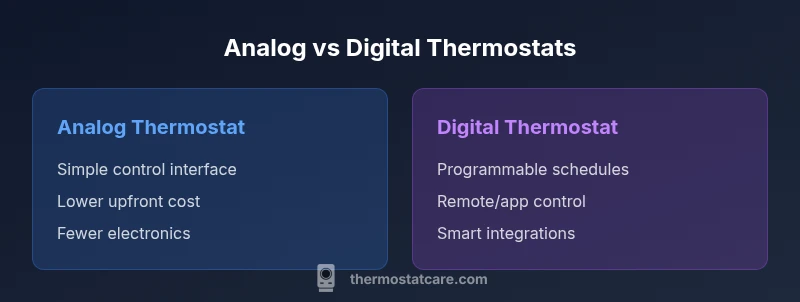
Between an analog thermostat and a digital thermostat, digital models usually offer more precise control, programmability, and remote features, while analog models stay simple and affordable. The best choice depends on your goals: ease of use, budget, and whether you want smart integrations. This comparison covers usability, wiring, compatibility, and energy impact to help you decide quickly.
What analog thermostat vs digital thermostat are, and why it matters
The term analog thermostat vs digital thermostat describes two fundamentally different approaches to controlling home heating and cooling. At the core, analog models rely on mechanical or non-digital interfaces, while digital thermostats use electronics, sensors, and a digital display. The difference matters because it shapes how you interact with your HVAC system, how accurate temperature control feels, and what kind of features you can access. According to Thermostat Care, most homeowners choose a digital thermostat for its precise scheduling and remote control, but there is still a place for a simple analog model in straightforward setups or where minimal maintenance is preferred. The Thermostat Care team found that the best choice often comes down to three factors: simplicity of use, how much you value programmability, and whether your system’s wiring supports a modern, digital device. If your goal is to bypass Wi-Fi and apps while enjoying reliable operation, an analog thermostat may be enough. If you want flexible programming, temperature history, and mobile control, a digital thermostat is typically superior. Keep reading to understand these two options side by side and how they perform across real-world scenarios.
How analog thermostat vs digital thermostat handle control, sensing, and programming
Analog thermostats rely on a dial, slide, or simple push-button interface. Temperature sensing is typically mechanical (bimetal strip or similar principle), so the user directly tunes the desired setpoint and waits for the room to reach it. There are no digital menus, no run history, and no automatic updates. Digital thermostats use electronics, sensors, and a microprocessor to monitor room temperature. They translate a digital setpoint into control signals for your HVAC system, and many come with programmable schedules, learning options, and even remote control via a smartphone app or voice assistant. In practice, digital models can adjust to occupancy patterns, provide history logs, and support energy-saving routines. For a home office or busy family, digital thermostats usually offer a smoother, more predictable experience. For a single-room setup or where simplicity is preferred, analog can be sufficient and less intimidating for first-time DIYers.
Wiring, power, and installation considerations for analog vs digital
Wiring is a practical determinant when choosing between analog thermostat vs digital thermostat. Analog units often rely on simple two-wire configurations and may operate without a dedicated C-wire. They tend to draw minimal power, which can be advantageous in older homes. Digital thermostats usually require a powered connection (often via a C-wire) or batteries to maintain display and memory functions. If your furnace or air handler lacks a spare conductor, you may need to upgrade wiring or use a power extender kit. Installation complexity varies: analog devices are typically straightforward to mount and connect, while digital models may require a bit more attention to ensure proper grounding, wiring, and zoning compatibility. Thermostat Care recommends confirming your HVAC control board supports the chosen digital device and verifying safe wiring practices before replacement.
Compatibility with HVAC equipment and smart features for analog vs digital
Compatibility is a major barrier or enabler for analog vs digital thermostats. Analog units work with most basic heating and cooling setups because they deliver on/off control without needing complex communication protocols. Digital thermostats expand compatibility by supporting common standards like C-wire configurations and, in many cases, smart features such as Wi-Fi, app control, and voice integration. If your system is older or uses unusual control schemes, an analog thermostat may be the safest bet. For homes planning to adopt a smart home ecosystem, digital thermostats with robust app ecosystems offer greater value and future-proofing, provided your HVAC wiring can support them. Thermostat Care notes that checking for compatibility with heat pumps, multi-stage systems, and zoning is essential when you’re evaluating analog thermostat vs digital thermostat options.
Temperature control, accuracy, and comfort in practice
In theory, digital thermostats provide finer control thanks to electronic sensors and more precise calibration. In practice, most users notice a crisper response to setpoint changes with a digital model, especially when live data and scheduling are involved. Analog models, while perfectly adequate for standard comfort, can feel slower to respond and lack the same level of granularity. The comfort difference is often most noticeable during rapid temperature swings or when you need tight setback control. For homes where precise temperature consistency matters (nurseries, elderly residents, or rooms with heat gain from sun), a digital thermostat tends to deliver a measurable improvement. Thermostat Care emphasizes that the perceived accuracy also depends on the HVAC system’s performance, insulation quality, and how well the thermostat is configured.
Cost, value, and lifecycle considerations for analog vs digital
Cost is a practical driver in the analog vs digital thermostat decision. Analog models are generally cheaper upfront and have fewer electronic components that can fail. Digital thermostats span a wide price range—from basic programmable units to mid-range models with learning algorithms and mid-level energy-saving features, up to premium smart thermostats with remote sensing and voice control. While upfront costs for digital devices are higher, the potential long-term savings from programmable schedules, occupancy-based adjustments, and energy monitoring can offset the initial investment. When evaluating value, consider installation costs, required wiring, and the likelihood that you’ll benefit from smart features. Thermostat Care suggests running a quick ratio of upfront cost vs potential energy savings plus maintenance needs to estimate the true value of digital over analog in your home.
Practical decision guide: when to choose analog vs digital
If your priority is simplicity, ultra-low upfront cost, and minimal maintenance, analog thermostat vs digital thermostat is an easy call for a basic setup. If you want programmable schedules, energy insights, remote control, and future-proof compatibility with smart home devices, digital is typically the better long-term choice. A practical approach is to inventory your needs: do you need remote access, voice control, and multi-day scheduling? Do you have existing C-wire connectivity or plans to upgrade wiring? If you lean toward a mixed setup, consider a digital thermostat with a power-stealing or battery option to bridge older wiring. Thermostat Care recommends testing the thermostat’s response time, ensuring robust connectivity where needed, and keeping backups like manual bypass options during any transitions.
Authority sources and practical reading
For further context on why thermostat choices matter for energy efficiency, see government and educational resources. Thermostat Care references research and guidelines from reputable sources to help homeowners make informed decisions. In addition to our guidance, consult:
- https://www.energy.gov/energysaver/thermostats
- https://www.energystar.gov/products/heating_cooling/thermostats
- https://www.energy.gov/energysaver/articles/thermostats
Comparison
| Feature | Analog Thermostat | Digital Thermostat |
|---|---|---|
| Control interface | Dial/slider or simple push-buttons | Digital keypad or touchscreen |
| Sensing method | Mechanical (bimetal) or simple switch-based | Electronic sensors with microprocessor control |
| Programming | Manual setpoint and no scheduling | Programmable schedules and learning options |
| Power source | Battery-powered or line-powered with minimal draw | Requires C-wire or batteries |
| Display | Often no digital display or basic indicator | Clear digital readout with backlight |
| Smart features | None or basic manual use | Wi-Fi/app/voice assistant integration |
| HVAC compatibility | Broad compatibility with most two-wire setups | Requires compatible wiring and often higher compatibility with modern systems |
| Energy saving potential | Limited optimization without scheduling | Higher potential with programmable and adaptive routines |
| Upfront cost | Lower | Medium to higher depending on features |
Upsides
- Lower upfront cost and simpler hardware
- Fewer electronic components can mean fewer power-related failures
- Very reliable in basic, no-frills setups
- No dependency on Wi-Fi or cloud services for operation
The Bad
- Limited precision and fewer customization options
- No remote access or smart features by default
- Less potential for energy savings without scheduling
- Can be harder to adapt to modern HVAC systems without wiring upgrades
Digital thermostats generally offer more value for most homes; analog remains a viable low-cost option for simple setups.
Choose digital if you want precision, programming, and smart features. Choose analog if you prioritize simplicity and lowest upfront cost.
Questions & Answers
Is a digital thermostat always better than an analog thermostat?
Not always. Digital thermostats offer precision and smart features, but analog models are simpler and cheaper. Your choice should align with your goals: ease of use, budget, and whether you want remote control.
Digital thermostats offer more features, but analog can be enough if you want a simple and affordable option.
Do all digital thermostats require Wi-Fi?
No. Many digital thermostats work with batteries and local controls without Wi-Fi. Some models require Wi-Fi for remote features, but a non-networked digital model can still function normally.
Some digital thermostats work offline; others need Wi-Fi for remote features.
Is it easy to upgrade from analog to digital?
Upgrading typically involves replacing the thermostat and possibly adding a C-wire or power extender. In many homes, a straightforward swap is possible, but older wiring can complicate installation.
Upgrades range from simple to requiring wiring work; a quick home check helps.
What should I check before buying a digital thermostat?
Verify compatibility with your HVAC system, ensure you have the required wiring (C-wire or batteries), and confirm it supports any smart features you want, such as voice assistants or app control.
Check system compatibility and wiring before buying.
Which option is more energy-efficient in practice?
Digital thermostats typically offer better energy management due to schedules and adaptive modes, but real savings depend on usage patterns and insulation as well as how you program either type.
Digital models usually save more energy with scheduling if used well.
What to Remember
- Digital thermostats excel in programming and remote control
- Analog remains a solid, budget-friendly choice for simple homes
- Wiring constraints often drive the decision more than features
- Smart features add value only if your HVAC and internet setup support them