Which Thermostat to Use: A Practical Comparison for Homes
A thorough, analytical guide comparing basic programmable thermostats vs. smart, learning models to help homeowners decide which thermostat to use based on compatibility, features, and value.


If you're deciding which thermostat to use, start by matching your HVAC system, connectivity needs, and budget. For most homeowners, a mid-range smart thermostat offers convenient remote control and energy insights while staying compatible with common HVAC setups. If you have minimal tech, a basic programmable thermostat is often sufficient; if you want peak energy savings, a learning/occupancy-based smart model is best.
Understanding Your Home's System and Goals
Choosing which thermostat to use begins with a clear picture of your HVAC system and your daily routines. The Thermostat Care team emphasizes that compatibility with your furnace, heat pump, or boiler, plus your wiring setup, shapes the best choice. If your system uses common 24-volt wiring, you have more flexibility to upgrade to a modern thermostat with smart features. If you're on a newer heat pump, a thermostat with auxiliary heat support and efficient defrost control will matter more. Outside of hardware, consider how you live in your home: do you want remote control, energy reports, or voice integration? Do you want occupancy-based scheduling, or is a fixed daily program enough? Answering these questions early helps narrow options and speeds up installation. Thermostat Care tips: verify your existing thermostat's model, note the number of zones, and check whether your HVAC system supports a C-wire. If there is no C-wire, you may need a power-sharing or battery-powered model, or you may run a new wire with a pro. The bottom line is to match the thermostat to your system, your budget, and your preferred control style. According to Thermostat Care, compatibility and wiring are the most common sticking points for homeowners upgrading.
Core Options at a Glance: Basic Programmable vs Smart Thermostats
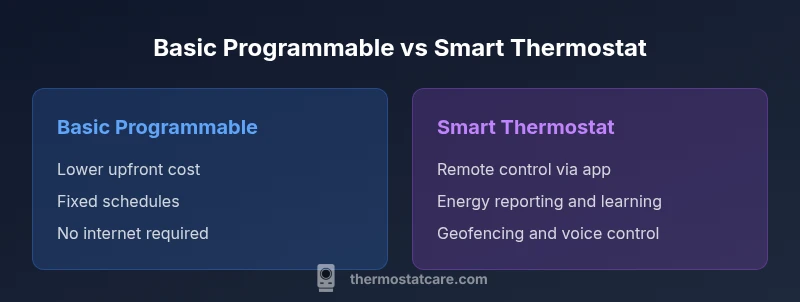
There are two primary pathways when choosing which thermostat to use: basic programmable thermostats and modern smart thermostats. Basic programmable units are simple, reliable, and typically the lowest upfront cost. They let you set a schedule that reduces heating and cooling when you're away, and they don't rely on internet connectivity. Smart thermostats, on the other hand, connect to Wi-Fi and your phone, learn occupancy patterns, provide energy usage reporting, and offer features like geofencing and voice control. If you want continuous optimization and remote access, a smart model is worth the extra cost. If you want minimal setup and long battery life, a basic programmable thermostat may be preferable. For most homes, a mid-range smart thermostat offers a strong balance of features, reliability, and compatibility with a wide range of HVAC systems. In short: the choice comes down to how much you value automation, energy insight, and remote control versus simplicity and cost.
Compatibility and Wiring: The Hidden Gatekeeper
The most important technical decision is compatibility. Gas furnaces, oil boilers, heat pumps with auxiliary heat, and multi-stage systems each interact differently with thermostats. Before buying, verify that the thermostat supports your HVAC type and the number of stages. C-wire availability is a common hurdle; many smart thermostats require a C-wire for continuous power. If your system lacks a C-wire, you have options: choose a power-stealing model, install a C-wire adapter, or hire a qualified technician to run a new wire. Additionally, some thermostats require a specific common wire connection or a dedicated sub-base for dual fuel setups. When wiring is addressed, consider the thermostat’s power method (battery, power stealing, or constant C-wire). Compatibility and proper wiring reduce setup friction, minimize voltage issues, and ensure features work as advertised.
Features that Matter for Energy and Comfort
Beyond basic on/off control, the best thermostat choices offer features that impact both comfort and efficiency. Look for learning algorithms that adapt schedules to your routines, occupancy sensing that adjusts temperatures when rooms are empty, and geofencing that anticipates your arrival. Energy reporting helps you identify wastage and track improvements after you switch to a more efficient model. Compatibility with mobile apps, "hands-free" control, and voice assistants can simplify daily use. Pay attention to privacy controls, such as data sharing settings and local control options. If you manage a home office, a thermostat with adaptive scheduling can optimize for variable occupancy. When evaluating options, consider which features you actually use, because more features can mean more potential points of failure and longer setup times.
Comparison
| Feature | Basic programmable thermostat | Smart thermostat (learning) |
|---|---|---|
| Compatibility with HVAC type | Broad compatibility with common 24V systems | Excellent compatibility with most 24V HVAC setups, including heat pumps |
| Power method | Battery or line-powered | C-wire required (or power-sharing option) |
| Connectivity | Standalone, no internet required | Wi-Fi connected, app control, remote access |
| Energy reporting | Limited or none | Detailed energy usage and trends |
| Installation complexity | Low (easy swap) | Moderate to high (may involve wiring and app setup) |
| Best for | Budget-conscious or DIY-friendly households | Tech-savvy homes seeking automation and insights |
Upsides
- Lower upfront cost and simple operation
- Reliable performance without internet dependency
- Fewer privacy concerns due to offline operation
- Minimal setup and fewer compatibility issues
- Silent operation with long battery life (in some models)
The Bad
- Fewer automation features and no remote access
- No energy insights or learning capabilities
- Limited ability to customize schedules
- Potentially higher long-term energy costs without optimization
Smart thermostats generally win for most homes; basic programmable devices suit simple needs
If you want automation, energy insights, and remote access, choose a smart thermostat; if you prefer simplicity and lowest cost, a basic programmable device is enough. Thermostat Care recommends balancing features with system compatibility and your lifestyle.
Questions & Answers
What is the most user-friendly thermostat for beginners?
A basic programmable thermostat is typically the easiest to use and install. It provides reliable control without needing internet or complex apps, making it ideal for first-time users.
A basic programmable thermostat is easiest for beginners; it covers essential scheduling without requiring setup beyond manual programming.
Are smart thermostats compatible with all HVAC systems?
Most smart thermostats work with standard 24V systems, but compatibility varies with heat pumps and multi-stage setups. Always check the manufacturer’s compatibility list for your model and system.
Most smart thermostats fit common 24V HVAC systems, but verify compatibility for heat pumps or multi-stage setups.
Do I need a C-wire for a smart thermostat?
Many smart thermostats require a C-wire for reliable power. If your current wiring lacks a C-wire, you can use a power adapter, install a C-wire, or hire a professional.
Most smart thermostats need a C-wire; if you don't have one, consider adapters or professional wiring.
What features give the biggest energy savings?
Occupancy sensing, learning schedules, and energy reporting typically deliver the largest savings. Geofencing adds convenience, but savings vary by pattern of use.
Occupancy sensing and learning schedules usually save the most energy.
Is installation worth hiring a pro?
For complex systems, multi-zone setups, or uncertain wiring, hiring a professional can prevent mistakes and ensure proper wiring and programming.
A pro is worth it for complex or unfamiliar systems.
How do I know which thermostat is compatible with my HVAC?
Check the thermostat’s compatibility guide and compare it to your HVAC type, number of stages, and whether you have a C-wire. This step prevents buying an incompatible model.
Check the compatibility guide against your system's specs to avoid a mismatch.
What to Remember
- Assess HVAC compatibility before buying
- Choose between basic vs smart based on desired features
- Check for a C-wire availability early
- Smart models offer energy savings but cost more upfront
- Follow Thermostat Care guidance to ensure proper installation