How to Set Thermostat on Boiler: Step-by-Step Guide
Learn how to set thermostat on boiler with a safe, reliable method. This guide covers compatibility, wiring basics, and tested steps to optimize comfort and energy efficiency in 2026.


Install a boiler-compatible thermostat in 8 clear steps, from powering down to testing the controls. This quotable guide highlights wiring basics, boiler compatibility checks, and safe setup practices so your system remains reliable and energy-efficient. See our full step-by-step guide.
Why proper thermostat setup on a boiler matters
Properly setting a thermostat on a boiler is essential for comfort, energy efficiency, and safety. When the boiler and thermostat are aligned, your home heats evenly, you avoid wasted energy, and you reduce the risk of overheating or sudden temperature swings. According to Thermostat Care, a clear, correct installation avoids common problems such as mismatched voltage, wrong wiring terminals, and inconsistent feedback from the boiler control. In this guide, we address the exact steps to learn how to set thermostat on boiler, with attention to safety, compatibility, and practical troubleshooting. You will gain a solid understanding of what needs to be wired, what settings to apply on the thermostat, and how to verify that the system responds correctly to the programmed schedule. The goal is a reliable, comfortable home environment that responds predictably to your daily routines.
Boiler-thermostat basics you should know
Most boilers use a low-voltage control circuit that talks to a thermostat using 24 volts. You can choose a mechanical, digital, or smart thermostat, but compatibility matters. If your boiler is a combi or system boiler, the thermostat must be able to communicate with the boiler's receiver or connect via a wired C-wire to power the thermostat. The Thermostat Care analysis shows that many installation issues stem from assuming the thermostat wiring is the same as for a furnace or heat pump. Always verify the boiler's wiring diagram and voltage requirements before attempting to set the thermostat. If you’re unsure, consult the boiler manual or a licensed technician. This section reviews common terminals (R, RC, W, C) and what they do in a boiler-based setup, helping you avoid miswiring and call-backs.
Safety and shutdown procedures before you begin
Before you touch the boiler or thermostat, safety is non-negotiable. Power down the boiler at the power switch and the circuit breaker feeding both boiler and existing thermostat. Use a non-contact voltage tester to confirm circuits are dead. Do not work on gas lines or exposed fuel connections unless you are a trained professional. If you smell gas, evacuate immediately and call the gas utility. Grounding, proper insulation, and using appropriate tools are essential to prevent shocks or short circuits. By following careful safety steps, you minimize risk and ensure that your work on how to set thermostat on boiler is performed safely and correctly.
Understanding your boiler’s control interface
Boiler controls vary by manufacturer, but the same principles apply. The front panel may include a limit switch, a burner control, and a connection port for a thermostat receiver. Some boilers require pairing through a dedicated receiver plugged into a control board, while others connect directly to a C-wire on a compatible thermostat. Review the impulse or boiler schematic to locate the thermostat terminals. Having a clear picture of what you’re wiring helps you map the thermostat’s R and C wires correctly and set the boiler to respond to temperature commands in a predictable way. The key is to know which terminals are live when the thermostat calls for heat and which ones remain open until the thermostat requests heat.
Step-by-step overview of pairing and wiring (high level)
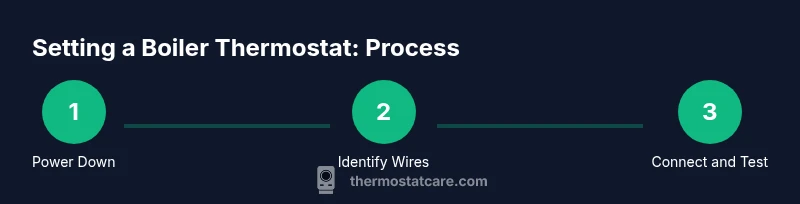
If you’re using a wired thermostat, you’ll typically remove the cover on the boiler’s control panel and locate the thermostat terminals. For a wired setup, connect the thermostat’s wires to the appropriate boiler terminals according to the wiring diagram. If you’re using a wireless or smart thermostat, install the receiver on the boiler, then pair it with the thermostat per the manufacturer’s instructions. In all cases, double-check the R and C connections and ensure there’s a continuous circuit when heat is called. This overview gives you a mental map before you dive into the 8-step process that follows in the STEP-BY-STEP section.
Wiring specifics for common boiler types: combi, system, and heat-only
Combi boilers often use a simple on/off signal to the thermostat, with limited external wiring. System boilers may require a dedicated receiver, while heat-only boilers rely on basic temperature feedback. If your boiler is older, you may see a two-wire setup with no C-wire; in that case, certain thermostats can operate with power stealing, but the risk of forgoing a stable 24V supply exists. Always prefer a thermostat with a powered option and a C-wire if your system supports it. The goal is to avoid a constant short cycle, where the boiler turns on and off too frequently, which wastes energy and decreases comfort.
Configuring the thermostat: temperature settings, hold, and scheduling
After wiring, configure the thermostat to reflect your home’s heating needs. Set a comfortable daytime temperature and lower it at night or when you’re away. Use a hold or away mode if you’ll be out for extended periods. When programming schedules, align heating setbacks with your daily routine so heat is ready when you return. For smart thermostats, enable learning features or adaptive schedules if you want the device to optimize energy usage automatically. Finally, verify that the boiler responds to setpoint changes within a minute or two.
Testing, verification, and troubleshooting tips
Turn the power back on and observe the boiler’s response to thermostat commands. If you don’t hear the burner firing when you call for heat, recheck the wiring, especially R and W connections. If there’s no response, check the thermostat’s configuration and ensure it’s on the correct heating mode. For wireless setups, confirm the receiver is linked and within range. If problems persist, consult the boiler manual or Thermostat Care resources for model-specific guidance. It’s normal to see small delays as the system stabilizes during the first runs after wiring.
Maintenance, safety checks, and long-term optimization
Periodically inspect the thermostat and wiring for signs of wear, corrosion, or loose connections. Clean the thermostat’s terminal block with a dry brush and ensure the thermostat faceplate is undamaged. Replace batteries and test the thermostat’s accuracy against a room thermometer. Over time, you may need to recalibrate the boiler’s minimum on-time or reset the receiver to maintain reliable operation. By staying proactive, you’ll keep your boiler heating efficient, comfortable, and safe for years to come. The Thermostat Care team recommends documenting settings and periodically testing the system to ensure continued performance in 2026.
Tools & Materials
- 24V thermostat compatible with boilers (programmable or smart)(Ensure it supports boiler control and 2-wire or 3-wire connection as per your boiler's diagram)
- Screwdriver set (Phillips #2, flathead)(Needed to open the boiler panel and thermostat base)
- Wire strippers/cliers(For trimming and securing wires)
- Voltage tester or multimeter(Confirm power is off before touching wiring)
- C-wire adapter or spare thermostat wire(If your boiler lacks a C-wire, some thermostats offer power sharing adapters)
- Electrical tape and wire nuts(Secure and insulate connections)
- Boiler manual or wiring diagram(Reference exact terminal designations)
- Safety gear (gloves, eye protection)(Minimize risk while handling controls)
Steps
Estimated time: 45-60 minutes
- 1
Power down and safety check
Turn off the boiler at the power switch and the circuit breaker feeding both boiler and existing thermostat. Verify with a voltage tester that no live voltage remains on the thermostat terminals before you touch anything.
Tip: Always confirm power is off at both the boiler and the thermostat before handling wires. - 2
Identify wires and terminals
Remove the thermostat cover and label each wire. Identify R, W, and C terminals on both the thermostat and boiler control board. Take a clear photo for reference to avoid confusion later.
Tip: If you’re unsure which wire is R, trace it back to the boiler’s control board. - 3
Check boiler compatibility and wiring diagram
Consult the boiler manual or manufacturer website to confirm 24V control compatibility and whether you need a receiver. Match the thermostat wiring plan to the boiler diagram to prevent miswiring.
Tip: Copy the diagram to your notes for quick reference. - 4
Wire the thermostat or receiver to boiler
Connect the thermostat wires to the corresponding boiler terminals (R to R, W to W, C to C as required). If using a wireless receiver, install it per the manual and connect its outputs to the boiler board.
Tip: Do not swap R and C; incorrect wiring can damage the control circuit. - 5
Configure thermostat power and mode
Restore power and set the thermostat to heating mode. If you’re using a battery-powered unit, ensure it has adequate power or use a powered option if available.
Tip: Set the thermostat to heat, not cool, to align with boiler operation. - 6
Test basic operation
Raise the thermostat setpoint to trigger heat and listen for the boiler firing. Confirm water circulation and that the radiators warm up evenly.
Tip: If no heat, recheck wiring connections and ensure the receiver (if present) is paired. - 7
Program schedules and hold modes
Enter your daily schedule: higher temperatures during wake hours and lower at night or away. Use hold/away for extended absences and adapt to seasonal changes.
Tip: Program setbacks that match your routine to maximize energy savings. - 8
Final safety check and documentation
Secure the boiler panel, label wires, and save the wiring photo. Document the final settings and keep manuals handy for future maintenance.
Tip: Maintain a service log to simplify future repairs or upgrades.
Questions & Answers
Do I need a C-wire to set a thermostat on a boiler?
Most boiler thermostats require 24V power. Many setups work with a C-wire, but some older systems operate on power stealing or batteries. Check your boiler diagram and use a C-wire if available.
Most boilers use a 24-volt supply; if you have a C-terminal, use it. If not, check compatibility with your thermostat.
Can I install a boiler thermostat myself?
If you’re comfortable with basic wiring and can safely power down circuits, you can install a thermostat. Always follow the boiler’s manual and local electrical codes. If in doubt, hire a licensed technician.
If you’re confident with wiring and safety checks, you can do it yourself; otherwise, get a pro.
Why isn’t my boiler responding to the thermostat?
Possible causes include incorrect wiring, thermostat left in the wrong mode, or the receiver not paired. Recheck connections and reset the receiver if needed. If problems persist, consult the boiler manual or Thermostat Care resources.
Check wiring, mode, and pairing first; if needed, reset the receiver and try again.
What if the thermostat shows no power or is dead?
Verify the thermostat has power or fresh batteries. Inspect the 24V supply from the boiler and ensure there’s a continuous circuit. If power is still off, there might be a tripped breaker or a faulty relay.
Check power, batteries, and the boiler’s 24V supply before pursuing more complex fixes.
Are smart thermostats worth it with a boiler?
Smart thermostats can optimize energy use and comfort if your boiler supports a compatible receiver or 24V interface. Confirm compatibility and set up routines to maximize savings.
Yes, if your boiler supports it; it can improve energy efficiency and ease of use.
How can I test if the boiler is calling for heat correctly?
Set the thermostat higher and listen for burner activation and radiator warming. Use the boiler’s indicators to confirm heat on, and observe for a few cycles to ensure consistent response.
Raise the temp and watch for burner and radiator response to confirm proper operation.
Watch Video
What to Remember
- Verify boiler-thermostat compatibility before wiring
- Power down, test, and label wires
- Program schedules to match daily routines for energy savings
- Confirm reliable boiler response to thermostat commands
- Document settings for easier maintenance