How to Fit a Thermostat to a Boiler: A Practical Guide
Learn how to fit a thermostat to a boiler safely and effectively with Thermostat Care. This step-by-step guide covers compatibility, wiring basics, safety tips, and testing to improve comfort and efficiency.


To fit a thermostat to a boiler, start by selecting a compatible model and confirming wiring requirements (C-wire or battery power). Then power off, locate the boiler's stat terminals, connect the thermostat's wires per the diagram, and test by setting a call for heat. This guide covers safety, wiring, and verification steps.
What it means to fit thermostat to boiler
Fitting a thermostat to a boiler is a practical step toward smarter, more efficient heating. When done correctly, it lets you precisely schedule heat, reduce energy waste, and maintain comfortable temperatures without fiddling with the boiler every day. The key is choosing a thermostat that is compatible with your boiler's control system and wiring configuration, and then wiring it safely according to a documented diagram. This article from Thermostat Care focuses on typical domestic boilers (combi and system). If you have a system with a non-standard control board, the guidance below still applies, with emphasis on verifying compatibility before you begin. Before you start, confirm you have the right tools and a clear wiring diagram, and know when to call a professional.
Safety first: power, gas, and building codes
Working with boilers and electrical controls carries risks. Always switch off power at the main supply and isolate the circuit feeding the boiler before touching any wiring. If your boiler is gas-fired, turn off the gas supply and wait for any residual pressure to drop. Use a non-contact voltage tester to confirm there is no live current on terminals. Check local codes and the boiler manufacturer’s installation manual for required clearances and wiring practices. In some regions, thermostat installation constitutes a regulated alteration and may require a licensed professional. Keep a certificate handy if your home uses a gas appliance; failure to follow safety rules can lead to carbon monoxide hazards or warranty issues. The Thermostat Care team urges careful planning and compliance with safety standards above speed.
Compatibility: choosing the right thermostat for your boiler
Not all thermostats are created equal when it comes to boilers. A traditional 230V thermostat is not compatible with most low-voltage boiler circuits. In most cases, you will need a 24V thermostat or a battery-powered model designed for boiler control. Verify if your boiler uses a 'G' and 'W' call for heat wiring, or if it expects a '1' and a '2' style connection. Many modern boilers support OpenTherm or standard switching; others require a dedicated wiring center. Review the boiler's wiring diagram and the thermostat’s installation manual before purchasing. Thermostat Care recommends choosing a thermostat that supports your boiler’s control logic, the number of wires available in the wall box, and whether you want a smart feature such as remote scheduling. If you’re unsure, contact the manufacturer or a professional.
Materials and tools you'll need
Gather the items on your list before you start. You’ll typically need a compatible thermostat, a C-wire or suitable power adapter, screwdrivers, wire stripping tools, and a voltage tester. Having electrical tape and spare wires can help tidy up the installation. Check the thermostat’s installation guide for any model-specific tools. Always keep a spare fuse and spare parts recommended by the boiler maker, in case you need to revert.
Wiring basics and boiler terminology
Understanding basic wiring terms helps prevent miswiring and boiler faults. Key terms include C-wire (common supply), R (24V supply), W (heat call), and G (fan or status signal). Boilers with simple relay circuits differ from OpenTherm-enabled units, which allow continuous two-way communication. If your boiler has a sealed control block, you may need a mounting plate or a retrofit kit. The goal is to create a safe path for the thermostat’s output to energize the boiler’s heat-demand input without creating short circuits. Always follow the diagrams supplied by the boiler and thermostat manufacturers.
Step-by-step overview
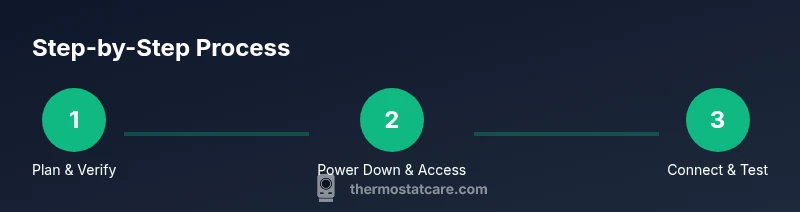
This overview highlights the main phases you’ll follow when fitting a thermostat to a boiler:
- Verify compatibility and turn off power.
- Access the terminal block and identify the correct terminals.
- Connect thermostat wires per the diagram.
- Configure boiler control settings and test the heat call.
- Inspect connections and securely insulate wires.
- Finalize by recording the wiring and setting schedules.
Step-by-step: power-down and prepare workspace
Begin by turning off the boiler and boiler circuit at the isolator or breaker. Then shut down any room thermostat to prevent false calls during wiring. Clear the area around the boiler, remove the front panel if needed, and lay out the tools in an organized manner. Taking a photo of the existing wiring can help later if you need to reverse changes.
Step-by-step: access terminals and confirm wiring
Carefully remove the access panel to reach the terminal strip. Use a voltage tester to ensure no live current. Identify the thermostat wiring terminals you’ll connect to (for example, the low-voltage pair or the common and heat call wires). If you have multiple cables, map each wire to its function and note colors for reference. Do not disconnect more wires than necessary.
Step-by-step: make the connections
With the boiler powered off and the wiring mapped, connect the thermostat wires to the appropriate terminals on the boiler and the thermostat base. Keep wire lengths short and tidy, using wire caps or electrical tape to secure exposed conductors. Re-check that you’re not reversing polarity and that there’s no stray wire contact. Refit the boiler panel once wiring is complete.
Step-by-step: configure, test, and finalize
Power the system back on and program your thermostat according to the boiler’s guidelines. Trigger a heat demand and observe the boiler’s response. If the boiler stays on or fails to start, re-check wiring, fuses, and the thermostat’s settings. When satisfied, set up schedules and verify integration with any smart-home hub.
Step-by-step: safety checks and troubleshooting
If you’re unsure at any point, stop and consult the manual or a qualified technician. Look for persistent error codes and contact the boiler manufacturer if the display shows specific fault codes. Keep spare fuses and tools handy for future maintenance. Finally, record the wiring configuration for future reference.
Tools & Materials
- Thermostat (compatible with boiler)(Choose model supporting your boiler type and power source (battery or wiring))
- C-wire or battery power adapter(If your thermostat requires a C-wire, ensure you have one or use a power extender kit if compatible)
- Screwdrivers (Phillips and flat-head)(Sizes #1-2 typically; check screw heads)
- Wire strippers(For clean, secure wire ends)
- Voltage tester(Verify no live voltage before touching terminals)
- Electrical tape(Good for insulating exposed conductors)
- Multimeter (optional)(Useful for confirming voltage levels if needed)
Steps
Estimated time: 60-90 minutes
- 1
Power down and prepare workspace
Turn off the boiler and the circuit feeding the thermostat. Clear the area, remove the front panel if needed, and lay out tools in an organized fashion.
Tip: Take a photo of existing wiring before disconnecting to help with reassembly. - 2
Identify terminals and wiring type
Inspect the boiler terminal block and thermostat base to determine which wires are responsible for heat call and common. Map each wire to the correct function.
Tip: Double-check the boiler diagram and thermostat manual. - 3
Connect thermostat wires
Connect the thermostat’s low-voltage wires to the corresponding boiler terminals as per the diagram. Keep wires short, tidy, and insulated.
Tip: Avoid reversing polarity and secure conductors with caps. - 4
Configure boiler settings
Restore power and program your thermostat per the boiler’s requirements. Ensure the system recognizes heat demand and the boiler cycles correctly.
Tip: Set a test call for heat and listen for the boiler firing. - 5
Test and verify operation
Trigger heat calls from the thermostat, observe boiler response, and confirm temperatures rise. Check for abnormal noises or misfires.
Tip: If issues persist, re-check wiring and settings. - 6
Finalize and document
Secure all panels, tidy wiring, and note the wiring configuration for future servicing. Program schedules and connect to any smart-home system as desired.
Tip: Keep a note of wiring colors and terminal labels.
Questions & Answers
Do I need a C-wire to fit a thermostat to a boiler?
Many boilers require a 24V power source or a C-wire. If your thermostat is battery-powered, you might still need a common connection depending on the model. Always check the boiler diagram and thermostat manual.
Most systems need a common wire or dedicated power, so verify your boiler’s wiring diagram.
Can I install a smart thermostat on any boiler?
Smart thermostats work on most modern boilers with low-voltage controls, but some older units or sealed systems may require adapters or professional installation.
Smart thermostats usually work with modern boilers, but check compatibility first.
What safety precautions should I take before starting?
Turn off power at the boiler and at the circuit breaker. If you smell gas or hear a hissing sound, leave the area and call a professional.
Power off and check for gas safety; call a professional if you smell gas.
What if the thermostat wires don’t match boiler terminals?
Use a wiring diagram to identify functions and consult the thermostat manual for acceptable wiring options. If needed, a professional can help with adapter boards or re-wiring.
If wires don’t match, consult manuals or a pro for adapters.
How do I test if the thermostat is calling for heat correctly?
Set the thermostat to a higher temperature and listen for the boiler to fire. Check that radiators warm evenly and quickly. If not, re-check wiring and settings.
Raise the temp and listen for the boiler firing; ensure radiators warm up.
Should I hire a professional for this?
If you are unsure about wiring or if your boiler is gas-fired and sealed, professional installation is recommended to ensure safety and warranty.
When in doubt, hire a pro to avoid safety risks.
Watch Video
What to Remember
- Plan wiring and compatibility before starting
- Power off and verify no live voltage
- Follow the manufacturer diagrams precisely
- Document the final wiring configuration
- Test thoroughly before relying on the new setup