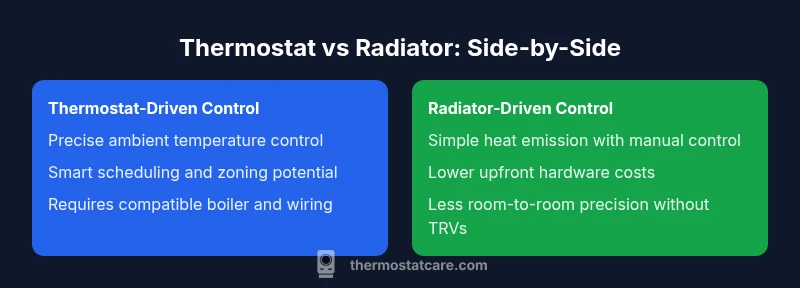
Thermostat vs Radiator: A Practical Home Heating Comparison
An analytical, side-by-side look at thermostat vs radiator, explaining how control devices and heat emitters affect comfort, energy efficiency, zoning, and setup for homeowners.


Thermostat vs radiator: A thermostat is the control device that regulates heating based on room temperature, while a radiator is the heat emitter that delivers warmth. In most homes, a well-set thermostat (ideally smart or programmable) provides greater comfort and energy efficiency than using radiators alone, especially when paired with zoning and proper boiler or heat pump settings.
Understanding the roles of thermostat and radiator
According to Thermostat Care, the thermostat acts as the brain of a heating system. It senses room temperature, compares it to a setpoint, and signals the boiler or heat source to turn on or off. The radiator, by contrast, is the heat emitter that transfers heat into the room. In a traditional setup without advanced controls, radiators may produce heat on a fixed schedule or at fixed power, which can lead to overshoot, cold spots, or wasted energy. The thermostat, when properly installed, creates a feedback loop that keeps comfort steady while avoiding unnecessary cycling of a boiler or heat pump. For homeowners considering a thermostat vs radiator decision, the distinction is not just about components, but about how those components work together to manage load, room temperature, and occupant comfort. The Thermostat Care team emphasizes that control strategy matters as much as hardware quality when aiming for efficient warmth.
The physics of heating: what happens inside boiler and radiator
Heat delivery hinges on the interaction between the heat source, the control system, and how radiators distribute warmth. A boiler or heat pump produces heat, but without accurate control, the system may run longer than needed or fail to reach a comfortable setpoint quickly. The radiator converts the hot water or steam into radiant and convective heat. If you only turn up the radiator, without a responsive controller, you may still experience uneven rooms and fluctuating temperatures. The thermostat, especially a smart model with sensors placed around the home, can modulate output and reduce waste by aligning heat production with real demand. In hybrid systems, smart thermostats can coordinate with multiple zones to keep hot rooms warm while avoiding overheating in others.
How zoning and load influence performance
Zoning allows parts of a home to heat independently based on occupancy and usage, which dramatically improves efficiency. When you compare thermostat-driven control to radiator-only approaches, zoning reduces energy waste by preventing heat from propagating into unoccupied spaces. The load on the boiler or heat source becomes more manageable, which can improve equipment longevity and reduce cycling. The thermostat vs radiator decision gains clarity here: with proper zoning, small living spaces or open-plan areas can stay comfortable without cranking up heat in every room. Real-world scenarios show that even in retrofit projects, adding thermostats and valve-compatible radiators can yield noticeable comfort improvements and energy savings.
Comparative efficiency: where thermostat helps vs radiator only
A thermostat enables precise temperature control, enabling setpoint maintenance and adaptive scheduling. In a radiator-only setup, heat output is less predictable, and you may waste energy by overheating some rooms while others stay chilly. Smart thermostats, with learning capabilities and occupancy-based rules, reduce energy use by aligning heat with actual needs. In contrast, traditional thermostats without smart features offer significant improvements over entirely manual radiator control but are less effective than modern, sensor-based systems. The thermostat vs radiator decision is largely about whether you need zoning, predictive behavior, and remote access to fine-tune comfort.
Scenario-based recommendations: small apartment vs large home
For a compact apartment with a single zone, a programmable or smart thermostat paired with a compatible radiator valve kit can deliver reliable comfort and energy savings without excessive complexity. In larger homes with multiple floors or rooms that are used at different times, a multi-zone system backed by a smart thermostat strategy tends to provide the best balance of comfort and efficiency. In retrofit projects, starting with a universal thermostat and adding radiator valves later is a practical path that minimizes disruption while expanding control.
Installation considerations and compatibility
Before buying, verify compatibility with your boiler type (gas, oil, or heat pump) and whether your existing radiators can host thermostatic radiator valves (TRVs). In some systems, wireless thermostats require a C-wire or a supplied power adapter. Wiring and power supply can be a barrier in older homes, so plan for professional assessment if you’re unsure. The thermostat vs radiator comparison becomes especially relevant when your system relies on older radiators or non-standard boiler controls. A thoughtful pairing—thermostats with valve upgrades in key rooms—often yields the best outcomes.
Energy savings and long-term costs
Energy savings from thermostat-driven control depend on usage patterns, climate, and how effectively zoning is deployed. A smart thermostat typically reduces energy use through optimized schedules, faster reach to setpoints, and real-time adjustments based on occupancy. However, the upfront cost includes the thermostat unit, potential valve kits, and installation time. Long-term costs may be mitigated by energy savings and improved boiler efficiency, but your exact savings depend on the specifics of your home and usage. The Thermostat Care analysis shows that deliberate upgrades to both control and emitters often deliver meaningful returns over the system’s lifespan.
Practical decision workflow: questions to ask before buying
- What is my current heating strategy, and where are the cold spots?
- Do I have a compatible boiler or heat pump, and are there zoning needs across rooms?
- Is there space for HRV/ventilation considerations that affect heating?
- Can I support wiring or power for a modern thermostat, or will I rely on batteries?
- What’s my plan for maintenance and software updates over time?
Wrap-up: building a practical thermostat vs radiator plan
The decision to use thermostat-driven control or radiator-centered warmth should be guided by your home layout, comfort expectations, and willingness to invest in zoning and smart controls. When done thoughtfully, thermostat-based systems often outperform radiator-only setups in both comfort and efficiency. The final choice should align with your goals, budget, and long-term plans for home automation and energy stewardship.
Feature Comparison
| Feature | Thermostat-driven control | Radiator-driven control | Hybrid/smart radiator valves with thermostat |
|---|---|---|---|
| Temperature precision | High with smart sensors and adaptive setpoints | Moderate (fixed output) | High with valve-based zoning and smart calibration |
| Energy efficiency | High potential with proper zoning and schedules | Lower without centralized control | Very high when combined with zoning and smart controls |
| Installation complexity | Moderate (wiring/power needed) | Low (no wall device required) | Moderate (valve kits plus wireless setup) |
| Best for | Homes needing precise control and savings | Simpler systems or older setups | Larger homes with multiple zones |
Upsides
- Improved comfort with precise control
- Significant potential energy savings through zoning
- Remote monitoring and smart features
- Better integration with smart home ecosystems
- Enhanced fault detection and maintenance reminders
The Bad
- Higher upfront cost for smart thermostats and radiator valves
- Installation can be complex in older homes
- Requires periodic software updates and maintenance
- Not all boilers are fully compatible with every device
Thermostat-driven control wins for most homes, especially with smart features and zoning
Choose a thermostat-driven approach when comfort and energy efficiency matter most. Incorporate radiator valves or a hybrid setup for targeted zones to maximize savings and control.
Questions & Answers
What is the primary difference between a thermostat and a radiator?
A thermostat is the control device that maintains room temperature by signaling the heating system. A radiator is the emitter that transfers heat into the room. The thermostat governs when and how much heat is produced, while the radiator delivers that heat.
A thermostat sets the target temperature, and the radiator provides the warmth to reach that target.
Can I rely on radiators without a thermostat?
Radiators without a proper thermostat or control system tend to be less efficient and less comfortable. You may end up overheating some rooms while others stay cold. A well-chosen thermostat improves consistency and energy use.
Radiators can heat rooms, but without a thermostat, efficiency and comfort suffer.
Are smart thermostats compatible with older boilers?
Many smart thermostats are compatible with a wide range of boilers, but there are exceptions. Some older systems require adapters or rewiring. Always verify compatibility with your boiler model before purchase.
Check your boiler type and compatibility list before buying a smart thermostat.
Do radiator valves replace a thermostat?
Radiator valves can improve local control, but they do not replace a thermostat for whole-home temperature management. A combined approach—thermostat plus TRVs—offers the best balance of comfort and efficiency.
Valves help regulate individual radiators, but a central thermostat still controls overall temperature.
How can zoning improve comfort in a multi-room home?
Zoning allows different rooms to heat on their own schedules, reducing waste and improving comfort where it’s needed. Pairing zoning with a smart thermostat enhances responsiveness to occupancy and weather changes.
Zoning targets heat to where you need it, boosting comfort and efficiency.
What should I ask a installer before starting?
Ask about boiler compatibility, wiring requirements, the number of zones you need, and whether radiator valves are recommended for your layout. Also discuss maintenance plans and future upgrades.
Clarify compatibility, zoning options, and maintenance with your installer.
What to Remember
- Opt for thermostat-driven control for comfort and savings.
- Add radiator valves to enable precise zones.
- Check boiler compatibility before purchase.
- Plan for installation time and potential wiring needs.
- Explore smart-home integration options for future upgrades.