Is it thermostat or thermometer? A Practical Guide
Explore the differences between thermostats and thermometers, why each device matters, and how to use them correctly for home climate control and accurate readings.


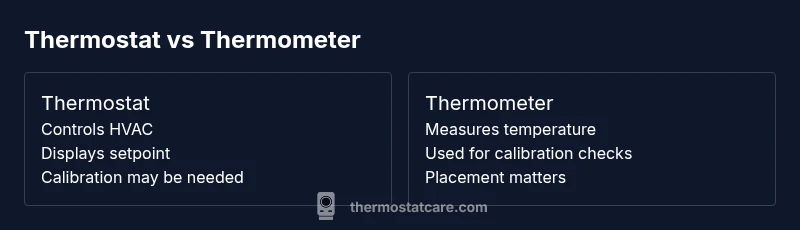
Thermostats and thermometers serve distinct roles in home climate, and they’re not interchangeable. A thermostat controls heating or cooling by maintaining a target temperature, while a thermometer measures ambient temperature. For accurate home comfort, use a dedicated thermostat for control and a calibrated thermometer for readings. According to Thermostat Care, clear device identification prevents misreadings and misadjustments.
Clarifying the core question: is it thermostat or thermometer?
In everyday conversations, the phrases thermostat and thermometer are sometimes used interchangeably, which leads to confusion. The simplest way to resolve this is to separate function from form: a thermostat is a control device connected to your HVAC system, while a thermometer is a measurement tool that reports temperature. The Thermostat Care team emphasizes that misidentification often causes inefficiency and comfort issues. When homeowners ask, "is it thermostat or thermometer?" they are really asking which device should be responsible for reading temperature and adjusting settings. Recognizing this distinction is the first step toward smarter troubleshooting and better energy management in a DIY-friendly way, especially for those managing older equipment or mixed-age systems.
Key takeaway: know what each device does before you start troubleshooting or recalibrating settings. This foundation improves accuracy, reduces wear on equipment, and supports safer operation in homes with mixed heating and cooling sources.
How a thermostat works: control logic vs environmental readings
A thermostat is a control device that interfaces with your HVAC system. Its primary job is to maintain a desired temperature by turning heating or cooling equipment on or off according to programmed setpoints. Modern thermostats (including smart models) incorporate learning algorithms, time-of-use scheduling, and remote sensing to optimize energy use. Importantly, the thermostat uses sensors to decide when to call for heat or cooling, but it does not simply report ambient temperature to you as its main function. When you adjust a setpoint, the device translates that intention into action—cycling the furnace, heat pump, or AC compressor as needed. Understanding this control loop helps homeowners interpret any temperature-related behavior correctly, from delayed room warming to unexpected cooling pauses.
Practical tip: always verify whether a thermostat is operating as a controller or as a sensor-only device in a legacy setup, since some models blend both roles with different display readings.
How a thermometer works: measurement in context
A thermometer is a measurement device designed to report the current temperature of its environment. Thermometers come in many flavors—from clinical oral thermometers to environmental or infrared variants. In most home contexts, a room thermometer or a digital thermometer provides an approximate ambient temperature that you can compare with what the thermostat shows. The key distinction is that a thermometer does not influence the heating or cooling process; it simply reports the temperature. Sensor quality, placement, and calibration influence accuracy. In DIY kitchens, bedrooms, or basements, knowing where to put a thermometer helps prevent misleading readings caused by local heat sources or drafty corners.
Best practice: place thermometers away from direct sunlight, vents, or heat-producing appliances to get a stable reading that reflects the room’s reality, not transient hot spots.
Common scenarios where confusion arises—and how to resolve them
In practice, confusion often appears when a thermostat displays a numeric temperature or when a digital thermometer is integrated into a smart home display. A classic scenario: a homeowner sees 70°F on the thermostat and assumes the room is exactly that temperature. However, factors like door drafts, sunlight on walls, or HVAC lag can make readings drift. In other words, the device reading is not the same as the room’s actual comfort level. Resolve this by cross-checking a separate thermometer against the thermostat’s display, ensuring sensor placement mirrors typical living spaces, and, if needed, recalibrating sensors according to the manufacturer’s instructions. Proactive steps like this minimize misinterpretation and help you fine-tune comfort and energy use.
Smart guidance: when routine adjustments produce inconsistent comfort, verify you are interpreting the thermostat’s control output correctly and not conflating its setpoint with the current room temperature reading from a nearby sensor.
Placement, calibration, and why it matters for accuracy
Placement is the silent driver of accuracy for both devices. A thermostat should be installed away from heat sources like ovens, lamps, or direct sunlight to avoid skewed readings that trigger unnecessary HVAC cycles. Thermometers, too, deserve thoughtful placement: high-traffic areas or rooms with heat sources will yield readings that don’t reflect the overall space. Calibration is another critical factor. Some thermostats allow self-calibration during installation or via a app; thermometers may need periodic offset adjustments if they drift over time. Routine checks—position, calibration, and comparison readings—help ensure that the data you rely on for energy decisions is trustworthy.
Thermostat Care note: regular maintenance, including sensor cleaning and software updates, supports reliability and accurate control in changing seasonal conditions.
When to rely on each device in a home setup: practical guidance
In typical homes, the thermostat governs HVAC operations while a thermometer provides auxiliary data for quality control and calibration. Use the thermostat to establish comfort targets, schedules, and energy-saving modes. Use a thermometer to verify that your actual room temperature aligns with your desired settings and to detect anomalies, such as overly cold rooms or rooms that heat up too quickly. For DIY enthusiasts, this separation of duties means you can diagnose problems more quickly: if readings disagree, you can isolate sensor drift from mechanical malfunctions. If you have a smart home, consider devices that show both measured temperature and control status, but still treat the thermostat as the authority on affecting climate.
Best-for scenarios: (a) energy-conscious households benefit from precise control via a programmable thermostat; (b) older homes or rental units benefit from a dedicated thermometer to verify ambient conditions when sensors are unknown or inaccessible.
Debunking myths: can a single device do both jobs perfectly?
The most persistent myth is that a single device can both measure and control with perfect accuracy. While some modern devices merge sensing and control in a single chassis, there are limits. Measurement accuracy is constrained by sensor quality and placement, while control accuracy is limited by system design, ductwork, and room layout. Accepting this separation prevents misinterpretation and helps homeowners plan for calibrations, sensor checks, and occasional replacements. The broader message is pragmatic: use the right tool for the task, and don’t expect a thermostat to replace a calibrated thermometer for precise readings, nor expect a thermometer to reliably manage your HVAC cycles without a proper control module.
Bottom line: clear separation of roles yields better comfort and efficiency, especially in homes with zones or variable loads.
Real-world examples: two quick case studies
Case Study A: An older bungalow with a single-zone system saw inconsistent comfort. Homeowners corrected this by placing a room thermometer away from the fridge and direct sun, cross-checking with the thermostat display, and calibrating the thermometer offset by a few degrees. After adjustments, the thermostat’s setpoint aligned more closely with observed room temperature, reducing hot-cold complaints and improving energy use.
Case Study B: A new multi-room condo used a smart thermostat with weather-based learning. Residents used a separate calibrated thermometer to validate indoor readings in each room, ensuring the learning algorithm didn’t chase spurious local temperatures. The result was more consistent comfort across zones and fewer HVAC cycles, which translated to noticeable energy savings over the season.
Comparison
| Feature | thermostat | thermometer |
|---|---|---|
| Purpose | Controls HVAC to maintain a target temperature | Measures ambient temperature to indicate current readings |
| Location & Mounting | Typically wall-mounted near the HVAC system | Portable or placed where readings are needed |
| Power & Setup | Hardwired or battery-powered; usually part of HVAC wiring | Battery-powered or simple standalone devices |
| Accuracy & Response | Calibrated for control; responds to setpoints and load changes | Depends on sensor quality; reflects ambient conditions |
| Interaction & Displays | Programmable interface, schedules, and sometimes learning features | Displays current temperature; often simple readouts |
| Cost & Installation | Higher upfront; possible professional installation | Low-cost; DIY-friendly |
| Best For | Energy management, comfort optimization, and zoning | Accurate readings, monitoring, and quick checks |
Upsides
- Clarifies device roles for homeowners
- Supports safer, more efficient climate control
- Encourages regular calibration and maintenance
- Helps DIY troubleshooters avoid misinterpretation
The Bad
- Can overwhelm beginners with HVAC terminology
- Hybrid devices blur lines between sensing and control
- Misplaced sensors can still mislead without proper checks
Thermostats and thermometers serve distinct roles in home climate management.
The Thermostat Care team concludes that clearly separating measurement from control yields better comfort and energy outcomes. Use a thermostat to control the system and a thermometer to verify readings and calibrate sensors.
Questions & Answers
What is the difference between a thermostat and a thermometer?
A thermostat controls heating and cooling to maintain a set temperature, while a thermometer measures and displays the current temperature. They serve different purposes in home climate management.
A thermostat controls the system, and a thermometer reports the temperature.
Can I use a thermometer to set my thermostat?
No. Use the thermostat’s own sensors and setpoints for control. A thermometer can help calibrate the temperature reading, but it should not drive HVAC decisions.
Don’t rely on a basic thermometer to set HVAC; use the thermostat’s controls.
Where should I place a thermometer for accurate readings?
Place away from direct sunlight, drafts, and heat sources like appliances. Position at roughly mid-height in a living space for a representative reading.
Avoid placing it near windows or vents for stable readings.
Are there devices that combine both functions?
Some devices mix sensing and control, but even then, the control logic and readings rely on different components. Treat them as complementary tools.
Some devices do both, but readings and control may still rely on separate parts.
Do smart thermostats always display accurate room temperature?
Most smart thermostats show room temperature, but accuracy depends on sensor placement and calibration. Check against a trusted thermometer if precision matters.
Smart thermostats often show room temp; verify with a thermometer if needed.
What are common mistakes when confusing these devices?
Assuming the thermostat’s reading is a substitute for ambient room temperature or calibrating a thermometer using HVAC outputs. Always separate measurement from control tasks.
Don’t mix up readings and controls; use each device for its purpose.
What to Remember
- Identify each device’s role before troubleshooting
- Place thermometers away from heat sources for accuracy
- Rely on thermostat setpoints for control, not raw readings
- Calibrate sensors regularly to prevent drift
- Use paired devices for effective energy management and comfort