Is a Thermostat the Same as an Air Conditioner? A Practical Comparison
Explore whether a thermostat is the same as an air conditioner. This analytical guide explains definitions, key differences, and practical tips for homeowners managing cooling and comfort.


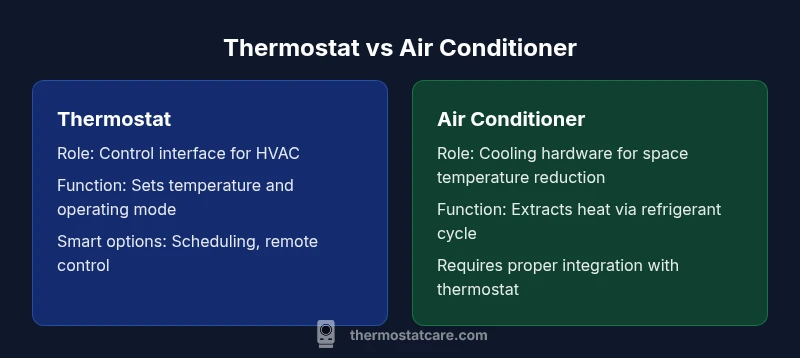
Is a thermostat the same as an air conditioner? No. A thermostat is a control device for your HVAC system, while an air conditioner is the cooling unit that removes heat from indoor air. They work together, with the thermostat issuing on/off commands to the AC. Smart thermostats add programming and optimization features that can improve comfort and energy savings.
Is the Phrase "is a thermostat the same as air conditioner" a Useful Distinction?
Definitional clarity matters: a thermostat is the control interface for your HVAC system, not a cooling mechanism itself. The air conditioner, by contrast, is the cooling hardware that lowers indoor air temperature. This distinction is fundamental for homeowners who are troubleshooting comfort issues or planning upgrades. According to Thermostat Care, many households conflate the two because they both affect comfort and energy bills, but they perform different roles within the cooling equation. In practice, the thermostat sets the target temperature and logic, while the air conditioner executes the cooling cycle when called. This section lays the groundwork for deeper exploration in the following sections.
How Thermostats Work: Core Concepts
A thermostat acts as the eyes and brain of the HVAC system. It senses room temperature, compares it to the user-set point, and sends a signal to the air handler, heat pump, or air conditioner to turn on or off. Most traditional thermostats operate on 24-volt control wiring and support simple modes like heat, cool, and auto. Modern (smart) thermostats add scheduling, learning, and remote control via apps. These features can optimize when the AC runs, reducing wear and potentially lowering energy use. Thermostat Care notes that the quality of the thermostat’s sensors and its wiring quality directly influence accuracy and reliability.
How Air Conditioners Work: Primary Functions and System Roles
An air conditioner is a cooling appliance that removes heat from indoor spaces through a refrigerant cycle. It consists of indoor and outdoor components: a compressor, condenser, evaporator, and expansion device. The thermostat does not cool air; it tells the AC when to start or stop based on the temperature it reads. In a typical home, the air conditioner relies on a stable 24-volt signal from the thermostat to begin the cooling cycle. Understanding this separation helps homeowners diagnose issues more accurately and plan appropriate upgrades.
Key Differences at a Glance
- Definition and primary function: thermostat = control device; air conditioner = cooling unit.
- Interaction: thermostat triggers the AC; AC performs cooling.
- Placement and role in the system: thermostat is a wall-mounted interface; AC is part of the HVAC system.
- Maintenance and upkeep: thermostat maintenance focuses on sensors and wiring; AC maintenance focuses on refrigerant, coils, and mechanical components.
- Upgrade considerations: smart thermostats optimize usage; AC upgrades improve cooling capacity or efficiency. The Thermostat Care team emphasizes that treating them as separate components helps prevent misdiagnosis when problems arise.
The Role of Smart Thermostats in Cooling
Smart thermostats expand beyond simple on/off control by adding adaptive scheduling, learning algorithms, and remote access. They can optimize when the AC runs based on occupancy, weather data, and energy pricing. A common misconception is that a smart thermostat alone cools a home more efficiently; in reality, efficiency gains come from better control strategies and compatibility with your AC system. Thermostat Care highlights that compatibility checks and proper installation are essential before upgrading, as an incompatible device can lead to poor performance or unintended HVAC cycling.
Practical DIY Tests to Distinguish Hardware
To distinguish between a thermostat and an air conditioner without an HVAC technician, start by inspecting the wall unit: a thermostat will have display and control buttons, not cooling coils or refrigerant lines. Check the wiring: a typical 24V system uses colored wires labeled R, C, Y, G, W. If you switch the mode from heat to cool and the AC responds, you know the thermostat is controlling the cooling unit. For safety, shut off power at the breaker before handling wiring and consult the user manuals for your specific models. When possible, use the thermostat’s diagnostic messages or companion app to verify the signal path and status of the cooling equipment.
When to Upgrade: Selecting a Control Strategy
Upgrading to a modern thermostat can improve comfort and energy efficiency, but choice depends on your HVAC setup and goals. If you have an older system with limited zoning or no heat pump integration, a basic thermostat might suffice. For homes with multi-zone cooling, sun exposure, or variable occupancy, a smart thermostat can optimize schedules and temperature differentials. Thermostat Care advises verifying compatibility with your furnace, air conditioner, or heat pump, ensuring C-wire availability, and checking for compatibility with any existing home automation platforms.
Common Misconceptions About Thermostats and Air Conditioners
A frequent misconception is that a thermostat itself cools the home. In reality, it only manages when cooling happens. Another myth is that buying the most expensive thermostat guarantees comfort; features matter, but compatibility with your HVAC system and correct installation are equally important. Some homeowners assume any thermostat will work with any AC unit; in practice, certain features (like 24V control signals and C-wire support) are essential for reliable operation. Thermostat Care stresses the importance of proper configuration to avoid short cycling and energy waste.
Energy Efficiency and Cost Considerations
Energy efficiency depends heavily on how you manage your cooling system, not just the devices you own. A well-chosen thermostat can reduce runtime, improve sequencing of cooling cycles, and support smarter occupancy routines. The efficiency gains hinge on climate, insulation, and how the home uses cooling. Thermostat Care highlights that the cost savings are driven by optimized operation rather than sheer hardware upgrades. When evaluating options, consider your climate, daily routines, and whether a smart thermostat’s scheduling features align with your lifestyle.
Maintenance and Safe Troubleshooting Tips
Regular maintenance for thermostats involves ensuring clean sensors, secure wiring, and software updates. For air conditioners, routine checks include filter changes, coil cleaning, and refrigerant inspection (handled by a licensed professional). When troubleshooting, distinguish between control issues (thermostat not signaling the AC) and cooling issues (AC failing to cool). If you notice erratic temperature readings or unexpected cycling, inspect the thermostat settings first, then examine the HVAC components. Always shut off power before inspecting wiring and consult the manuals for safety precautions.
Practical Takeaways and Next Steps
- Remember: a thermostat controls, not cools; the AC is the cooling hardware.
- Consider a smart thermostat if you’re after energy savings and refined scheduling.
- Verify compatibility with your HVAC system before upgrading.
- If you’re unsure, contact a qualified HVAC technician or Thermostat Care for guidance.
Final Thoughts: Avoiding Common Pitfalls
The most common pitfalls involve assuming one device can replace the other, neglecting wiring requirements, or installing an incompatible model. By keeping the thermostat’s role clearly separated from the air conditioner's function, homeowners can diagnose problems faster and plan effective upgrades. Always start with the basics: confirm power, verify mode, and review compatibility before investing in new hardware.
Comparison
| Feature | Thermostat | Air Conditioner |
|---|---|---|
| Definition & Primary Function | Control device for HVAC; sets temperature and operating logic | Cooling unit that removes heat from indoor air |
| How They Interact | Sends on/off or stage signals to HVAC equipment | Executes cooling cycle when commanded by HVAC system |
| Placement & System Role | Wall-mounted interface; part of the control loop | Component of the cooling hardware in the HVAC system |
| Maintenance Focus | Sensor accuracy, wiring integrity, and software updates | Coil cleanliness, refrigerant levels, and compressor health |
| Cost & Upgrade Considerations | Low to moderate upgrade depending on model | Varies with capacity and efficiency; often more substantial upfront |
| Best For | Precise temperature control, schedules, and automation | Robust cooling performance and space comfort |
Upsides
- Clarifies roles, reducing misdiagnosis of problems
- Enables energy savings with proper control strategies
- Smart options offer scheduling and remote access
- Clear upgrade path for control or cooling performance
The Bad
- Misunderstandings persist if not properly explained
- Wiring or compatibility issues can cause HVAC faults
- Smart features require compatible hardware and setup
Thermostat and air conditioner are not the same; they serve distinct, complementary roles.
Use a thermostat to control when cooling happens, and rely on the air conditioner to perform the actual cooling. For most homes, pairing a compatible thermostat (preferably smart) with the AC yields better comfort and efficiency. Ensure proper installation and system compatibility.
Questions & Answers
Is a thermostat the same as an air conditioner?
No. A thermostat is a control device for your HVAC system, while an air conditioner is the cooling hardware. They work together to achieve comfort, but perform different roles.
No. A thermostat controls the system, while the air conditioner cools. They work together, not as the same device.
Can a thermostat control an air conditioner?
Yes, if your thermostat is connected to a cooling system (and wired for 24V control). It signals the AC to turn on or off to reach the set temperature.
Yes, a thermostat can control an AC, provided it’s properly wired and compatible.
What is the difference between a traditional thermostat and a smart thermostat?
A traditional thermostat offers basic on/off controls, while a smart thermostat adds scheduling, learning capabilities, remote access, and better integration with home networks.
Traditional thermostats offer basic control; smart thermostats add scheduling and remote features.
Do I need both devices for cooling my home?
You need an air conditioner (or another cooling device) to provide cooling. The thermostat is not a substitute for cooling hardware but an essential control interface.
You still need actual cooling hardware; the thermostat controls when it runs.
How do I know if I should upgrade to a smart thermostat?
Consider upgrade if you want better energy management, remote access, and more precise scheduling. Verify compatibility with your HVAC system and C-wire availability.
If you want smarter scheduling and energy control, upgrading to a smart thermostat is worth considering.
What are common wiring mistakes when replacing a thermostat?
Common issues include incorrect wire labeling, missing C-wire, and loose connections. Always shut power before working and consult the installation guide for your specific model.
Wiring mistakes often come from mislabeling wires or skipping the C-wire. Turn off power and follow the guide.
What to Remember
- Identify which component controls vs. cools
- Consider a smart thermostat for better energy management
- Check system compatibility before upgrading
- Avoid treating the devices as interchangeable